

The steady clank–clank of metal Y-lanyards clips being fastened to a telecom tower punctuate each few steps as Brian Bourquin climbs. He reaches a point two-thirds of the way up, anchors himself with his positioning strap, and tests the sturdiness of his positioning rope before trusting it with his weight.
Bourquin is watched from below by more than half a dozen experienced climbers — and me. He is demonstrating a proper, safe climb and tie-off as the instructor for Safety One International’s basic tower safety and rescue class, and in a few minutes I’ll be making my first climb ever, other than shinnying up my parents’ TV antenna in the 1980s to retrieve errant frisbees from the roof.
On a bleak, chilly winter day in Colorado, we are lucky enough to be able to climb in the relative comfort of Safety One’s warehouse, at a temperate 60-odd degrees. The facility has a variety of mini-towers that reach the 23-foot-tall ceiling, from a basic three-sided tower frame to a monopole to a wooden telephone pole and others. A dummy strapped into a climbing harness dangles from the ceiling, a rescue prop reminiscent of MythBusters.
Safety training is going to be scrutinized more closely than ever, after four deaths so far in 2014 and more deaths in 2013 than the previous two years put together. A wireless industry safety task force and the National Association of Tower Erectors have launched a 100% tie-off 24-7 education campaign for the industry. OSHA recently sent a warning letter to tower companies to pay attention to providing gear and safety training and making sure that subcontractors live up to appropriate standards of care so that the price of new wireless capabilities doesn’t end up being climbers’ lives.
Training sessions like these are one way that veterans get a refresher and newbies like me learn the — quite literal — ropes.
The class is made up of 8 people – everyone, unsurprisingly, has more experience than me. Some have spent a dozen years or more climbing towers in telecom, oil and gas, TV broadcast and other industries.
The morning is devoted to classroom instruction, going over OSHA rules and emphasizing that best practices established by industry must also be followed. Bourquin emphasizes a “fall protection triangle” of anchorage, body support and means of connection to the tower – if any one part fails, the whole system fails, he noted.

Brian Bourquin, lead instructor at Safety One Training International
Bourquin takes us through weight limits for ropes, harnesses and other gear, as well as giving a quick primer on the force generated by a fall. He talks about ways to inspect a tower prior to a climb, and running your hands over bolts as you climb to be aware of how structurally sound the tower is. Often, he said, parts of the brace or bolts can be missing and there is little a climber can do to fix the situation in the moment, but awareness is paramount.
He also goes over the risks, and there are many of them. A fall can cause internal bleeding. Even if your fall protection successfully catches you, your harness can cut off circulation to your legs and cause complications if you dangle for too long. Frostbite can trap a climber with no way to warm his hands enough to get down. Sharp edges are everywhere on towers, and straps or rope without reinforced edge protection can be all too easily cut, especially when they are under tension bearing the weight of a climber.
But despite all the very real external dangers, the emphasis seems to be primarily on attitude. Complacency is dangerous — routine daily safety briefings on-site need to be taken seriously and done thoroughly, Bourquin emphasizes. Near-misses can lead to overconfidence instead of caution. Bourquin says there is an important difference between rational and irrational fear of heights.
“I don’t want to climb with anybody who’s not afraid of heights. It puts us all at risk,” Bourquin said. “I don’t want someone with an irrational fear of heights tht gets 20 feet up and starts shaking – that’s going to be trouble. A healthy amount of respect for the situation you’re in is the sweet spot.”
Even the class, which is held indoors, isn’t free of fear. Bourquin has had to do two rescues just at the training facility. I hope I’m not going to be his third.
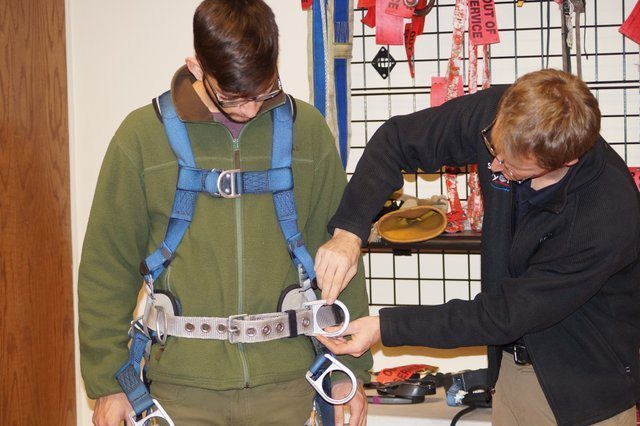
After a written test –which everyone passes, with the material fresh in mind – and lunch, we head down to the warehouse. Several people have brought their own climbing gear, and SafetyOne has a wall of harnesses and helmets for the rest of us to suit up.
Bourquin demonstrates each climb, and then each class participant has a go, being checked for proper technique and awareness. Soon it’s my turn. I realize quickly how many things there are to keep track of: my positioning rope thumps against my leg with every step upward. I’m managing two Y-lanyard clips and need to make sure they latch completely closed every time they secure me to the tower; stay aware that their weak points aren’t ever in a position to take all of my weight; yet move them at pace with my climbing. The springy lanyard lines threaten to twist or tangle every few steps. And I’m not even carrying any equipment to work with that could throw off my balance.
I climb near the ceiling of the warehouse, fasten both clips securely where they will give me slack to move but not fall far, and tie off, testing my positoner before trusting it, just as Bourquin demonstrated. After performing the entire process in reverse, I’m back on the ground having completed my first climb.
There’s so much close at hand to focus on that the height seems almost an after-thought, but it still permeates every motion. And I’m acutely aware that this is a baby tower compared to the real structures that climbers around the country scale every day.
Still, the training focuses on preparation for those real towers and extreme heights. We practice rappelling to exit a tower quickly, and then it’s on to a roped rescue in which one person climbs up and brings down a “stranded” classmate. The challenges are immediately obvious: double the weight or more, little control over the other person’s movements or swinging on the tower, the strength and dexterity needed to manipulate the ropes and gear for two people, and trying to protect them from colliding with the braces or getting limbs stuck on the way down.
But we all achieve it. My partner does come in for some teasing about being rescued by a girl with purple nail polish, but I think it’s a testament to the value of training and good gear that after arriving at the class as a complete climbing novice, I’m able to maneuver a much larger person off of a tower safely.
We do multiple climbs and more rescues over the course of the afternoon, learn how to tie knots that will provide safety if equipment fails or isn’t available, and more. Several of the class members will be back the next day for advanced training.
I walk away officially certified in basic tower climbing and rescue. Do I feel like a real tower tech? Not even close. But I have even more respect for, and much more insight on, the dangerous job that techs are asked to do. The fact that longtime veterans are in the same class is a good reminder that anyone can use a brush-up on the basics for continuing certification. No one brushes this class off.
No, I’m definitely not in the same league as an experienced tower tech, but now I have a much better idea of what it takes to get to the top and back down safely.
Follow me on Twitter! @khillrcr

