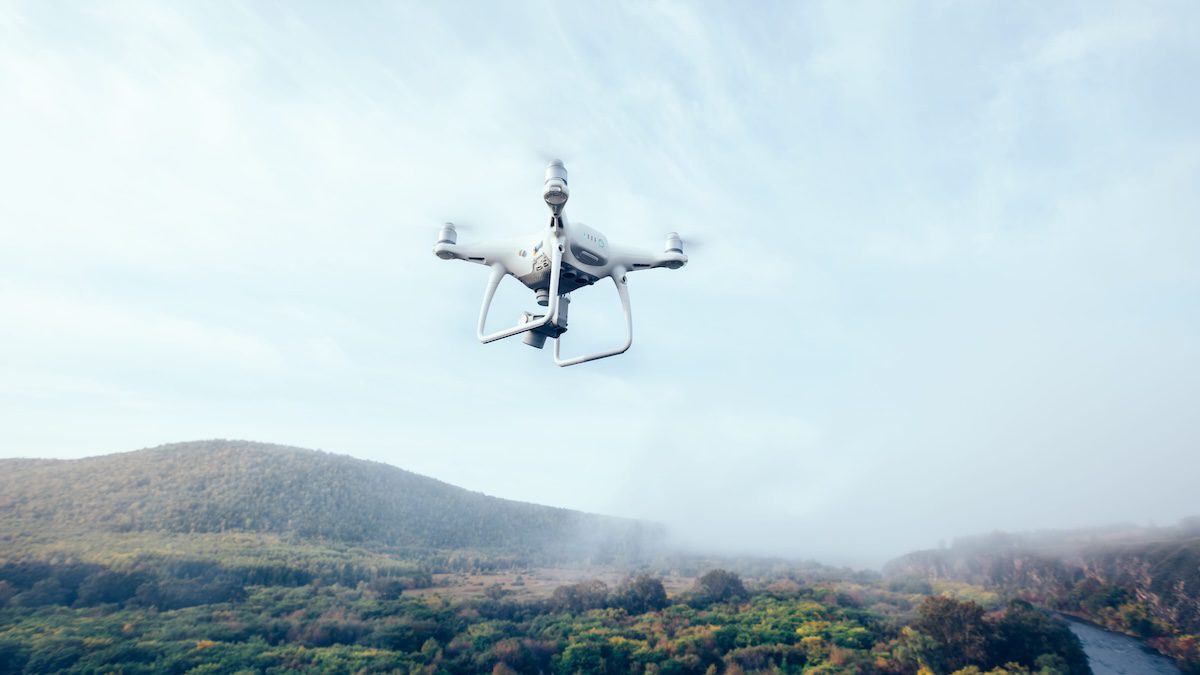
Ericsson Federal CEO, Christopher Ling, says that integrated sensing can protect present-day defense infrastructure, and drive an entire drone economy in the future
Integrated sensing and communications (ISAC) has been touted as one of the most defining features of future 6G networks. It’ll see 6G networks sense the physical world using the same waveforms, spectrum, and hardware used to connect users and devices.
Network sensing works by bouncing signals off of physical objects, which allows mobile base stations that have special reception sensors embedded in them to detect objects’ presence, determine which way they are moving, and what they are made of. This is a critical capability in drone defense.
But network-based sensing is not unique to 6G. The capabilities already exist today, and are used to amplify traditional drone detection and airspace monitoring systems. Increased drone activities in protected and off-limit areas have raised serious security concerns in recent times, prompting efforts to extend awareness to low altitudes and geofence critical assets.
One of the biggest gaps that exist with detection and airspace monitoring systems is that they cannot comprehensively observe low-altitude airspace. “A lot of people assume radar coverage is everywhere, but that is simply not the case, especially for the kinds of small, low-flying drones that pose an increasing security concern,” said Christopher Ling, CEO of Ericsson Federal, a subsidiary of Ericsson that focuses on 5G and 6G technologies for U.S. government use cases.
Traditional radar systems also struggle to maintain line-of-sight and are obstructed by the Earth’s curvature, which make it difficult to maintain visibility at the altitudes of 3,000 ft where many drones operate.
“That exposes us to real risk around homeland security, base protection, critical infrastructure security and public safety, because threats can appear in parts of the airspace that are not consistently observed,” Ling noted.
Current 5G sensing capabilities use the radio network to detect objects through reflected signals. “In simple terms, you are using the 5G network infrastructure like a sensing layer in addition to its communications role,” Ling said.
This can augment existing monitoring systems by extending awareness and visibility into places where standalone systems cannot reach.
Today, the most immediate national security use case for network-based sensing is drone detection. Ericsson Federal is actively exploring how sensing can complement current defense architectures. In February, the company demonstrated an ISAC proof of concept (PoC) using Ericsson’s massive-MIMO radios, demonstrating network’s ability to track unmanned aerial vehicles (UAVs) within the surrounding airspace.
“ISAC leverages existing wireless infrastructure to provide persistent spatial awareness, which is a fundamentally different approach. It’s not just about deploying another sensor – it’s about turning the network itself into a sensing platform,” Ling said.
The PoC marked a step towards reliably detecting and tracking low flying objects in real time, and provides a path to scaling defense and broader airspace awareness applications.
“It’s an important step in the evolution toward 6G, where sensing will be more deeply integrated, and it reinforces Ericsson Federal’s view that communications networks can play a much larger role in supporting mission-critical operations,” Ling said.
While drone defense remains a priority use case, Ling said that the underlying technology has potential for significantly expanded applications. “Because integrated sensing can detect all types of moving objects, not just drones, we see future potential in areas such as traffic management, public safety, and broader airspace coordination.”
For example, it can support drone delivery and other autonomous operations, help prevent traffic accidents, communicate with bots and machines remotely, and alert emergency responders in crisis situations. On the defense side, it can contribute to wider situational awareness around installations, transportation corridors, and mission-critical infrastructure, Ling said.
In the future, integrated sensing capabilities can drive an entire drone economy. “If you think about drone delivery, autonomous systems, and other beyond-visual-line-of-sight operations, those capabilities all depend on having far better visibility into low-altitude airspace. There will need to be some form of persistent airspace monitoring and coordination for those systems to scale safely, because sensing can be built on top of existing telecom infrastructure and spectrum. It offers a scalable path to support that future,” Ling said.
There are multiple telco-enabled drone detection services available today. Recently Orange introduced its anti-drone service, Orange Drone Guardian, designed to identify and classify intrusive drones in low-altitude airspace across France. Vodafone Business is also collaborating with Dedrone to deliver counter-drone solutions using Multi-access Edge Computing (MEC) and 5G.
For more content on ISAC, check out on-demand sessions from the recent Defense Communications Forum.