
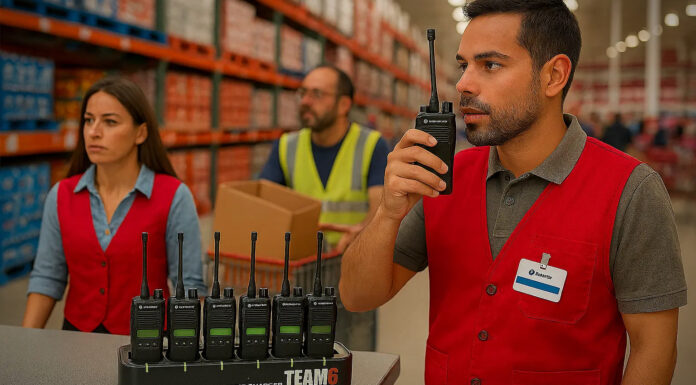
PoC combines instant radio-style communication with wide-area mobile coverage, addressing the limits of both technologies. By enabling real-time group messaging, enhanced safety and integrated services, PoC systems improve productivity and reliability for distributed, mission-critical enterprise teams.
When compared to traditional two-way radios, access to cellular was a game-changer in enterprise communications. Teams could easily communicate with each other over distances of hundreds of miles, instead of the limited range of traditional push-to-talk technology. However, cellular technology has its own limits.
When it comes to safety and productivity, there are plenty of reasons to consider a hybrid solution. With push-to-talk over cellular (PoC) systems, organizations can get the best of both worlds without compromising the speed or quality of communication.
Limits of traditional PTT
Anyone who used a toy two-way radio as a child understands the basic limitations of these systems. Even modern push-to-talk systems cannot overcome the restrictions of proximity. Users benefit from immediate communication, but the range is typically limited to a few miles. Teams can improve the range by using repeaters or signal extenders, but that also increases infrastructure and the cost of operation. At the same time, traditional PTT systems do not benefit from many of the advantages of cellular systems, like access to the latest digital transmission technology.
Constraints of cellular
While cellular may seem like a solution to the main problem of distance, cellular systems have their own constraints. Cellular technology allows users to communicate across hundreds or thousands of miles, using technology that is regularly updated to increase speed and quality. The problem is that coverage and performance can vary depending on location and network availability, and also requires someone on the other end to answer. In critical moments when teams must act incredibly quickly, the ability to transmit a message virtually immediately can make the difference between life and death.
Advantages of PoC
Instant group calling | PoC offers the best of both worlds in that it allows for the use of digital technology to provide instant group calling. When teams rely on Motorola radios for sale, they can push to relay a message. Within seconds, the entire group receives the transmission and can act. Instantaneous communication provides convenience as well as rapid response during emergencies. Members of the group do not have to wait for one person to be available for a call, when they can send and receive messages asynchronously.
Broad coverage | Traditional PTT systems have such limited coverage, so reliance on cellular technology dramatically extends coverage with a PoC system. The device captures the message, digitizes the sound, and sends the data as a packet to the server. The server then distributes the data to each device, which plays the message.
With the use of both technologies, PoC dramatically extends coverage where cellular data networks are available, allowing teams to communicate across regions far beyond the range of traditional radio systems.
Integration with mobile | While cellular is a critical asset for PoC systems, engagement with mobile networks provides even more benefits. PoC devices can easily integrate with mobile networks, which opens up access to more services, including:
– Texting
– GPS services
– Image sharing
– Emergency alerts
PoC systems can also integrate with dispatch consoles and management software, so the administrators can gain useful data about use and performance of each team.
Consistent access | Consistent access is an important part of business function. Organizations that rely on timely communication must be able to reach every member of the team without having to make repeated calls or messages. The automated receipt of PoC communications ensures that everyone can receive the message without having to perform extra steps. Additionally, the combination of technologies ensures consistent access even if certain members of the team are in a rural area or underground.
Improved safety | For corporations with large teams that need to coordinate regularly in the field, safety is paramount. Employees who are constantly fighting with a cellular phone may not be able to pay attention to the critical tasks they are performing, like driving. Similarly, team managers need to know that where each person in the group is located, even in areas with unreliable coverage. PoC solves both of these problems. When messages are instantaneous, the team can get important safety alerts about hazards to avoid, without having to turn their attention away. They can also receive these messages regardless of where they are.
Increased productivity | All these advantages can translate into major productivity gains. Teams that are regularly waiting for the last person to show up can quickly find out the person’s location using GPS. The lead can also send a quick message to the entire team, even if everyone is not at the device. The mobile device technology means that PoC devices become a productivity tool designed to get more done, faster. When someone needs to collaborate, they can push to send a message and move on to the next task.
Infrastructure requirements
Push-to-talk radio is a proven technology for short-range communication but can require significant infrastructure to expand coverage. Cellular is a more-recent and accessible option that increases coverage but can slow down transmission of information. With PoC devices, organizations can combine the assets of both of these technologies into one system that improves safety, productivity, and team communication.
Matt Risley is director of sales and marketing at MYRO, a leader in two-way radios, PoC devices, and business communication systems. Matt has more than 22 years of experience in the wireless communications space, including business operations, sales, marketing and system design.
