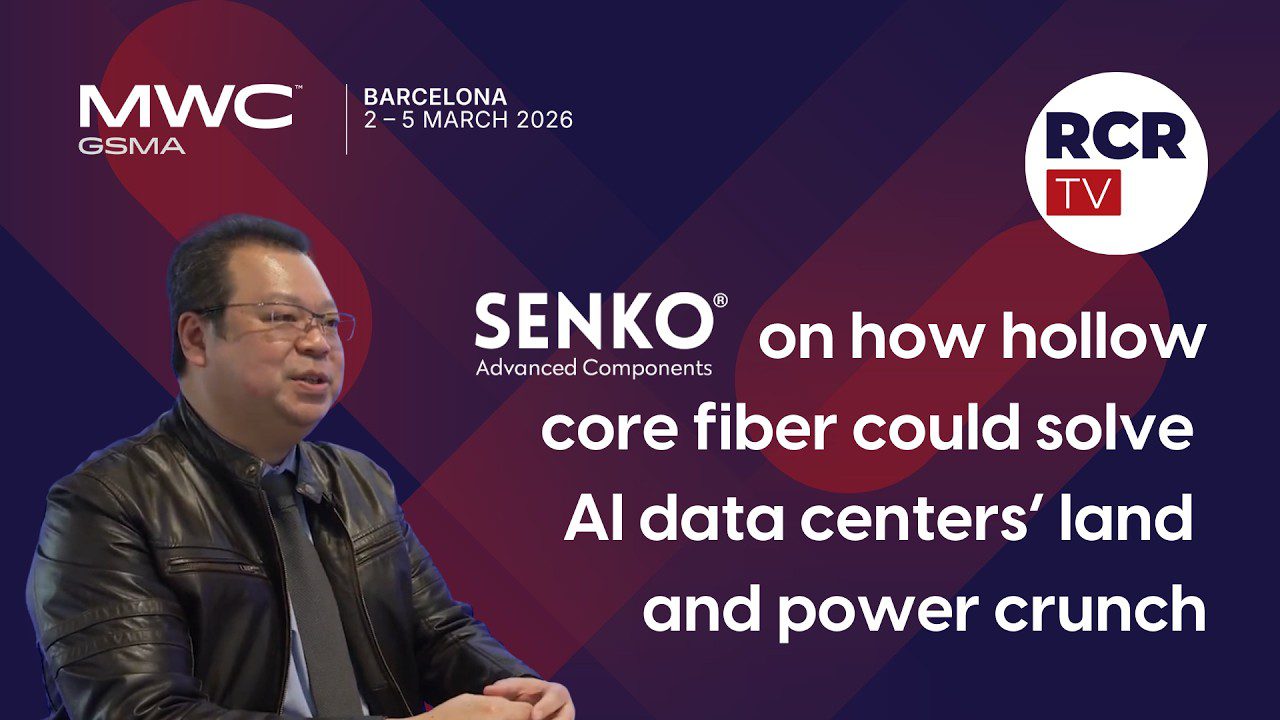
As AI data centers strain land and power resources, hollow core fiber could enable a geographically distributed infrastructure.
As the AI race continues to heat up, hollow core fiber (HCF) has emerged as a potential alternative to single-mode optical fiber (SMF).
Rooted in the photonic-crystal fiber (PCF) technology discovered in 1996, HCF uses a hollowed-out core which allows light to pass through air or vacuum. This is a stark contrast to conventional optical fiber, whose solid glass core — while a major improvement over copper — still introduces resistance and signal attenuation.
By comparison, HCF’s unique confinement characteristics enable significantly faster transmission with far lower attenuation.
Those properties are especially attractive as ever-faster, high-volume data transfer remains a chokepoint for AI.
Compared to SMF, HCF can deliver up to 30% lower latency, which may only translate to a few milliseconds, but in sectors like high-frequency trading where transactions are executed in microseconds, it’s the difference between winning and losing a trade.
“Transfer that few milliseconds to large language models and machine learning, your AI learns faster,” said Bernard Lee, sr. director of strategic technology and innovation at SENKO Advanced Components. That is crucial to give any AI model an edge over its competitors, he added.
But more importantly, Lee argued, that HCF could ease the power and land crunch gripping the AI industry.
The U.S. power market currently faces 85 GW of new capacity requests expected by 2030 – 15 GW more than it currently supplies. Meanwhile, powered land for new data center builds is in short supply.
As AI’s heavy power demand threatens to break our power grid, and as investors – squeezed by a land shortage in data center hubs – scope secondary and tertiary markets where both commodities are readily available, HCF could provide the fiber infrastructure needed to connect distributed data centers.
It’s ultra-low latency “gives you that ability to choose your location more strategically. It makes it more economical, and lowers the barrier to entry for building a new data center,” he said.
But there is one caveat: It has to be economically viable. High-precision manufacturing and the unique physical properties of HCF that require specialized handling and splicing, have contributed to a high price tag which presents a challenge for many adopters.
“The economies of hollow core fiber are still more towards the initial stage of deployment,” Lee said, noting that with standardization in progress and the ecosystem coming together, barriers will eventually come down to a point where it becomes feasible.
With the flurry of advancements in chip design and performance, could AI silicon outshine HCF? Lee sees the two technologies as complementary rather than competing.
“Hollow core fiber is like the aerodynamics of a car and the silicon, the engine,” he said. “Both of these would actually push and allow AI to be deployed more sustainably and responsibly.”
Lee is also a realist about the timeline for widespread deployment. “That will really depend on what is the appetite of the industry to work together to collaborate on this one,” he said.
He believes that all stakeholders — cable manufacturers, fiber providers, test equipment vendors — will need to align on standards and best practices to enable deployment at scale.
Because as Lee said, “It takes a village to raise a child.”