


Once in defensive mode and fighting decline, Lumen Technologies has re-emerged with a radically simplified strategy, a repaired balance sheet, and a bold claim to be critical infrastructure for the AI economy — as enterprise network spending shifts from connecting offices to connecting data centres and GPUs.
In sum – what to know:
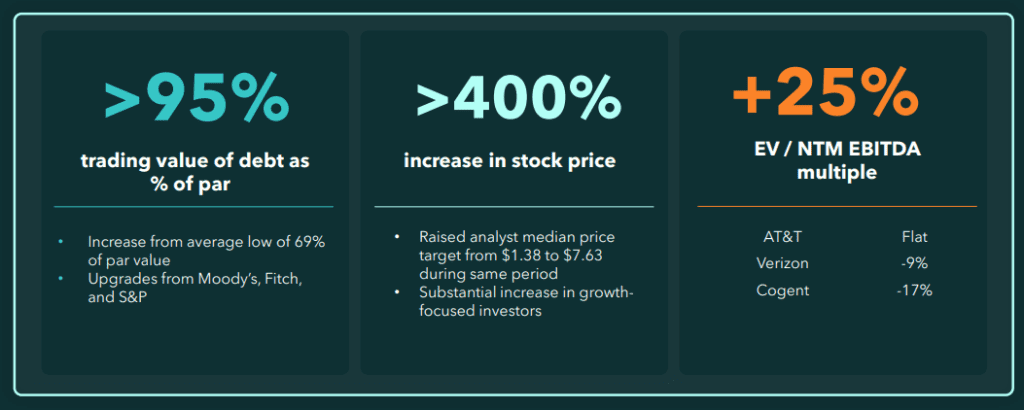
Total reset – Lumen has sold its consumer FTTH assets to AT&T for $5.75 billion, secured $13 billion in private connectivity deals, restored its bonds to near-par levels, and delivered a 400% equity return.
Growth engine – The firm is positioning itself as the AI backbone, targeting hyperscalers and enterprises that need high-capacity, low-latency fibre and programmable NaaS to connect to and between AI factories.
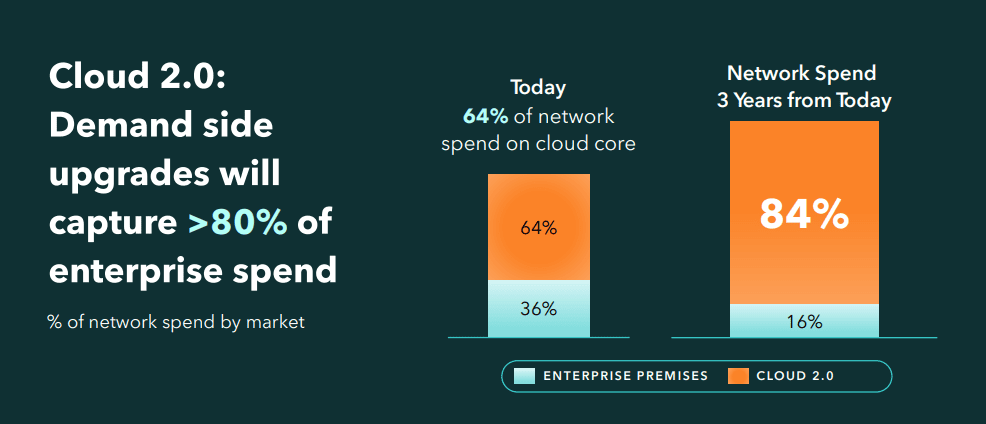
Structural shift – Enterprise budgets are moving away from office-to-cloud connectivity (36% today) to cloud-core and AI data centre interconnection (64% today, rising to 84 percent in three years).
Here’s an attempt to take you through a roller-coaster investor presentation (or two) from US fibre service provider Lumen Technologies this week. It’s was a stacked deck, and RCR will invariably miss some of the finer detail, (and be forced to break the coverage into two parts), but hopefully there is enough to get the gist, and get us started – about the excitable opportunity for down-trodden telcos to serve the hyped-up AI infrastructure market, between data centres and enterprise venues. Because Lumen is on a tear-up, now – from having been on the brink.
“The dark days are over,” remarked Kate Johnson, chief executive at the firm, speaking during the opening keynote at its investor day on February 25 in New York. “We’ve stabilized the company. We’ve driven a turnaround (for) both credit and equity investors, and the future is very bright.” She ran through the back-story: how the company has been “rebuilt” from its “people-up” over 30 months, since shrinking revenues, heavy leverage, and market scepticism forced soul-searching in 2023, and a total revamp through 2024/25.
Johnson said: “We were in survival mode. We were playing not to lose, focused on trying to slow the decline – harvesting cash to pay a dividend. We’re now playing to win. We’re making intentional bets, which takes a completely different mindset – to constantly learn so you take feedback from the market to pivot. It takes agility, and courage to speak truth to power to point to problems, and have the mindset to fix them.” Some time was given to the cultural reset – “eight behaviours… for successful transformation”, and a “big reason why we’re here today”.
The company “imported industry leadership from telecom at all levels, across all functions”, she said, and “retrained and upskilled” staff as required. Besides, Lumen has reorganised its proposition. Johnson stated: “We simplified the portfolio, and got rid of adjacencies that didn’t make sense – to focus on the enterprise in the world of Cloud 2.0 and AI. We have driven a massive expansion of our physical network and continue to do so. Importantly, we have built a digital platform [as] a very exciting and fast growing organic growth [engine] for the company.”
Its capital structure has been “absolutely reboot(ed”. The firm sold its fibre-to-the-home (FTTH) business, including most of its residential fibre assets, to AT&T for $5.75 billion in cash; the deal closed this month (February). Meanwhile, it has busily “inked” $13 billion of “Private Connectivity Fabric deals with the biggest tech companies in the world” – meaning hyperscalers, in the main. Its debt bonds are now trading at 95 cents on the dollar – close to face (‘par’) value; much healthier, “up from a very low number” in its darkest days.
Markets have responded, it seems: its equity investors have seen a 400 percent return in two years; its average stock price has risen from about a dollar per share to more than $7; its valuation multiple has expanded by 25 percent relative to peers. So said Johnson in New York. It might be presented as a model for telco transformation: a strategy reset, a product revamp, and a cultural shift, leading to a major re-rating by investors, and a marked recovery. This week, the firm said it had doubled its NaaS base to over 2,000 enterprises – since late (Q3) 2025.
Which is a testament to both the market’s appetite for on-demand programmable networking for AI and cloud workloads, and Lumen’s own pivot to deliver the same. Which is the whole strategy for telcos in the AI market, really. Johnson remarked: “We are now a part of the AI trade, and the talk about the AI economy is positive one day and negative the next. We’re now a part of that story and we see volatility as a result of it. [But] we need to make sure that the world understands our story – which will tend to moderate the volatility over time, once that story is known.”
Lumen will have a job to make its story stand out, perhaps. Its network-as-a-service (NaaS) pitch is broadly the same as its rivals’, in fixed and mobile provision – even if it is engineered differently. It is about delivering “intelligent fibre solutions”, said Johnson. Without fail, connectivity for AI, for infrastructure providers and enterprises users, should be plentiful, quick, secure, and resilient; but it also has to be flexible, programmable, and available everywhere – “whether it’s on-prem, at the edge, in any data center, in any cloud; on-net or off-net”.
But the lure is impossible to deny, despite the volatility – as it is for every AI-adjacent infrastructure sector. As much as $2 trillion will be spent on “AI factories” over the next decade, suggested Johnson, and graphics processing units (GPUs), the AI infrastructure market’s essential stock-in-trade, are the “fastest depreciating asset on planet Earth”, she said – and so the job to connect GPUs efficiently, as they multiply in volume in trillion-dollar real estate, is a TCO exercise for the whole AI industry. “The most critical [thing] is networking,” she said.
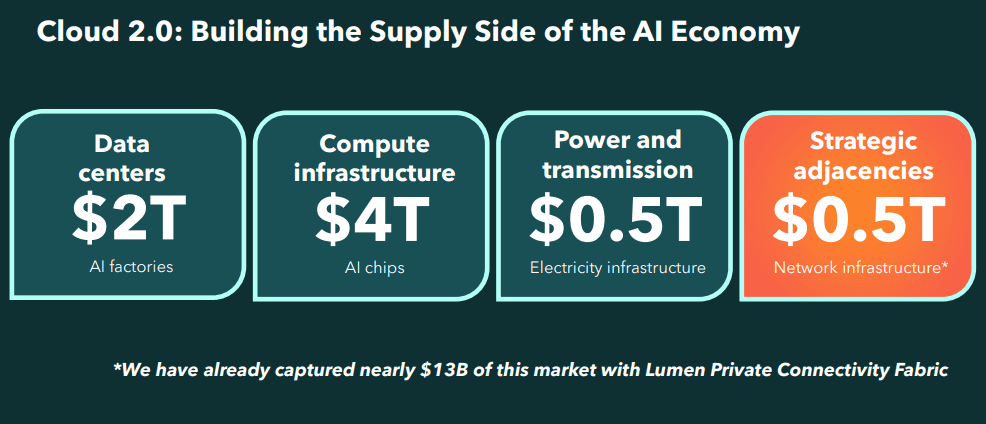
“Because otherwise those data centers are just bricks. The biggest proof point that Lumen is critical infrastructure in the construction of the supply-side of the AI economy is the $13 billion of Private Connectivity Fabric deals we’ve done – as big tech builds-out the infrastructure to provide AI services to enterprises. They’ve tapped Lumen as the trusted network for AI, but there’s a demand side and a demand side (to connect enterprise usage of AI) – and the demand side is where most of our growth lies. It’s where the exciting part of our valuation will come into play.”
Which is the most interesting part, really, of the presentation. There is a structural shift in network spending by enterprises, said Johnson – away from simple site connectivity, between offices and data centres via traditional long-haul and last-mile systems (36 percent of spending today), towards high-capacity interconnection between AI factories and cloud-core locations (64 percent today, rising to 84 percent over three years). So fibre spend is moving from connecting users to connecting machines – and specifically data centres for AI-related workloads.
Which require massive bandwidth, ultra-low latency, and on-demand programmability via data centre interconnect (DCI) switching houses and along new fibre lanes between GPU clusters and hyperscale sites. It means a move from premise-to-cloud connectivity on enterprise WAN systems to inter-cloud data-centre connectivity in new ‘AI corridors’. She said: “Yes, enterprises have to connect to those data centers, but, more importantly, they also need services to help them move their data in an agile way between them. And that’s the essence of our strategy.”
We will pick up again tomorrow – or after the weekend, or maybe after MWC. There is lots more to unpack.

