

Vodafone has urged the UK government to write targets and incentives for 5G and IoT adoption into its forthcoming net-zero strategy blueprints, due to be published later this year. The UK-headquartered operator said the UK government should create a regulatory and policy framework that “removes barriers to adoption and incentivises the uptake” of digital tech across the economy.
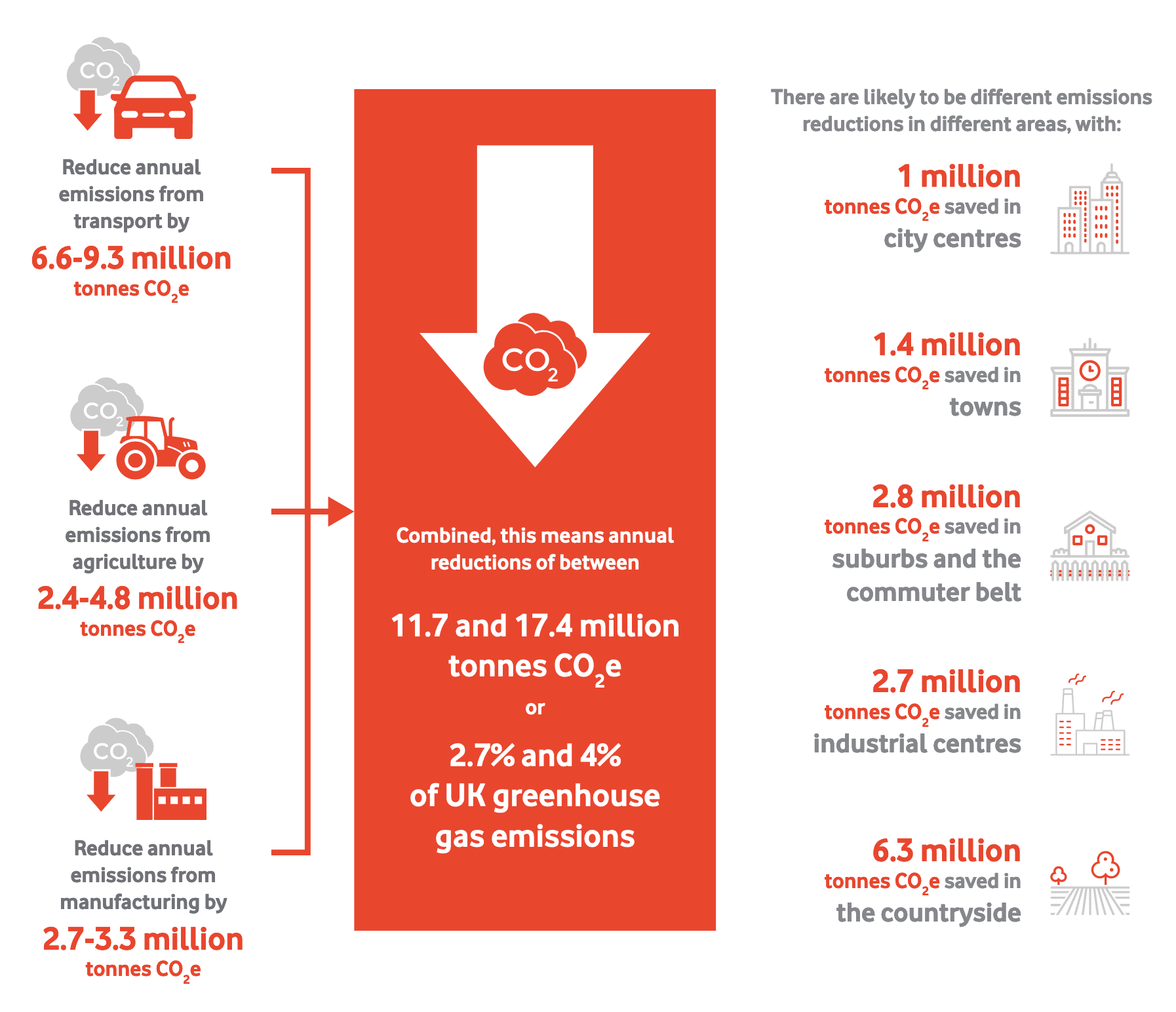
As the supplier of said tech, with vested interest in the sale of 5G and IoT to public and private enterprises, its conclusions are hardly surprising. But a new report, which makes the case, is a good read. Co-authored by WPI Economics, as lead researcher, it puts focus on three industrial sectors – manufacturing, transport and agriculture – and suggests 5G and IoT, plus all the over-the-top pyrotechnics, can save four percent per year in carbon emissions.
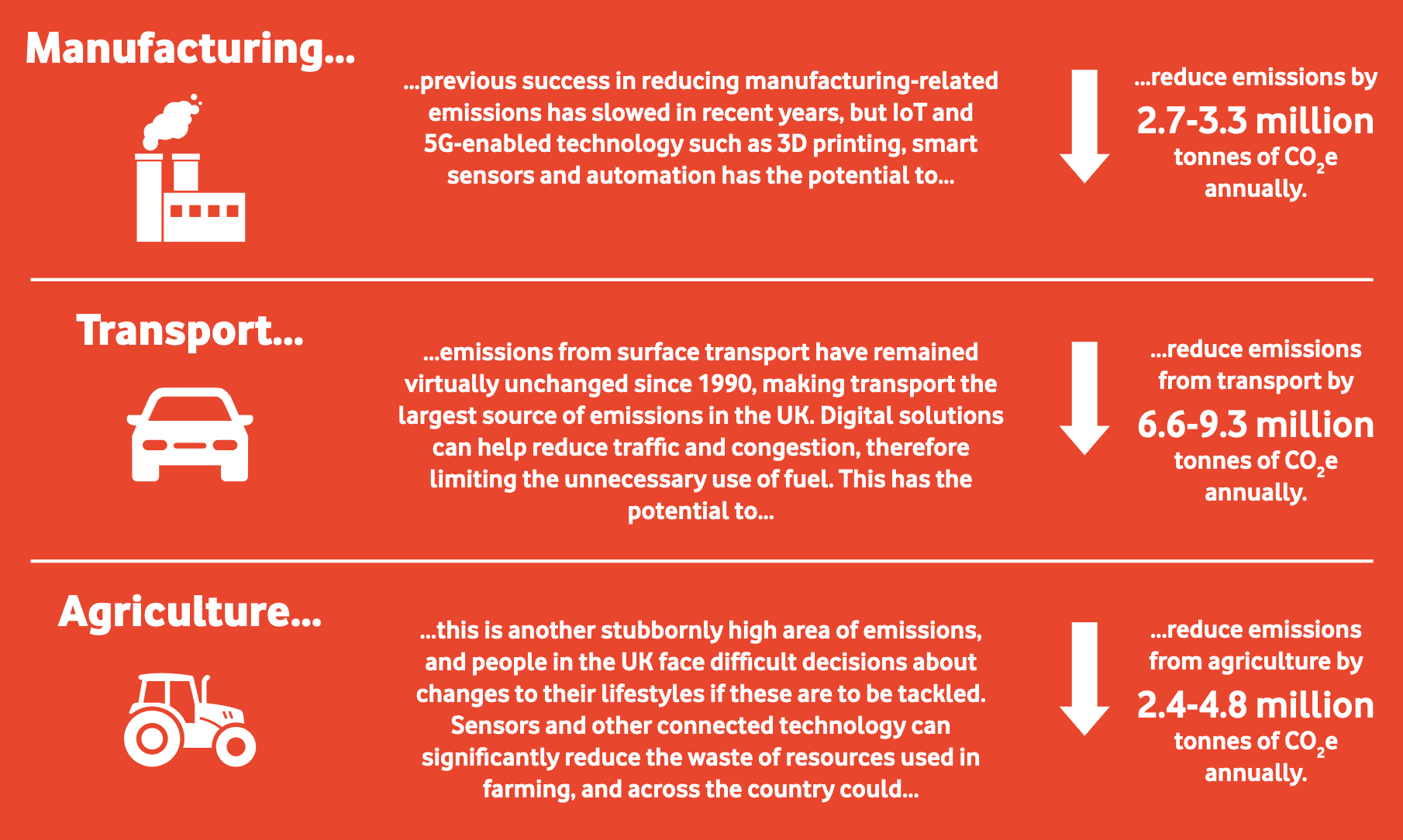
Which is equivalent to 17.4 million tonnes of carbon-dioxide equivalent (CO2e) – which, in UK terms, is about what the North East produces each year. This is a top-end scenario, however; the lower-end of the forecast settles on a 2.7 percent reduction, equivalent to 11.7 million tonnes of CO2e. The transport, agriculture, and manufacturing sectors can realise reductions of 6.6-9.3 million, 2.4-4.8 million, and 2.7-3.3 million tonnes, respectively.
More than this, the paper argues 5G and IoT (as the base-line tech) could help the UK reach its goal to slash emissions by 78 percent by 2035 – as published in the government’s sixth Carbon Budget in June, and as plotted in its new Net Zero Strategy, to be published ahead of COP26 in November – and, finally, to arrive at net zero by 2050. But Vodafone wants a more supportive regulatory and policy environment to bring the underlying tech.
It wants the government to set targets and offer financial support (incentives) for key industrial sectors to adopt 5G and IoT, to be written down as part of its November net-zero blueprints. In addition, it wants an ‘operational review’ to assess how emissions can be reduced across government departments, and which technologies can help most in the cause, with increased weighting allocated for “carbon reduction tech” in government procurement processes.
As well, Vodafone has urged the UK government to fight against inertia and inexperience among businesses and local authorities by collaborating with industry on skills and knowledge. It suggests the UK follow the German model for funding of Fraunhofer research institutes by expanding its various ‘catapult’ setups as an institutionalised framework for innovation, and put aside £500 million of public funding for regional IoT and 5G innovation centres.
The report states: “Better energy and resource efficiency is a prerequisite for the government meeting its targets to tackle climate change. Digital technology – through IoT and 5G – can make a substantial contribution to achieving these efficiency gains. To realise the benefits of IoT and 5G, the government should create a regulatory and policy framework that removes barriers to adoption and incentivises the uptake of digital tech across the economy.”
The report puts focus on the current return-rate for 5G infrastructure rollout in the UK, levied against a difficult telecoms environment and a broader economic climate. “5G could add over £150 billion to the UK economy by 2030. To achieve these environmental and societal benefits, significant investment is required to roll out and maintain 5G networks, build more mobile sites and develop new 5G applications and technologies,” the report says.
“Operators are faced with these investment demands at a time when the industry is under serious cost pressures, for example through the requirement to swap equipment, increasing operating costs and high regulatory and spectrum costs. Operators need 5G to deliver an investment boost via the industrialisation of new 5G technologies. This would lead to improvements to the current low return on capital employed in the UK for mobile infrastructure.
“This boost could be delivered by the uptake of digital technology across manufacturing, agriculture and transport, which would not only reduce emissions and support the government’s net zero target, but would also create a virtuous circle by opening up new revenues for operators. These new revenue streams can then be reinvested in the rollout of 5G and the development of new applications which will also benefit consumers and smaller businesses.”
The high-end forecast for annual greenhouse gas reductions in manufacturing, of 3.3 million tonnes of CO2e, would be like removing 600,000 cars from UK roads, the report says; the high-end forecast for transport, of 9.3 million tonnes of CO2e, is like taking two million cars off the road. The analogy switches for agriculture, with the projected 4.8 million tonnes annual saving equivalent to the emissions from producing three billion pints of milk.
The over-the-top digital tech to be supported by the cellular-sponsored foundation layer of industrial 5G broadband and industrial IoT narrowband networks, across the three disciplines, includes artificial intelligence (AI), machine learning, various smart building solutions, telematics for logistics, and sundry agricultural sensing applications. A bunch of other solutions are also highlighted.
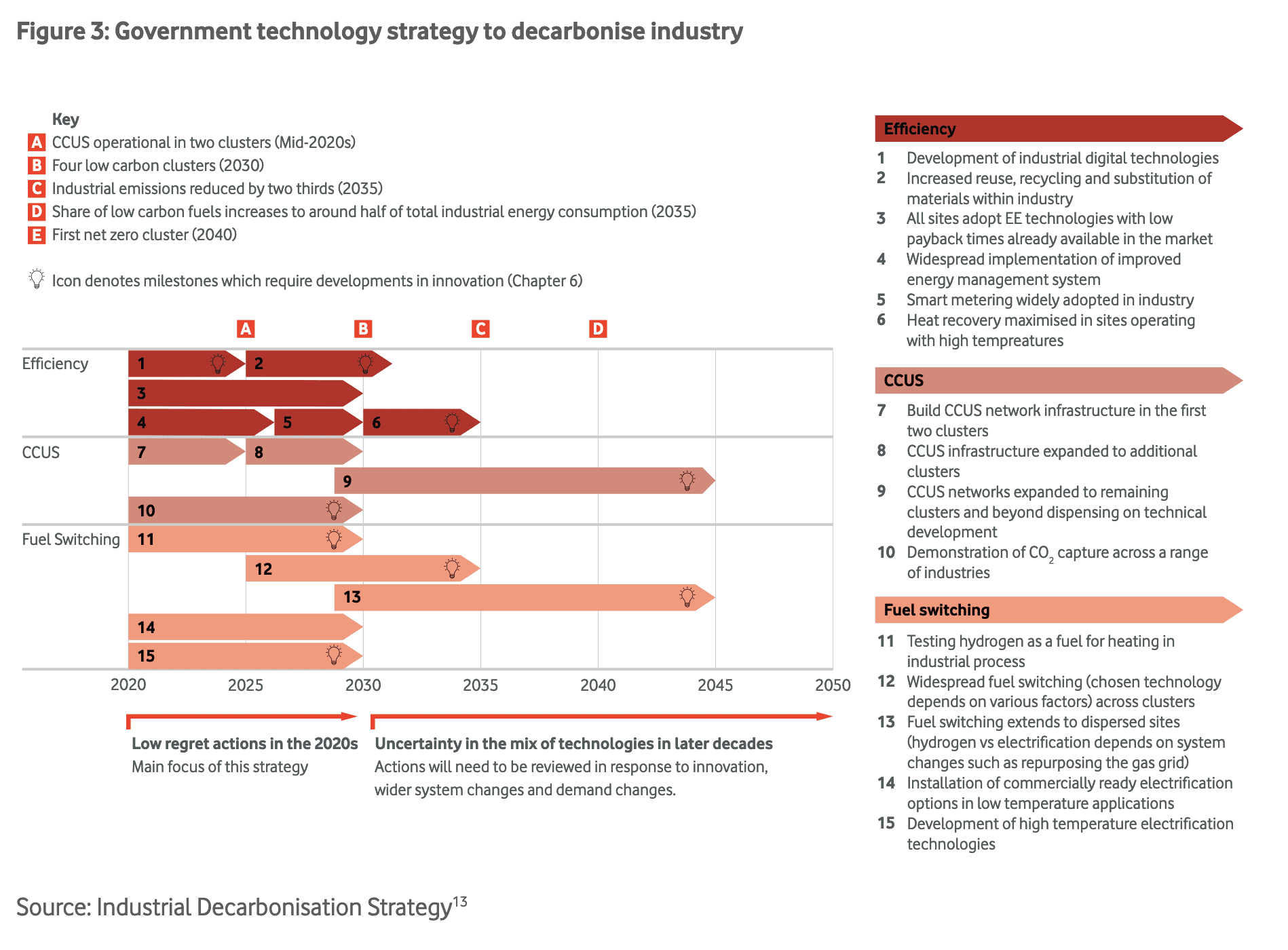
On manufacturing, the report says: “Bolder and more innovative steps will be necessary. Technology is at the forefront of key actions within the government’s strategy… [to deploy] industrial digital technologies including IoT, augmented reality, virtual reality, robotics and additive manufacturing (3D printing). These complement key actions around switching to lower carbon sources of fuel and scaling carbon capture, usage and storage (CCUS) technology.
“The use of 5G in industrial settings could be facilitated by private 5G networks. The use of digital technology and IoT also has significant potential to support the competitiveness of the UK economy, as well as supporting jobs in lower employment areas of the country, hard hit by the pandemic. The greatest impact would be in Wales, the North East and North West, and the East and West Midlands, because of the distribution of manufacturing.”
On transport, it says: “Electric vehicles will have a major impact on delivering net zero in the long term, but this will be limited in the short term due to the 2030 target being nearly a decade away… IoT as it exists today can play a significant role in bridging this gap by delivering emissions reduction in the short term through changing driver behaviour, while providing the bridge to connected and autonomous vehicles and, ultimately, electric vehicles.”
On agriculture, it talks about “difficult trade-offs”, quoting the the Climate Change Committee (CCC) that consumption of beef, lamb, and dairy should be reduced by 20 percent per head to achieve net zero by 2050, and by 100 percent (“near elimination of livestock demand”) if the UK is to bring the target forward to 2040. The report states: “Technology can… [make] a sizeable contribution to total emissions reduction, and potentially soften some of the hard choices that need to be made in relation to our lifestyles in the coming decades.”