

RCR Wireless
  • News
  • Channels
    • 5G
    • 6G
    • BSS OSS
    • Carriers
    • IoT
    • Network Infrastructure
    • Open RAN
    • Private 5G
    • Telco AI
    • Telco Cloud
    • Test & Measurement
  • Resources
    • Reports
    • Webinars
    • White papers
    • AI Fundamentals
    • Analyst Angle
    • Editorial Calendar
    • Fundamentals
      • 5G NR Release 17
      • AI
        • Telco AI in 2025
    • Podcasts
      • Let’s Get Digital with Carrie Charles
      • Wireless Connectivity to Enable Industry 4.0 for the Middleprise
      • Well Technically…
      • Will 5G Change the World
      • Accelerating Industry 4.0 Digitalization
  • AI Infrastructure
  • Programs
  • Events
  • RCRtv
  • Advertise
  • Subscribe
Friday, July 10, 2026
RCR Wireless
  • News
  • Channels
    • 5G
    • 6G
    • BSS OSS
    • Carriers
    • IoT
    • Network Infrastructure
    • Open RAN
    • Private 5G
    • Telco AI
    • Telco Cloud
    • Test & Measurement
  • Resources
    • Reports
    • Webinars
    • White papers
    • AI Fundamentals
    • Analyst Angle
    • Editorial Calendar
    • Fundamentals
      • 5G NR Release 17
      • AI
        • Telco AI in 2025
    • Podcasts
      • Let’s Get Digital with Carrie Charles
      • Wireless Connectivity to Enable Industry 4.0 for the Middleprise
      • Well Technically…
      • Will 5G Change the World
      • Accelerating Industry 4.0 Digitalization
  • AI Infrastructure
  • Programs
  • Events
  • RCRtv
  • Advertise
  • Subscribe
Add RCR Wireless as a preferred source on Google
  • Qualcomm 6G Insights
  • Huawei Content Hub
  • Qualcomm – 6G Vision
  • OSS/BSS Channel
  • RCRTech Roundtable: AI Infrastructure
RCR Wireless
RCR Wireless
  • Advanced Mimo
  • Mobile mmWave
  • 5G Positioning
  • Green Networks
  • Metaverse
  • Automotive
  • Industrial and Wide-area IoT
Copyright 2021 - All Right Reserved
Home - How will cellular private networks enable smart ports?
Private 5G5GCarriersFeatured

How will cellular private networks enable smart ports?

by Juan Pedro Tomás December 1, 2022
written by Juan Pedro Tomás December 1, 2022 Share
LinkedinEmail
Share 0LinkedinEmail
private networks
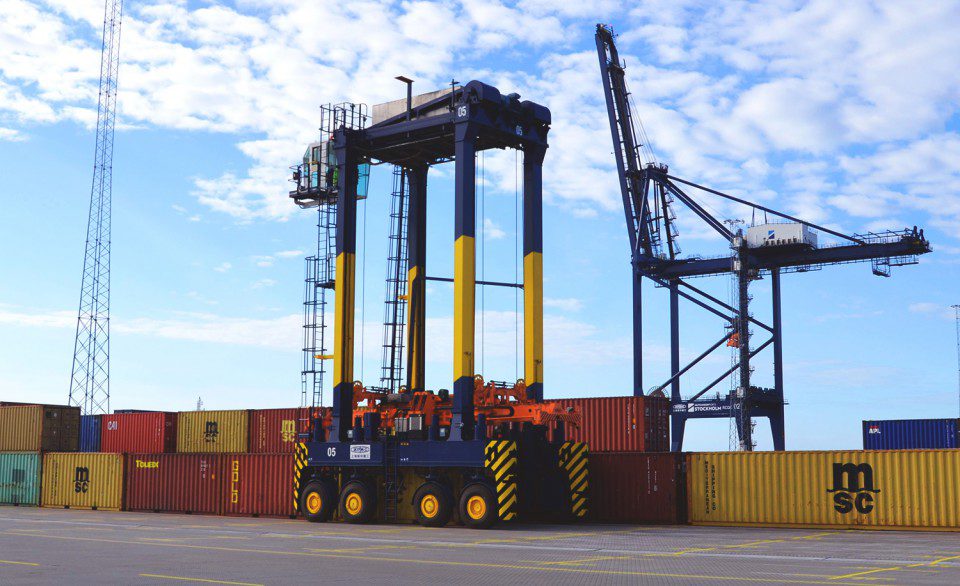
Image courtesy of Hutchison Ports Stockholm
179

The private networks deployed at this Swedish port currently rely on 4G LTE technology

A cellular private network for Hutchison Ports Stockholm has enabled a high level of automation at the facility, including the operation of automated straddle carriers, Graham Wilde, head of 5G business development at CKH IOD, the international development hub of CK Hutchinson, said during a presentation at the Private Network European Forum—available on demand here.

Hutchison Ports Stockholm is a highly-automated container-handling facility, situated at the port of Stockholm, which was inaugurated in 2020.

Private networks to enable automation of straddle carriers

“The port has just 38 people working there. And it runs eight to 12 hours a day. And there’s a lot of automation in many, many different aspects of the port, which allows them to work with a relatively small number of people. So we were asked to provide a private cellular network to support eight autonomous straddle carriers,” Wilde said.

Wilde noted that the port decided to implement a cellular private network with the aim of increasing automation and reducing costs but also deal with the lack of workers willing to operate the straddle carriers.

“A more strategic and common issue across many ports is that it’s really hard to find anybody who wants to do that job. People just don’t want to drive these straddle carriers around anymore. It’s very hard to find people to do that. So it was imperative to automate these vehicles,” the executive said.

Wilde noted that CKH IOD worked with Ericsson for the provision of the 14 private networks currently operating at the port. Other partners in the project include Swedish telco Three, which provided the spectrum in the 2.5 GHz band and also worked as the system integrator of the project.

Wilde highlighted that the automated straddle carriers carry two kinds of communication. “They carry PLC, safety management traffic, and then the current video traffic. And the PLC traffic is very sensitive to variations in latency. So we were looking at a round trip latency of about 26 milliseconds to make this all work. Video is more bandwidth hungry, but less sensitive. And video is not used all the time. So video [is used] particularly in the commissioning phase. Or if there’s a particular problem with straddle carrier, the cameras may be turned on, but video is not in use all the time. So the PLC is what is constantly being used,” the executive said.

Wilde noted that the private network project required a lot of work to deal with all the safety management protocols of the port. “We found that the variations in latency or even a momentary complete loss of connection will trip the safety system. So the safety system will have three attempts at communicating around trip latency of 26 milliseconds and if it doesn’t succeed within that 26 millisecond window, then it deems that it’s basically lost the connection with the vehicle and the vehicle stops. And unfortunately, the vehicle doesn’t start again, when the connection is restored or when the latency improves what both are very specific protocols safety protocol that has to be gone through which is specified by the vehicle manufacturer and by the port,” Wilde added. The executive explained that once stopped, the vehicle needs to be taken by a human being to a commissioning area which requires all automated vehicles in the area to be stopped. “If you miss that latency window for three three tries, then the whole port stops working. That’s the bottom line.”

Extreme testing to make private networks highly reliable

Wilde noted that to deal with these challenges, the company needed to carry out numerous tests to make the private networks extremely reliable.

“We have to be super reliable. And we had a limited number of tools that we can use to make it reliable,” he said. “So, one of the keys to the success of this is just testing everything to death. Starting with individual components of the network, then testing the subsystems of the network, then testing the whole network, including the user equipment and the mode and then testing the automation and PLC applications over the top of that network. And then finally, testing, obviously, all the trouble tickets in the service management aspects of the network too.

“And every test you do, you have to go through the cycle … of planning, and carrying it out, analyzing the results and changing configurations of various things, and then doing it all again,” he added.

Wilde also said that the private network deployed at this Swedish port was based on 4G LTE technology.


You Might Also Like
  • How operations leaders see 5G as vital for mission-critical workflows (Reader Forum)
  • Thursday (telco diary) | The plumbing is the product
  • Wednesday (telco diary) | Mobility matters for physical AI
  • Mimosa Networks and Viaero Wireless demonstrate scalable 5 GHz and 6 GHz fixed wireless broadband with AFC
  • Tuesday (telco diary) | AI hub and spoke, cloud to edge
  • What defines network performance in 5G and beyond? A CTO Perspective
Share 0 LinkedinEmail
Juan Pedro Tomás

Juan Pedro covers Global Carriers and Global Enterprise IoT. Prior to RCR, Juan Pedro worked for Business News Americas, covering telecoms and IT news in the Latin American markets. He also worked for Telecompaper as their Regional Editor for Latin America and Asia/Pacific. Juan Pedro has also contributed to Latin Trade magazine as the publication's correspondent in Argentina and with political risk consultancy firm Exclusive Analysis, writing reports and providing political and economic information from certain Latin American markets. He has a degree in International Relations and a master in Journalism and is married with two kids.

previous post
Big game hunting with private 5G – more takeaways from Private Networks Forum
next post
Telenor, Axiata complete merger in Malaysia

White Papers

  • Enea White Paper: Why Intelligent AAA is the Swiss Army Knife of Telecom

  • CSG White Paper: Telco AI Enabler: Mediation’s Defining Role

  • Enea White Paper: Scalable Database Design for 5G and Beyond

  • Supermicro and NVIDIA Whitepaper: Powering sovereign AI at scale

  • VIAVI Whitepaper: RAN scenario generators and their critical role for future-proofing AI-native RAN in Advanced 5G and 6G networks

Editorial Reports

  • Report: Scaling Optical Networks For The Hyperscale And AI Era

  • Test And Measurement Market Pulse Report

  • Editorial Report: Securing telecom infrastructure for the quantum era

Webinars

  • SIMCom Webinar: Scaling your next deployment – from plastic to provisioning

  • Webinar: Rethinking the RAN as AI, cloud and openness converge

  • Webinar: Scale-Up, Scale-Out, Scale-Across – Building AI-Era Network Fabrics

  • Webinar: NTN in motion – evolving standards, expanding services

  • Webinar: Noise-Figure Measurements with RFmx and PXI VSTs

Since 1982, RCR Wireless News has been providing wireless and mobile industry news, insights, and analysis to mobile and wireless industry professionals, decision makers, policy makers, analysts and investors.

Facebook Twitter Youtube Linkedin Envelope Rss

Useful Links

  • Subscribe
  • About RCR Wireless News
  • Contact Us
  • Advertise
  • Editorial Calendar
  • Archive
  • RSS
  • Wireless News Archive
  • Subscribe
  • About RCR Wireless News
  • Contact Us
  • Advertise
  • Editorial Calendar
  • Archive
  • RSS
  • Wireless News Archive

Edtior's Picks

How operations leaders see 5G as vital for mission-critical workflows (Reader Forum)
Thursday (telco diary) | The plumbing is the product
NestAI and Nokia debut AI defense tech for denied battlefields

Latest Articles

How operations leaders see 5G as vital for mission-critical workflows (Reader Forum)
Thursday (telco diary) | The plumbing is the product
NestAI and Nokia debut AI defense tech for denied battlefields
OCUDU aims to resolve the ‘last bottlenecks of proprietary software’

© 2026 RCR Wireless News All Right Reserved. Developed by Eight Hats.

Cookie Policy | Privacy Policy

RCR Wireless
  • News
  • Channels
    • 5G
    • 6G
    • BSS OSS
    • Carriers
    • IoT
    • Network Infrastructure
    • Open RAN
    • Private 5G
    • Telco AI
    • Telco Cloud
    • Test & Measurement
  • Resources
    • Reports
    • Webinars
    • White papers
    • AI Fundamentals
    • Analyst Angle
    • Editorial Calendar
    • Fundamentals
      • 5G NR Release 17
      • AI
        • Telco AI in 2025
    • Podcasts
      • Let’s Get Digital with Carrie Charles
      • Wireless Connectivity to Enable Industry 4.0 for the Middleprise
      • Well Technically…
      • Will 5G Change the World
      • Accelerating Industry 4.0 Digitalization
  • AI Infrastructure
  • Programs
  • Events
  • RCRtv
  • Advertise
  • Subscribe
RCR Wireless
  • News
  • Channels
    • 5G
    • 6G
    • BSS OSS
    • Carriers
    • IoT
    • Network Infrastructure
    • Open RAN
    • Private 5G
    • Telco AI
    • Telco Cloud
    • Test & Measurement
  • Resources
    • Reports
    • Webinars
    • White papers
    • AI Fundamentals
    • Analyst Angle
    • Editorial Calendar
    • Fundamentals
      • 5G NR Release 17
      • AI
        • Telco AI in 2025
    • Podcasts
      • Let’s Get Digital with Carrie Charles
      • Wireless Connectivity to Enable Industry 4.0 for the Middleprise
      • Well Technically…
      • Will 5G Change the World
      • Accelerating Industry 4.0 Digitalization
  • AI Infrastructure
  • Programs
  • Events
  • RCRtv
  • Advertise
  • Subscribe
@2020 - All Right Reserved. Designed and Developed by PenciDesign