

RCR Wireless
  • News
  • Channels
    • 5G
    • 6G
    • BSS OSS
    • Carriers
    • IoT
    • Network Infrastructure
    • Open RAN
    • Private 5G
    • Telco AI
    • Telco Cloud
    • Test & Measurement
  • Resources
    • Reports
    • Webinars
    • White papers
    • AI Fundamentals
    • Analyst Angle
    • Editorial Calendar
    • Fundamentals
      • 5G NR Release 17
      • AI
        • Telco AI in 2025
    • Podcasts
      • Let’s Get Digital with Carrie Charles
      • Wireless Connectivity to Enable Industry 4.0 for the Middleprise
      • Well Technically…
      • Will 5G Change the World
      • Accelerating Industry 4.0 Digitalization
  • AI Infrastructure
  • Programs
  • Events
  • RCRtv
  • Advertise
  • Subscribe
Sunday, July 26, 2026
RCR Wireless
  • News
  • Channels
    • 5G
    • 6G
    • BSS OSS
    • Carriers
    • IoT
    • Network Infrastructure
    • Open RAN
    • Private 5G
    • Telco AI
    • Telco Cloud
    • Test & Measurement
  • Resources
    • Reports
    • Webinars
    • White papers
    • AI Fundamentals
    • Analyst Angle
    • Editorial Calendar
    • Fundamentals
      • 5G NR Release 17
      • AI
        • Telco AI in 2025
    • Podcasts
      • Let’s Get Digital with Carrie Charles
      • Wireless Connectivity to Enable Industry 4.0 for the Middleprise
      • Well Technically…
      • Will 5G Change the World
      • Accelerating Industry 4.0 Digitalization
  • AI Infrastructure
  • Programs
  • Events
  • RCRtv
  • Advertise
  • Subscribe
Add RCR Wireless as a preferred source on Google
  • Qualcomm 6G Insights
  • Huawei Content Hub
  • Qualcomm – 6G Vision
  • OSS/BSS Channel
  • RCRTech Roundtable: AI Infrastructure
RCR Wireless
RCR Wireless
  • Advanced Mimo
  • Mobile mmWave
  • 5G Positioning
  • Green Networks
  • Metaverse
  • Automotive
  • Industrial and Wide-area IoT
Copyright 2021 - All Right Reserved
Home - 5G offers ‘a long tail’ of services and monetization opportunities
5GBusinessFeatured

5G offers ‘a long tail’ of services and monetization opportunities

by Catherine Sbeglia Nin March 16, 2022
written by Catherine Sbeglia Nin March 16, 2022 Share
LinkedinEmail
Share 0LinkedinEmail
5g monetization
(Courtesy of Bell Labs)
213

There is a long journey ahead for 5G monetization but CSPs can start by tuning up their networks to deliver the best experience possible

5G is setting the stage for a boom in cellular use cases that extend beyond those in the consumer segment, creating what Stéphane Téral, chief analyst at LightCounting, called “a long tail of services,” all of which come with their own potential for monetization.

5G’s promise of lower latency and higher throughput, for instance, is being used to address enterprise, Industry 4.0 and autonomous vehicle needs, opening up new monetization opportunities for communications services providers (CSPs), as long as they carefully pair technology investments to desired business outcomes.

That’s not to say that new revenue opportunities are not waiting to be unlocked in the consumer segment. Particularly in the U.S., operators are standing up fixed wireless access home internet service and going head-to-head with cable companies. There are also emerging device types, cellular-connected PCs and AR/VR products, that could push ratepayers into new plans with more lines. Gaming is also a nascent area for operators with the logic being that mobile gaming is a growing space, and it could certainly benefit from 5G, so there might be an opportunity for a premium-priced gaming tier.

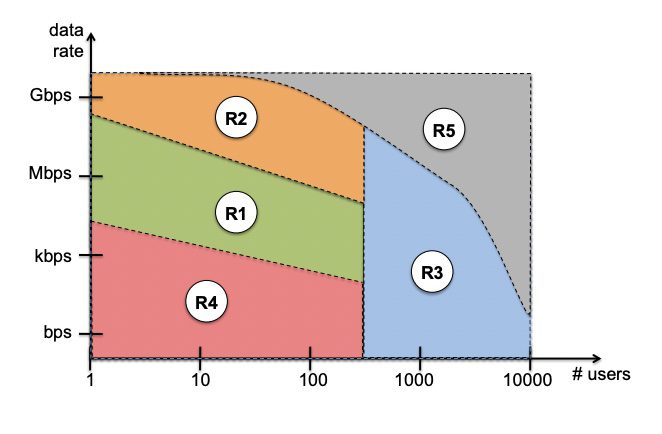
To better explain these two paths to 5G monetization and how they relate, Téral tapped into the Region (R) concept. First published in a 2013 Bell Labs’ research paper, the concept is an attempt to map the possibilities of the next generation of cellular technologies by determining the boundaries of possible data rates as network users increase. Ultimately, Téral concluded, two forms of 5G monetization are established: direct and indirect.

4vSMUoCJzHFmBVLzxVedD bKLgZdA905SoTB56WfJbd8Q5n9TsZQ21aDoaPXsTfBGTmFmv9rcn

Region 1: the low-hanging 5G monetization fruit

According to Téral, the industry is currently in Region 1 (R1), and while Region 2 (R2) requires ongoing research to improve spectral efficiencies (will it be 6G?), he believes there already exists significant potential for Region 3 (R3) and Region 4 (R4). Considered to be direct monetization, R1 involves enhanced mobile broadband (eMBB).

“[In Region 1], you have the service providers collecting 5G revenues if they do a good job of selling the network and coming up with packages that people are willing to pay for,” said Téral, providing specific lifestyle needs such as video streaming, cloud gaming and immersive sports and music events with AR/VR services as examples of such premium-tier consumer services.

 “And then, gradually, you go after the rest of your subscriber base,” he continued. “That is the process we are observing. Region 1 is clear cut.” And by that, he means it’s simple and reflects monetization models of the past.

LightCounting estimates that global 5G revenues were between $15 and $20 billion in 2021, with 86% coming from R1 services, driven by strong 5G subscriber uptake in China and Korea, both of which implemented “winning” 5G consumer strategies, according to Téral.

Using supporting materials from Ericsson, Téral laid out these strategies: “Number one, build a network [that] is cost-efficient and scalable. Then you have to look at how to deliver the best smartphone experience. Eventually you expand the 5G [wireless] coverage. Then […] you go after fixed wireless, as well. Then, beef up the pricing strategy [and finally] you lead with innovative and immersive services.”

AUfjfGONzf3 j2 kFXyJwJ6boP0Ys DY uy3W6qK2IjlFZdAxwsSZiAtTVoZgQQ0SIzgemKi6PntxdGQcga6qojB UxXTMjskA6rjbayapmcccQzVZJ 9Z5oQ FkzgbKA3j Qo97

In South Korea, almost 30% of mobile subscribers — equal to 20.9 million — are on 5G as of the fourth quarter of 2021. That number is even greater in China, reaching 730 million subscribers as of the end of 2021. In the U.S., however, 4G remains the dominant consumer revenue engine because 5G operations in low-band spectrum are not yet producing speeds faster than 4G. 

“The U.S. [started] 5G on the opposite side of the rest of the world,” explained Téral. “They didn’t have mid-band. T-Mobile [did] after acquiring Sprint [and that] put T-Mobile in a sweet spot. In fact, it is now the poster child of real 5G, if you wish, in the U.S.” 

While AT&T does not publish their average revenue per account (ARPA) data, both T-Mobile US and Verizon’s ARPA figures are increasing, so Téral expressed confidence that “things are looking up in the U.S.,” adding that the deployment of C-band will provide additional revenue opportunities for U.S. operators.  

Region 3 and Region 4: 5G as the complex enabler

Region 3, which involves mMTC (Massive Machine-Type Communications), and Region 4, which involves uRRLC (ultra-reliable low-latency communications), are examples of indirect 5G monetization, and LightCounting estimates that these two regions raked in a combined 5G revenue of between $2 and $2.8 billion as of 2021, based on GSA, Ericsson and Nokia data points.

From Téral’s perspective, R3 and R4 both represent a “more complex environment characterized by the need for tight cooperation and partnership between various players to solve a specific issue.”

In other words, these regions require knowledge of enterprise, industrial and government needs so that an ecosystem of partners can be developed specifically to address those needs.

“In Region 3 and 4, 5G is the enabler,” said Téral. “This means it’s not necessarily the service provider that is going to collect money for a particular use case; it can be a partnership between a service provider, a systems integrator and a vendor. 5G is being used […] to solve a problem and […] this is not a direct 5G monetization item.”

In this case, he continued, 5G is simply helping a customer achieve a desired business outcome, such as providing further efficiencies within a factory, and in doing so, the customer deploying 5G is also collecting on the extra revenue. All of this, he said, makes it challenging to parse out who can truly claim additional revenue from 5G services.

The bottom line, Téral concluded, is that there is a long journey ahead for the monetization of 5G, but CSPs can start by tuning up their 5G network to deliver the best experience possible and offering tailored packages to those consumers willing to pay a premium. The next step, R3 and R4 will take more time to establish, particularly because Wi-Fi and LTE are good enough for most current IoT application, and when it comes industrial 4.0, 5G will have to compete with other technology offerings like non-cellular Bluetooth Low Energy (BLE) indoor tracking systems, LPWAN, NB-IoT, LTE-M and non-cellular LoRaWAN.

“We are on a long journey; it has started. That’s the good news,” he said, adding that by following in the steps of those leading the industry, like South Korea and China, and heeding the roadmap laid out by Ericsson, the industry will “get there” in terms of monetizing 5G across R1, as well as the more complex and elusive R3 and R4.

You Might Also Like
  • Huawei sees Mobile AI driving new wave of uplink network investment
  • South Korea launches AI-RAN project to advance industrial AI
  • Rakuten Mobile expands O-RAN footprint with 1Finity radios
  •  VodafoneThree puts P.I. Works’ SMO at the center of network transformation
  • Operators are seeking greater control of NTN: GSMA Intelligence
  • Mimosa Networks and Viaero Wireless demonstrate scalable 5 GHz and 6 GHz fixed wireless broadband with AFC

Table of Contents

  • There is a long journey ahead for 5G monetization but CSPs can start by tuning up their networks to deliver the best experience possible
    • Region 1: the low-hanging 5G monetization fruit
    • Region 3 and Region 4: 5G as the complex enabler
Share 0 LinkedinEmail
Catherine Sbeglia Nin

Catherine Sbeglia Nin is the Managing Editor for RCR Wireless News, where she covers topics such as Wi-Fi, network infrastructure, AI and edge computing. She also produced and hosted Arden Media's podcast Well, technically... After studying English and Film & Media Studies at The University of Rochester, she moved to Madison, WI. Having already lived on both coasts, she thought she’d give the middle a try. So far, she likes it very much.

previous post
Qualcomm, Movandi partnership demonstrates shared mmWave vision
next post
How changes in 5G architecture impact network visibility

White Papers

  • Norton eBook: The 2026 Telco Playbook

  • Enea White Paper: Why Intelligent AAA is the Swiss Army Knife of Telecom

  • CSG White Paper: Telco AI Enabler: Mediation’s Defining Role

  • Enea White Paper: Scalable Database Design for 5G and Beyond

  • Supermicro and NVIDIA Whitepaper: Powering sovereign AI at scale

Editorial Reports

  • Market Pulse Report: Telco AI in 2026 – Trends, Challenges and Opportunities

  • Nvidia Report: The State of AI in Telecommunications: 2026 Trends

  • Report: Scaling Optical Networks For The Hyperscale And AI Era

Webinars

  • Webinar: Building 6G — aligning technology, policy and purpose

  • SIMCom Webinar: Scaling your next deployment – from plastic to provisioning

  • Webinar: Rethinking the RAN as AI, cloud and openness converge

  • Webinar: Scale-Up, Scale-Out, Scale-Across – Building AI-Era Network Fabrics

  • Webinar: NTN in motion – evolving standards, expanding services

Since 1982, RCR Wireless News has been providing wireless and mobile industry news, insights, and analysis to mobile and wireless industry professionals, decision makers, policy makers, analysts and investors.

Facebook Twitter Youtube Linkedin Envelope Rss

Useful Links

  • Subscribe
  • About RCR Wireless News
  • Contact Us
  • Advertise
  • Editorial Calendar
  • Archive
  • RSS
  • Wireless News Archive
  • Subscribe
  • About RCR Wireless News
  • Contact Us
  • Advertise
  • Editorial Calendar
  • Archive
  • RSS
  • Wireless News Archive

Edtior's Picks

AT&T says its network is already built for the agentic AI wave
AT&T and Ericsson use network sensing to spot drones with ordinary 5G towers
Huawei sees Mobile AI driving new wave of uplink network investment

Latest Articles

AT&T says its network is already built for the agentic AI wave
AT&T and Ericsson use network sensing to spot drones with ordinary 5G towers
Huawei sees Mobile AI driving new wave of uplink network investment
Spectrum supercycle – US opens floodgates; UK shares it out

© 2026 RCR Wireless News All Right Reserved. Developed by Eight Hats.

Cookie Policy | Privacy Policy

RCR Wireless
  • News
  • Channels
    • 5G
    • 6G
    • BSS OSS
    • Carriers
    • IoT
    • Network Infrastructure
    • Open RAN
    • Private 5G
    • Telco AI
    • Telco Cloud
    • Test & Measurement
  • Resources
    • Reports
    • Webinars
    • White papers
    • AI Fundamentals
    • Analyst Angle
    • Editorial Calendar
    • Fundamentals
      • 5G NR Release 17
      • AI
        • Telco AI in 2025
    • Podcasts
      • Let’s Get Digital with Carrie Charles
      • Wireless Connectivity to Enable Industry 4.0 for the Middleprise
      • Well Technically…
      • Will 5G Change the World
      • Accelerating Industry 4.0 Digitalization
  • AI Infrastructure
  • Programs
  • Events
  • RCRtv
  • Advertise
  • Subscribe
RCR Wireless
  • News
  • Channels
    • 5G
    • 6G
    • BSS OSS
    • Carriers
    • IoT
    • Network Infrastructure
    • Open RAN
    • Private 5G
    • Telco AI
    • Telco Cloud
    • Test & Measurement
  • Resources
    • Reports
    • Webinars
    • White papers
    • AI Fundamentals
    • Analyst Angle
    • Editorial Calendar
    • Fundamentals
      • 5G NR Release 17
      • AI
        • Telco AI in 2025
    • Podcasts
      • Let’s Get Digital with Carrie Charles
      • Wireless Connectivity to Enable Industry 4.0 for the Middleprise
      • Well Technically…
      • Will 5G Change the World
      • Accelerating Industry 4.0 Digitalization
  • AI Infrastructure
  • Programs
  • Events
  • RCRtv
  • Advertise
  • Subscribe
@2020 - All Right Reserved. Designed and Developed by PenciDesign
