

RCR Wireless
  • News
  • Channels
    • 5G
    • 6G
    • BSS OSS
    • Carriers
    • IoT
    • Network Infrastructure
    • Open RAN
    • Private 5G
    • Telco AI
    • Telco Cloud
    • Test & Measurement
  • Resources
    • Reports
    • Webinars
    • White papers
    • AI Fundamentals
    • Analyst Angle
    • Editorial Calendar
    • Fundamentals
      • 5G NR Release 17
      • AI
        • Telco AI in 2025
    • Podcasts
      • Let’s Get Digital with Carrie Charles
      • Wireless Connectivity to Enable Industry 4.0 for the Middleprise
      • Well Technically…
      • Will 5G Change the World
      • Accelerating Industry 4.0 Digitalization
  • AI Infrastructure
  • Programs
  • Events
  • RCRtv
  • Advertise
  • Subscribe
Sunday, July 26, 2026
RCR Wireless
  • News
  • Channels
    • 5G
    • 6G
    • BSS OSS
    • Carriers
    • IoT
    • Network Infrastructure
    • Open RAN
    • Private 5G
    • Telco AI
    • Telco Cloud
    • Test & Measurement
  • Resources
    • Reports
    • Webinars
    • White papers
    • AI Fundamentals
    • Analyst Angle
    • Editorial Calendar
    • Fundamentals
      • 5G NR Release 17
      • AI
        • Telco AI in 2025
    • Podcasts
      • Let’s Get Digital with Carrie Charles
      • Wireless Connectivity to Enable Industry 4.0 for the Middleprise
      • Well Technically…
      • Will 5G Change the World
      • Accelerating Industry 4.0 Digitalization
  • AI Infrastructure
  • Programs
  • Events
  • RCRtv
  • Advertise
  • Subscribe
Add RCR Wireless as a preferred source on Google
  • Qualcomm 6G Insights
  • Huawei Content Hub
  • Qualcomm – 6G Vision
  • OSS/BSS Channel
  • RCRTech Roundtable: AI Infrastructure
RCR Wireless
RCR Wireless
  • Advanced Mimo
  • Mobile mmWave
  • 5G Positioning
  • Green Networks
  • Metaverse
  • Automotive
  • Industrial and Wide-area IoT
Copyright 2021 - All Right Reserved
Home - Minimizing delay and delay variation in Ethernet fronthaul networks (Reader Forum)
Network InfrastructureOpinionReader Forum

Minimizing delay and delay variation in Ethernet fronthaul networks (Reader Forum)

by Reader Forum October 25, 2020
written by Reader Forum October 25, 2020 Share
LinkedinEmail
Share 0LinkedinEmail
carriers ethernet fronthaul
187

Architectural changes made in 5G to optimize and scale networks with cloud radio access networks (C-RAN) have created stricter synchronization and latency requirements, particularly for fronthaul networks that provide connectivity between radios and centralized baseband controllers.

Standardization bodies have developed new standards for meeting these requirements. One such standard in the Time-Sensitive Networking (TSN) toolkit is IEEE Std 802.1Qbu, which specifies frame preemption. This amendment to IEEE Std 802.1Q, along with IEEE Std 802.3br, specifies a method for transmitting time-sensitive frames in a manner that significantly reduces delay and delay variation.

While the greatest benefit of delay reduction is realized at lower port rates, the intent of frame preemption is to minimize delay and frame delay variation and protect time-sensitive flows from other flows in a deterministic manner. This allows latency-sensitive fronthaul traffic to be transported without being impeded by other flows, making it easier to conform to the rigorous requirements imposed by standards such as IEEE 802.1CM, which defines TSN for Fronthaul profiles.

Operators have a strong desire to move to packet-based fronthaul to drive down cost and increase scale. In the past, operators addressed fronthaul primarily through direct fiber and point-to-point wavelength-division multiplexing (WDM) links, which did not cause asymmetry or delay variation. With the move to transport fronthaul streams over bridged Ethernet networks, strict latency and jitter requirements raise the need for new standards-based mechanisms that will make Ethernet deterministic. The need is greatest in cases where time-sensitive frames must be prioritized over non-time-sensitive frames.

Traditional Ethernet queue management and scheduling techniques such as strict priority queuing (SPQ) or variants of round-robin (RR) queuing schedule full frames by priority or, by relative weight. However, these techniques do not provide the determinism needed for the transport of high-priority time-sensitive traffic. Instead, they require high-priority frames to wait in a queue if a lower-priority frame is already transmitting. They then process the high-priority frames as quickly as possible, but the delays can reach the tens of microseconds if the lower-priority frames are large. Unbounded frame delay for time-sensitive frames can have negative impacts such as deterioration in voice and video services and inaccurate data collection in real-time monitoring systems. 

A system that complies with IEEE 802.1Qbu interrupts the transmission of a non-time-sensitive frame if it receives a time-sensitive frame. The system treats the time-sensitive frame as an express frame and transmit it either immediately or after transmitting a minimum fragment of the preemptable frame. It then resumes transmitting the preemptable frame. The receive side of the system (at the other end of the link) then reassembles the preempted fragments into their original frames. 

With this approach in place, operators can ensure that time-sensitive frames experience much smaller delays (marked by tight frame delay variation). In a fronthaul application, time-critical fronthaul traffic is configured to use high-priority express queues, while other, non-time-critical traffic is configured to use preemptable queues. The figure below explains this concept at a high-level.
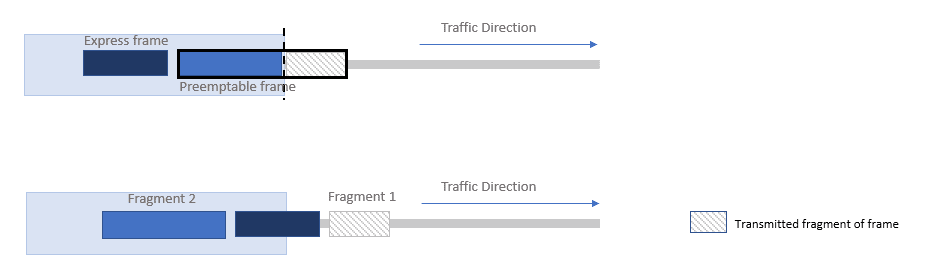
image1 1

Figure 1. The basics of frame preemption

Changes in the MAC merge sublayer (MMS) are required to determine which frames are preemptable and which ones are not, as well as how to reassemble preempted frames at every hop, as described in IEEE 802.3br. With IEEE 802.3br, the MAC layer uses the MMS to support two MAC service interfaces: express MAC (eMAC) and preemptable MAC (pMAC). As preemptable frames are fragmented and express frames are interspersed between them, frame preemption must be enabled on each hop to ensure that frames are reassembled correctly. 

Skeptics have argued about whether frame preemption is necessary, noting that the greatest impact of frame preemption on latency is seen at lower port rates and that impact decreases as port rates increase. However, testing has revealed that frame preemption saves multiple microseconds in conditions where a high fan-in of client ports compete for the same line port. Schedulers may transmit in microbursts instead of frame by frame allowing for features such as look-ahead scheduling. Frames in between the scheduler and the MAC are considered inflight frames and can negatively impact FDV. Without frame preemption, once a frame has left the scheduler, it cannot be interrupted.

Frame preemption can lower latency. But its real value comes from its ability to decrease the effects of non-fronthaul traffic on fronthaul traffic and to make network design for fronthaul traffic deterministic by minimizing latency and latency variation in a queued bridged network. This becomes crucial when operators mix fronthaul and non-fronthaul services within a C-RAN fronthaul network that offers converged multiservice access.


You Might Also Like
  • Spectrum supercycle – US opens floodgates; UK shares it out
  • Why throwing money at broadband speeds isn’t fixing America’s internet (Reader Forum)
  • Thursday (telco diary) | Telco pieces in the AI jigsaw
  • Nokia nips and tucks, and sees supercycle upside – as AI and cloud orders double
  • Only 50 of 170 digital infrastructure firms will exist in in five years (Reader Forum)
  • Wednesday (telco diary) | What AT&T and Lumen tell us about the AI fiber build-out
Share 0 LinkedinEmail
Reader Forum

Submit Reader Forum articles to [email protected]. Articles submitted to RCR Wireless News become property of RCR Wireless News and will be subject to editorial review and copy edit. Posting of submitted Reader Forum articles shall be at RCR Wireless News sole discretion.

previous post
China’s 5G infrastructure push continues to accelerate
next post
Integrated radio system design key for solving RF front end complexity in 5G smartphone (Analyst Angle)

White Papers

  • Norton eBook: The 2026 Telco Playbook

  • Enea White Paper: Why Intelligent AAA is the Swiss Army Knife of Telecom

  • CSG White Paper: Telco AI Enabler: Mediation’s Defining Role

  • Enea White Paper: Scalable Database Design for 5G and Beyond

  • Supermicro and NVIDIA Whitepaper: Powering sovereign AI at scale

Editorial Reports

  • Market Pulse Report: Telco AI in 2026 – Trends, Challenges and Opportunities

  • Nvidia Report: The State of AI in Telecommunications: 2026 Trends

  • Report: Scaling Optical Networks For The Hyperscale And AI Era

Webinars

  • Webinar: Building 6G — aligning technology, policy and purpose

  • SIMCom Webinar: Scaling your next deployment – from plastic to provisioning

  • Webinar: Rethinking the RAN as AI, cloud and openness converge

  • Webinar: Scale-Up, Scale-Out, Scale-Across – Building AI-Era Network Fabrics

  • Webinar: NTN in motion – evolving standards, expanding services

Since 1982, RCR Wireless News has been providing wireless and mobile industry news, insights, and analysis to mobile and wireless industry professionals, decision makers, policy makers, analysts and investors.

Facebook Twitter Youtube Linkedin Envelope Rss

Useful Links

  • Subscribe
  • About RCR Wireless News
  • Contact Us
  • Advertise
  • Editorial Calendar
  • Archive
  • RSS
  • Wireless News Archive
  • Subscribe
  • About RCR Wireless News
  • Contact Us
  • Advertise
  • Editorial Calendar
  • Archive
  • RSS
  • Wireless News Archive

Edtior's Picks

AT&T says its network is already built for the agentic AI wave
AT&T and Ericsson use network sensing to spot drones with ordinary 5G towers
Huawei sees Mobile AI driving new wave of uplink network investment

Latest Articles

AT&T says its network is already built for the agentic AI wave
AT&T and Ericsson use network sensing to spot drones with ordinary 5G towers
Huawei sees Mobile AI driving new wave of uplink network investment
Spectrum supercycle – US opens floodgates; UK shares it out

© 2026 RCR Wireless News All Right Reserved. Developed by Eight Hats.

Cookie Policy | Privacy Policy

RCR Wireless
  • News
  • Channels
    • 5G
    • 6G
    • BSS OSS
    • Carriers
    • IoT
    • Network Infrastructure
    • Open RAN
    • Private 5G
    • Telco AI
    • Telco Cloud
    • Test & Measurement
  • Resources
    • Reports
    • Webinars
    • White papers
    • AI Fundamentals
    • Analyst Angle
    • Editorial Calendar
    • Fundamentals
      • 5G NR Release 17
      • AI
        • Telco AI in 2025
    • Podcasts
      • Let’s Get Digital with Carrie Charles
      • Wireless Connectivity to Enable Industry 4.0 for the Middleprise
      • Well Technically…
      • Will 5G Change the World
      • Accelerating Industry 4.0 Digitalization
  • AI Infrastructure
  • Programs
  • Events
  • RCRtv
  • Advertise
  • Subscribe
RCR Wireless
  • News
  • Channels
    • 5G
    • 6G
    • BSS OSS
    • Carriers
    • IoT
    • Network Infrastructure
    • Open RAN
    • Private 5G
    • Telco AI
    • Telco Cloud
    • Test & Measurement
  • Resources
    • Reports
    • Webinars
    • White papers
    • AI Fundamentals
    • Analyst Angle
    • Editorial Calendar
    • Fundamentals
      • 5G NR Release 17
      • AI
        • Telco AI in 2025
    • Podcasts
      • Let’s Get Digital with Carrie Charles
      • Wireless Connectivity to Enable Industry 4.0 for the Middleprise
      • Well Technically…
      • Will 5G Change the World
      • Accelerating Industry 4.0 Digitalization
  • AI Infrastructure
  • Programs
  • Events
  • RCRtv
  • Advertise
  • Subscribe
@2020 - All Right Reserved. Designed and Developed by PenciDesign