

RCR Wireless
  • News
  • Channels
    • 5G
    • 6G
    • BSS OSS
    • Carriers
    • IoT
    • Network Infrastructure
    • Open RAN
    • Private 5G
    • Telco AI
    • Telco Cloud
    • Test & Measurement
  • Resources
    • Reports
    • Webinars
    • White papers
    • AI Fundamentals
    • Analyst Angle
    • Editorial Calendar
    • Fundamentals
      • 5G NR Release 17
      • AI
        • Telco AI in 2025
    • Podcasts
      • Let’s Get Digital with Carrie Charles
      • Wireless Connectivity to Enable Industry 4.0 for the Middleprise
      • Well Technically…
      • Will 5G Change the World
      • Accelerating Industry 4.0 Digitalization
  • AI Infrastructure
  • Programs
  • Events
  • RCRtv
  • Advertise
  • Subscribe
Thursday, July 9, 2026
RCR Wireless
  • News
  • Channels
    • 5G
    • 6G
    • BSS OSS
    • Carriers
    • IoT
    • Network Infrastructure
    • Open RAN
    • Private 5G
    • Telco AI
    • Telco Cloud
    • Test & Measurement
  • Resources
    • Reports
    • Webinars
    • White papers
    • AI Fundamentals
    • Analyst Angle
    • Editorial Calendar
    • Fundamentals
      • 5G NR Release 17
      • AI
        • Telco AI in 2025
    • Podcasts
      • Let’s Get Digital with Carrie Charles
      • Wireless Connectivity to Enable Industry 4.0 for the Middleprise
      • Well Technically…
      • Will 5G Change the World
      • Accelerating Industry 4.0 Digitalization
  • AI Infrastructure
  • Programs
  • Events
  • RCRtv
  • Advertise
  • Subscribe
Add RCR Wireless as a preferred source on Google
  • Qualcomm 6G Insights
  • Huawei Content Hub
  • Qualcomm – 6G Vision
  • OSS/BSS Channel
  • RCRTech Roundtable: AI Infrastructure
RCR Wireless
RCR Wireless
  • Advanced Mimo
  • Mobile mmWave
  • 5G Positioning
  • Green Networks
  • Metaverse
  • Automotive
  • Industrial and Wide-area IoT
Copyright 2021 - All Right Reserved
Home - FCC looks to divvyup 5.9 GHz band between C-V2X and unlicensed use
Connected CarsPolicySpectrum

FCC looks to divvyup 5.9 GHz band between C-V2X and unlicensed use

by Sean Kinney, Principal Analyst November 22, 2019
written by Sean Kinney, Principal Analyst November 22, 2019 Share
LinkedinEmail
Share 0LinkedinEmail
C-V2X
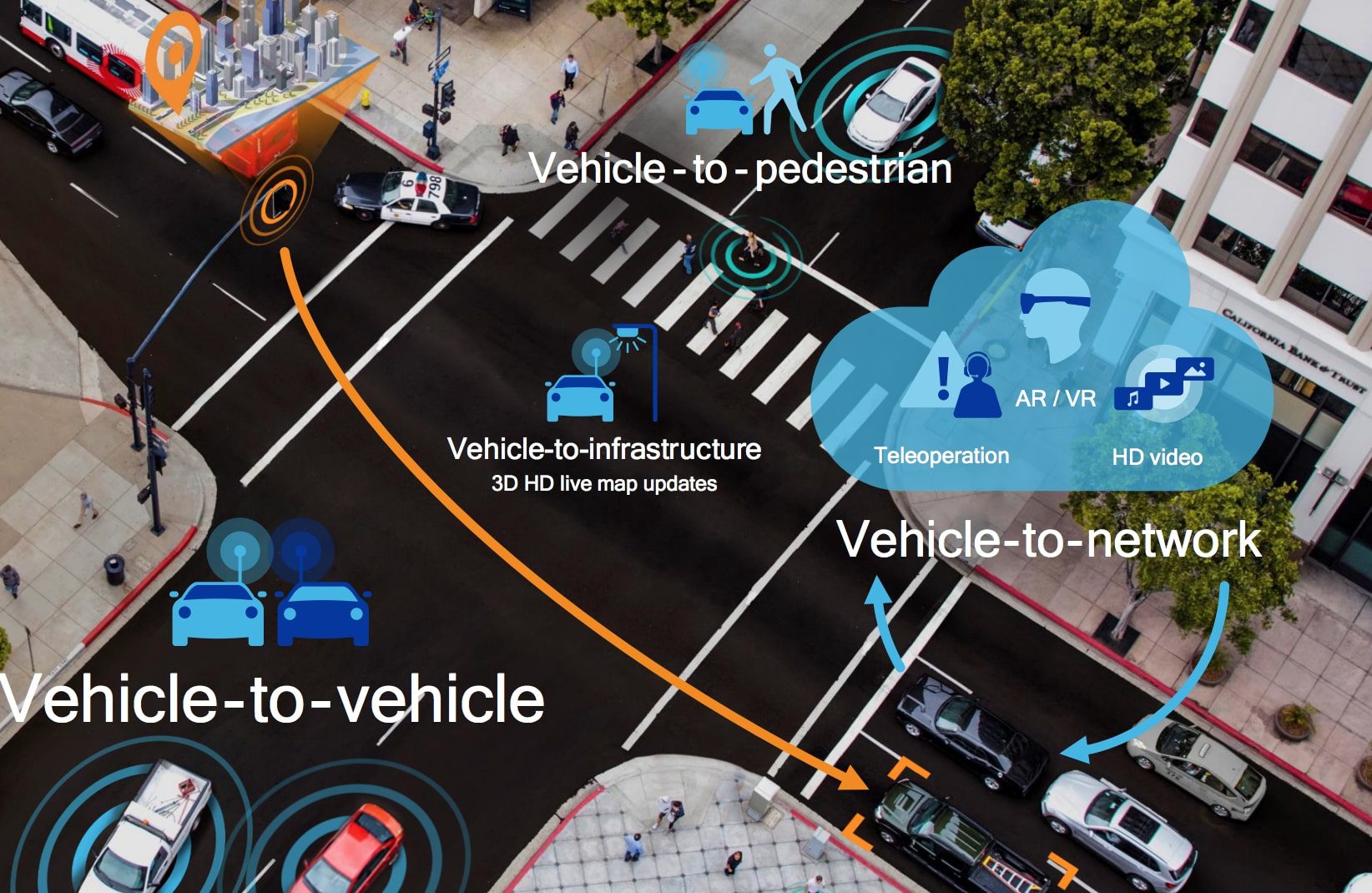
Image courtesy of Qualcomm.
178

75 megahertz of 5.9 GHz spectrum are in play 

This week U.S. Federal Communications Commission Chairman Ajit Pai laid out a plan to reallocate 75 megahertz of the 5.9 GHz band for cellular vehicle-to-everything (C-V2X) communications and for unlicensed uses like Wi-Fi. The FCC will vote on the notice of proposed rulemaking at its Dec. 12 meeting. 

A favorable vote in December–which is very likely given support for the change among a majority of FCC commissioners, would also initiate a public comment period with a particular emphasis on potentially reserving 10 megahertz of the 75 megahertz for Dedicated Short-Range (DSRC). The 5.9 GHz band was initially set aside for DSRC, based on the IEEE 802.11p standards and meant for Intelligent Transportation Systems, never really caught on to any extent with Pai calling the technology a “promise unfulfilled” in comments made on Nov. 20 at the National Union Building in Washington D.C. 

Pai’s plan calls for dividing up the 75 megahertz as follows: the lower 45 megahertz would go for unlicensed uses like Wi-Fi, the upper 20 megahertz for C-V2X, and the remaining 10 megahertz would be the subject of public comment on whether it should remain for DSRC or also go to C-V2X. It’s worth noting that the 45 megahertz that could go over to unlicensed use is adjacent to unlicensed spectrum in the 5.725 GHz to 5.850 GHz range.

On unlicensed uses like Wi-Fi, Pai also called out work to open up the 6 GHz band for unlicensed use. “We need to make more spectrum available for unlicensed use,” he said. “The FCC hears this call.” Regarding the 45 megahertz up for a vote next month, the “sub-band [is] ideally suited for unlicensed use. Thanks to its neighbor, this spectrum would punch above its weight. Having more contiguous spectrum here is essential for the larger channels needed to support innovative use cases.”

In the context of 5G, the 5 GHz and 6 GHz bands are the subject of 3GPP standardization work for what’s called New Radio-Unlicensed, or NR-U. Expected to be included in Release 16, NR-U considers operating cellular in unlicensed bands in a non-standalone mode of operation like LAA for 5G, or in a standalone mode akin to MulteFire for 5G. 

For vehicular communications, C-V2X has been embraced by the telecom ecosystem as well as automotive manufacturers. Audio, BMW, Ford, Toyota and others automakers, along with dozens of global operators, have collaborated on C-V2X testing, which is also the subject of ongoing standardization work regarding an evolutionary path from LTE to 5G NR. 

The 5G Automotive Association, a cross industry consortium, said of the FCC move, “Extensive crash avoidance testing continues to demonstrate that C-V2X technology will deliver safety benefits to the American Public. We look forward to working with all stakeholders throughout this process to ensure that spectrum regulations adequately address the needs of transportation safety.” 

Dean Brenner, Qualcomm’s senior vice president of spectrum strategy and technology, called the FCC proposal “visionary” and said in a statement it “will enable us to bring the tremendous, unmatched safety benefits from C-V2X to U.S. drivers, passengers, and pedestrians. We look forward to working with the FCC and all other stakeholders to get C-V2X on the air as quickly and broadly as possible.” 

DSRC vs. C-V2X 

DSRC is is “a two-way short-to-medium-range wireless communications capability that permits very high data transmission critical in communications-based active safety applications,” according to the U.S. Department of Transportation’s Intelligent Transportation Systems Joint Program Office, which heads up much of the research related to DSRC. 

In general, intelligent transportation systems — smarter infrastructure, as well as vehicles with new driver assistance and eventually, autonomous driving features — are seen as a way to reduce traffic accidents and fatalities, as well as improve traffic congestion and fuel efficiency.

The idea was (is?) to use DSRC for vehicle-to-vehicle and vehicle-to-infrastructure communications. The spectrum is seen as particularly useful for V2X communications because it can support very low-latency, secure transmissions, fast network acquisition and in general, the ability to handle rapid and frequent handovers that are inherent in a vehicle environment, as well as being highly robust in adverse weather conditions. ITS also notes that it is tolerant of multi-path transmission.

C-V2X considers direct communications between vehicles and infrastructure, pedestrians and other vehicles; and vehicle to network communications using traditional mobile networks deployed in licensed spectrum. The major benefits of connecting  a vehicle to everything around it are non-line-of-sight sensing, improved situational awareness and conveying intent. Connectivity also enables new types of in-vehicle infotainment experiences and integration with other connected, cloud-based services, smart home applications for instance. 

Here’s a comprehensive look at C-V2X from Qualcomm. 

As Pai put it, “C-V2X would use standard cellular protocols to provide direct communications between vehicles, and, as the name suggests, everything—including other vehicles on the road, infrastructure (like light poles), cyclists (like me), pedestrians, and road workers. C-V2X is also expected to support new, advanced applications as we transition to faster, more responsive 5G networks. And it is backed by automakers like Ford, Audi, BMW, Daimler, and Tesla.”

C-V2X is a 5G “game-changer”

Brenner, in an interview with RCR Wireless News during Mobile World Congress Los Angeles, characterized C-V2X as one of five 5G game-changers alongside dynamic spectrum sharing, NR-U, small cells and enhanced millimeter wave transmissions.

He noted that, contained in the LTE specifications, is direct communications between vehicles and vehicles and infrastructure. On DSRC, “It really has not taken off in these 20 years. DSRC has really only been deployed in the most minimal way. We went back to the drawing board. A cars just another device and we’re putting a lot of smartphone functionality in cars. Why do we put this smartphone technology, just refine it, and put it in cars. There’s now a full spec for how cars can use 4G.”

“If DSRC was the best that could be done, we wouldn’t have done it. There are inherent advantages to cellular. Using cellular we’re going to get better range and better reliability. If I’m trying to communicate with cars as they go around a curve…or at night, or in a rainstorm, or in a snowstorm….The technology that’s more reliable, that has greater range, that’s going to translate into safety.”

Here’s a video of the full interview with Brenner. 

You Might Also Like
  • How the FCC can protect IoT innovation and GPS resilience in the 900 MHz band (Reader Forum)
  • India tightens scrutiny of foreign satellite operators as Jio expands space ambitions
  • ASML’s warning for Europe – sovereignty has to move up the AI stack
  • Europe’s new digital statecraft – sovereignty goes from spectrum to cloud to identity
  • The EU AI Act delay buys time – here’s how to use it (Reader Forum)
  • China moves 6G research into field testing

Table of Contents

  • 75 megahertz of 5.9 GHz spectrum are in play 
  • DSRC vs. C-V2X 
  • C-V2X is a 5G “game-changer”
Share 0 LinkedinEmail
Sean Kinney
Sean Kinney, Principal Analyst

Sean focuses on multiple subject areas including 5G, 6G, Open RAN, hybrid cloud, edge computing, and Industry 4.0. Prior to his work at RCR, Sean studied journalism and literature at the University of Mississippi then spent six years based in Key West, Florida, working as a reporter for the Miami Herald Media Company. He currently lives in Fayetteville, Arkansas.

previous post
Radisys focused on building a ‘truly open’ network
next post
Verizon, Snapchat to develop 5G AR ads and experiences

White Papers

  • Enea White Paper: Why Intelligent AAA is the Swiss Army Knife of Telecom

  • CSG White Paper: Telco AI Enabler: Mediation’s Defining Role

  • Enea White Paper: Scalable Database Design for 5G and Beyond

  • Supermicro and NVIDIA Whitepaper: Powering sovereign AI at scale

  • VIAVI Whitepaper: RAN scenario generators and their critical role for future-proofing AI-native RAN in Advanced 5G and 6G networks

Editorial Reports

  • Report: Scaling Optical Networks For The Hyperscale And AI Era

  • Test And Measurement Market Pulse Report

  • Editorial Report: Securing telecom infrastructure for the quantum era

Webinars

  • SIMCom Webinar: Scaling your next deployment – from plastic to provisioning

  • Webinar: Rethinking the RAN as AI, cloud and openness converge

  • Webinar: Scale-Up, Scale-Out, Scale-Across – Building AI-Era Network Fabrics

  • Webinar: NTN in motion – evolving standards, expanding services

  • Webinar: Noise-Figure Measurements with RFmx and PXI VSTs

Since 1982, RCR Wireless News has been providing wireless and mobile industry news, insights, and analysis to mobile and wireless industry professionals, decision makers, policy makers, analysts and investors.

Facebook Twitter Youtube Linkedin Envelope Rss

Useful Links

  • Subscribe
  • About RCR Wireless News
  • Contact Us
  • Advertise
  • Editorial Calendar
  • Archive
  • RSS
  • Wireless News Archive
  • Subscribe
  • About RCR Wireless News
  • Contact Us
  • Advertise
  • Editorial Calendar
  • Archive
  • RSS
  • Wireless News Archive

Edtior's Picks

SIMCom Webinar: Scaling your next deployment – from plastic to provisioning
GSMA Industry Insight: Enabling seamless cellular wearable experiences
Wednesday (telco diary) | Mobility matters for physical AI

Latest Articles

SIMCom Webinar: Scaling your next deployment – from plastic to provisioning
GSMA Industry Insight: Enabling seamless cellular wearable experiences
Wednesday (telco diary) | Mobility matters for physical AI
Fifteen years on, how did that 1,000x mobile broadband forecast fare? (Analyst Angle)

© 2026 RCR Wireless News All Right Reserved. Developed by Eight Hats.

Cookie Policy | Privacy Policy

RCR Wireless
  • News
  • Channels
    • 5G
    • 6G
    • BSS OSS
    • Carriers
    • IoT
    • Network Infrastructure
    • Open RAN
    • Private 5G
    • Telco AI
    • Telco Cloud
    • Test & Measurement
  • Resources
    • Reports
    • Webinars
    • White papers
    • AI Fundamentals
    • Analyst Angle
    • Editorial Calendar
    • Fundamentals
      • 5G NR Release 17
      • AI
        • Telco AI in 2025
    • Podcasts
      • Let’s Get Digital with Carrie Charles
      • Wireless Connectivity to Enable Industry 4.0 for the Middleprise
      • Well Technically…
      • Will 5G Change the World
      • Accelerating Industry 4.0 Digitalization
  • AI Infrastructure
  • Programs
  • Events
  • RCRtv
  • Advertise
  • Subscribe
RCR Wireless
  • News
  • Channels
    • 5G
    • 6G
    • BSS OSS
    • Carriers
    • IoT
    • Network Infrastructure
    • Open RAN
    • Private 5G
    • Telco AI
    • Telco Cloud
    • Test & Measurement
  • Resources
    • Reports
    • Webinars
    • White papers
    • AI Fundamentals
    • Analyst Angle
    • Editorial Calendar
    • Fundamentals
      • 5G NR Release 17
      • AI
        • Telco AI in 2025
    • Podcasts
      • Let’s Get Digital with Carrie Charles
      • Wireless Connectivity to Enable Industry 4.0 for the Middleprise
      • Well Technically…
      • Will 5G Change the World
      • Accelerating Industry 4.0 Digitalization
  • AI Infrastructure
  • Programs
  • Events
  • RCRtv
  • Advertise
  • Subscribe
@2020 - All Right Reserved. Designed and Developed by PenciDesign
