

Dependent on location, network, subscription and the handset used, the roll-out of 5G will herald notable changes in mobile network performance. For subscribers, 5G offers the much talked-about ‘enhanced mobile broadband’ [compared to the existing ‘mobile broadband’ LTE/4G networks]. With its enhanced capabilities, 5G supports many more applications such as 8K video streaming, augmented reality (AR) and different ways of data sharing etc. Equally, for enterprise users, 5G can support a multitude of new machine type applications and uses cases, which in addition to higher data-rates also require ultra-low latency and reliability. These include vehicular safety, industrial applications, sensors and real-time control etc., operating at massive scale simultaneously, which previously was not possible.
Making it happen
But how is this possible? Well, to achieve this level of performance requires some quite significant changes in the mobile network and the resources it uses. In this article we look at one of those resources; spectrum, which is fundamental to all mobile networks. While 5G networks employ a variety of techniques to make even more efficient use of spectrum than existing networks, the highest levels of performance of 5G are predicated on the availability and use of much larger amounts of spectrum. This presents a challenge.
Today’s mobile networks’ frequency bands
Most of today’s existing mobile networks tend to operate in a variety of frequency bands in the range 600 Mega-Hertz (MHz) to 3500 MHz. The mobile industry is mature and the spectrum within the existing frequency bands has been allocated to operators for use with existing mobile technologies, such as GSM (2G) and LTE (4G). Furthermore, these frequency bands are quite narrow (e.g. The band known as ‘3GPP, Band 1’ (commonly used for WCDMA/LTE services) covers 2110 – 2170 MHz (60 MHz bandwidth)) and the spectrum allocated to each operator is obviously much less than the overall bandwidth. While this works for existing technologies and the few operators the spectrum is divided between, no bandwidth remains for use with 5G. Even if a change of use of the spectrum is permitted by the Regulator, in the example given, only 60 MHz is available, which will not deliver the expected performance across the different operators’ networks. In summary, existing bands and operator frequency allocations do not support high-performance 5G, which presents a challenge.
Overcoming the spectrum availability challenge
For this reason, the industry has looked beyond the spectrum currently used by mobile networks, to identify suitable ‘new’ spectrum. The so-called millimeter-wave (mmWave) spectrum, which has previously been underused, offers the necessary high-bandwidth. Now, telecom regulatory authorities around the world are in the process of licensing the previously underused spectrum for use with 5G networks. mmWave frequencies are those above 6 Giga-Hertz (GHz). As these extremely high frequencies are relatively underused, the available bandwidth is much greater than the crowded spectrum below 6 GHz.
What are mmWaves?
Millimeter waves, abbreviated to mmWaves are radio waves between 30 GHz and 300 GHz, which equates to wavelengths in the range 10 mm to 1 mm; they are classified as Extremely High Frequency (EHF). However, the mobile industry generally defines frequencies above 6 GHz as mmWave. It’s likely that the highest frequency spectrum to be used by mobile networks will be less than 90 GHz. At the time of writing (July 2019), the highest frequency band discussed for 5G mobile networks use is between 66 GHz and 71 GHz.
mmWaves present challenges of their own
While mmWaves help overcome the bandwidth limitations presented by the sub-6 GHz frequency bands, their very short-wave lengths pose inherent challenges for their deployment. In short, mmWave signals are not as “robust” and suffer from greater propagation path losses than their lower frequency counterparts; the net result is that they do not provide the same level of coverage.
Existing mobile network technologies can also find penetration losses difficult to overcome, dependent on a range or parameters relating to the mobile network and the physical environment, which is why many buildings already employ in-building, so-called ‘small cells’ solutions. mmWaves experience a higher signal loss when transmitting from outside to inside a building.
Even when deployed within the building, in addition to being more susceptible to propagation and penetration losses, they also offer reduced diffraction, where the signal ‘is bent’ around objects and corners, meaning that they are very much line-of-sight in nature, something that network planners must account for. This also applies to deployments in outdoor environments.
For 5G networks to successfully leverage mmWave spectrum, they must use advanced techniques and be deployed in ways that address the challenges in its practical application.
What are small cells?
Just that, small cells. Small in relation to the size of mobile cell coverage that is usually achieved using so-called macro cells – those that provide wide area coverage and are commonplace in existing networks. Small cells are not new and are used to complement many existing macro networks to improve coverage and provide a boost to capacity in places where it’s needed. Since the early days of mobile broadband, it has been the case that some 70% of all mobile data traffic originates from indoor locations; that has not changed. That said, small cells are also found in outdoor environments, where they provide increased capacity to specific locations and hot-spots. In the 5G era, small cells will deliver the expected performance in hotspot locations, both indoors and outdoors. In addition to the performance characteristics, small cell base-stations are much smaller in size than macro cell base-stations, naturally making them easier to site in busy downtown locations where space is often a premium and aesthetics are important.
Bringing it all together: mmWave and small cells
Despite its challenges, mmWave spectrum is well suited to small cells deployments and some of the challenges of operating at such high frequencies can be used to the advantage in network densification. Previously, mmWave spectrum was generally limited to point-to-point short-range and fixed wireless access type applications. Recent advances in mobile network technology covering signal processing and antennas have enabled the introduction of sophisticated techniques called beamforming and beam-tracking. These techniques permit the system to follow user devices (cell-phones) using a narrow beam from the antenna, while also mitigating any blocking (shadowing) of the signal using base-station diversity. Base-station diversity uses multiple base-stations and the rapid re-routing of signals around blocking obstacles, to help overcome such challenges.
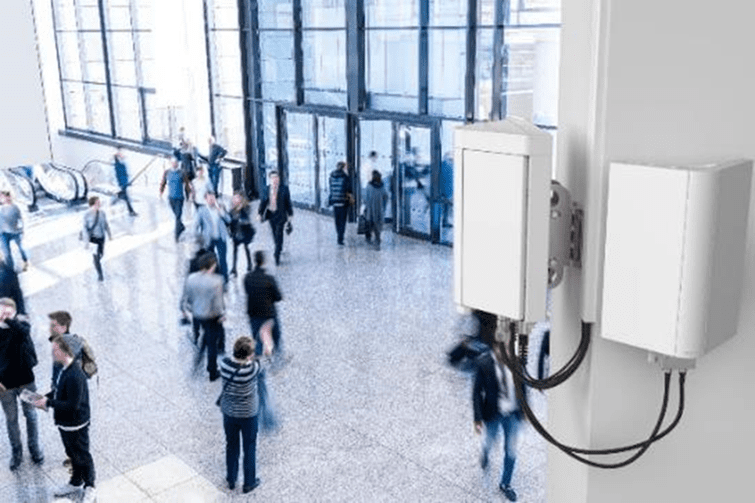
5G mmWave small cells are currently targeted to be deployed in both urban-micro outdoors, typically covering cell radii of around 100 meters and sub-urban micro outdoors (typical cell radii of around 200 meters) locations, namely on rooftops and light poles; and Indoor hotspots such as shopping malls, offices and transit hubs. These types of deployments will need to be cost effective, relatively small and with unobtrusive, easy to deploy form factors. The operating frequencies of mmWave small cells, quite literally in the millimeter wavelengths leads to smaller antenna dimensions. This characteristic permits the use of ‘integrated antennas’, in which both the antenna and other, often separate base-station components are integrated into the same assembly, resulting a highly compact solution that is readily suited to deployment in today’s city environments.
mmWave and small cells help boost network densification and 5G data rates
Macro-cells are the mainstay of existing mobile networks in which they provide wide-area coverage and mobility; this will also be the case in 5G. Small cells are already used in many of today’s WCDMA and LTE networks, in both indoor and outdoor settings. With careful network planning and optimization, small cells can be used to support deployments in mmWave, allowing operators to deliver on the continuing demand for more capacity and coverage as 5G is deployed in both indoor and outdoor environments.
Table of Contents

