

RCR Wireless
  • News
  • Channels
    • 5G
    • 6G
    • BSS OSS
    • Carriers
    • IoT
    • Network Infrastructure
    • Open RAN
    • Private 5G
    • Telco AI
    • Telco Cloud
    • Test & Measurement
  • Resources
    • Reports
    • Webinars
    • White papers
    • AI Fundamentals
    • Analyst Angle
    • Editorial Calendar
    • Fundamentals
      • 5G NR Release 17
      • AI
        • Telco AI in 2025
    • Podcasts
      • Let’s Get Digital with Carrie Charles
      • Wireless Connectivity to Enable Industry 4.0 for the Middleprise
      • Well Technically…
      • Will 5G Change the World
      • Accelerating Industry 4.0 Digitalization
  • AI Infrastructure
  • Programs
  • Events
  • RCRtv
  • Advertise
  • Subscribe
Friday, July 10, 2026
RCR Wireless
  • News
  • Channels
    • 5G
    • 6G
    • BSS OSS
    • Carriers
    • IoT
    • Network Infrastructure
    • Open RAN
    • Private 5G
    • Telco AI
    • Telco Cloud
    • Test & Measurement
  • Resources
    • Reports
    • Webinars
    • White papers
    • AI Fundamentals
    • Analyst Angle
    • Editorial Calendar
    • Fundamentals
      • 5G NR Release 17
      • AI
        • Telco AI in 2025
    • Podcasts
      • Let’s Get Digital with Carrie Charles
      • Wireless Connectivity to Enable Industry 4.0 for the Middleprise
      • Well Technically…
      • Will 5G Change the World
      • Accelerating Industry 4.0 Digitalization
  • AI Infrastructure
  • Programs
  • Events
  • RCRtv
  • Advertise
  • Subscribe
Add RCR Wireless as a preferred source on Google
  • Qualcomm 6G Insights
  • Huawei Content Hub
  • Qualcomm – 6G Vision
  • OSS/BSS Channel
  • RCRTech Roundtable: AI Infrastructure
RCR Wireless
RCR Wireless
  • Advanced Mimo
  • Mobile mmWave
  • 5G Positioning
  • Green Networks
  • Metaverse
  • Automotive
  • Industrial and Wide-area IoT
Copyright 2021 - All Right Reserved
Home - The inside story of 3GPP–Who are the unsung heroes that create the standards? (Analyst Angle)
5GAnalyst Angle

The inside story of 3GPP–Who are the unsung heroes that create the standards? (Analyst Angle)

by Prakash Sangam August 19, 2019
written by Prakash Sangam August 19, 2019 Share
LinkedinEmail
Share 0LinkedinEmail
3GPP
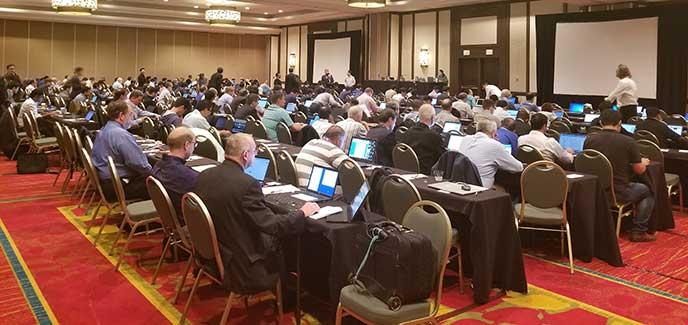
3GPP meets work on the 5G NR specification.
244

Demystifying cellular patents and licensing – Part 4 

3GPP is this mystic organization that many seem to know, but few understand it. The key players of this efficient and well-regarded organization work often without the fanfare or public recognition. But no more! As part of this article series, I go behind the doors, explore the organization, meet the hard-working people, and bare the details on its inner workings. 

Side note, if you would like to understand the cellular standardization process, please read my previous articles in the series here, here, and here. 

“3GPP is a membership-driven organization. Any company interested in telecommunications can join, through one of its SDOs (Standard Development Organizations)” said Mr. Balazs Bertenyi of Nokia Corporation, the current chair of TSG-RAN and a 3GPP veteran. “One of the important aspects of 3GPP is that a large portion of its working-level office bearers are members themselves and are elected by the other fellow members.” 

I became a proud member of 3GPP through the American SDO, ATIS, earlier this year. 

3GPP organization structure
Screen Shot 2019 08 19 at 7.19.34 AM

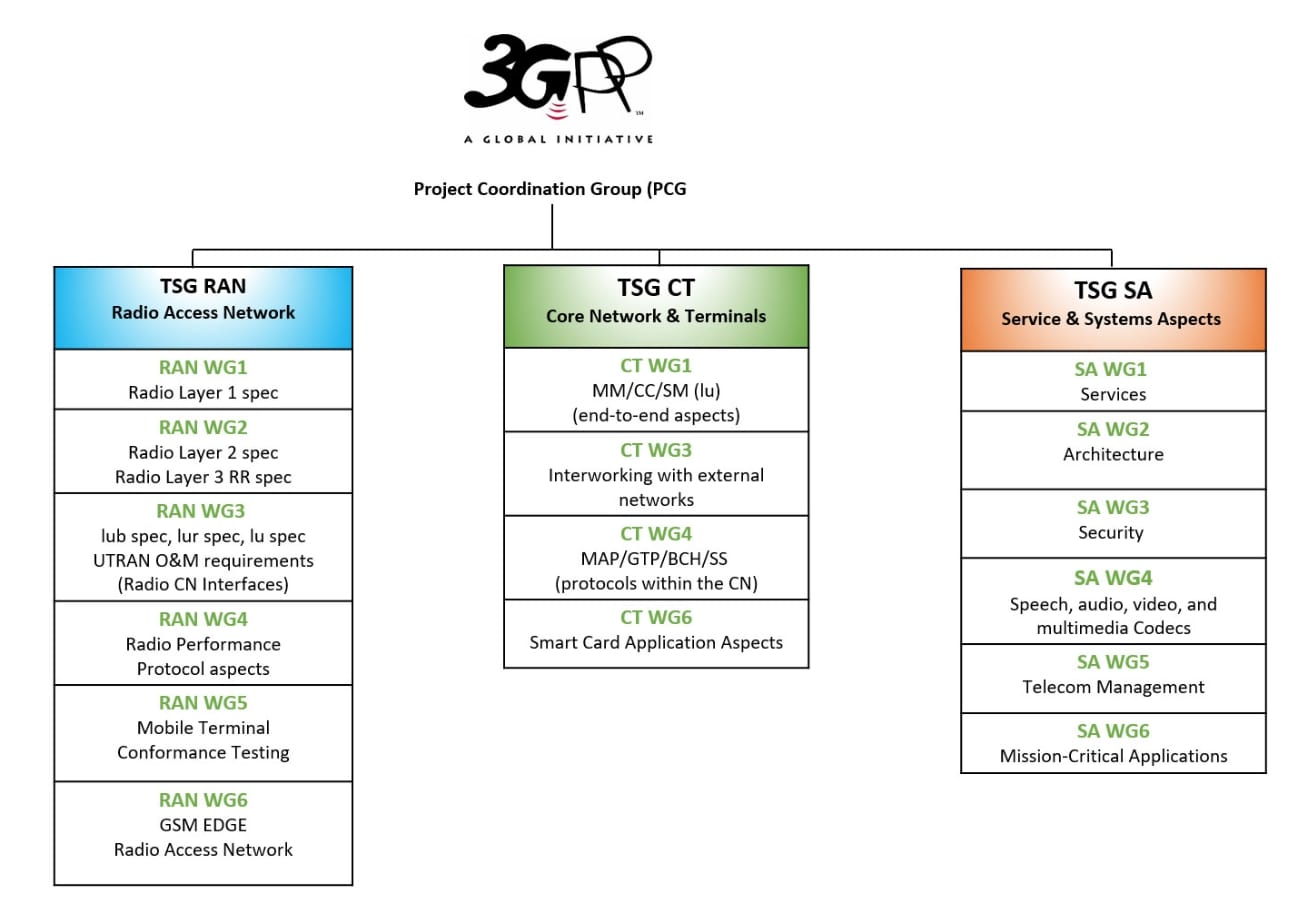
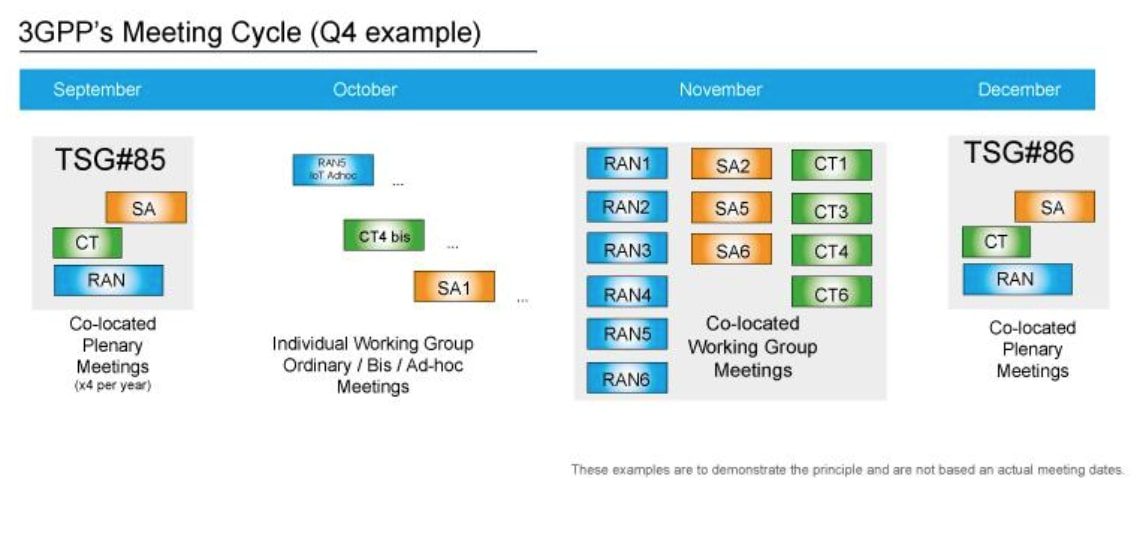
3GPP consists of three layers, as shown in the schematic: Project Coordination Group (PCG) at the top, which is more ceremonial; three Technical Specifications Groups (TSG) in the middle, each responsible for a specific part of the network; multiple Working Groups (WG) at the bottom, where the actual standards development occurs. There are many ad-hoc groups formed within each of these as well. All these groups meet regularly, as shown in the example meeting cycle.
Screen Shot 2019 08 19 at 7.23.37 AMInner workings of WGs and the unsung heroes

Let’s start with the WGs, specifically the ones that are part of TSG-RAN. Being an RF Engineer, these are closest to my heart. However, this discussion applies equally to other TSGs/WGs as well. There are six WGs within TSG-RAN, each with one chair and two vice-chairs. 

The best way to understand the group’s workings is to analyze how a fundamental 5G feature such as Scalable OFDMA would be standardized. There might be a few proposals from different member companies. The WGs have to evaluate these proposals in detail, run simulations for various scenarios to understand the performance, the pros and cons, competitive benefits, and so on. They have to decide the best solution and develop standards to implement it across the system. As evident, the WG chair must facilitate the discussion in an orderly, fair, and impartial way, and let the group reach a consensus decision. As you can imagine, this task is a combination of science and art—bringing people together through collaboration, personal relationships, and making sure they arrive at meaningful conclusions—all of this while under tremendous time pressure.

 In such a situation, WG members expect the chair to be fair, balanced, and trustworthy. Many times, the members whose companies they represent are bitter competitors with diagonally opposite interests, each trying to push their views and assertions for adoption. “It is quite a task bringing these parties together for a consensus-based agreement, in the true spirit of 3GPP,” says Mr. Bertenyi. “It requires deep technical knowledge, a lot of patience, empathy, leadership, and ability to find common ground to be a successful WG chair.” That is the reason why 3GPP’s process of electing chairpersons through the ballot, instead of nomination, makes perfect sense. 

The members of WG vote and elect somebody they trust and have respect for to lead the group. Before taking over, the employer of the newly elected officer has to formally sign a support letter declaring that the officer will get all the support from his company to successfully undertake his duties as a neutral chair. “From then on the elected officer stops being a delegate for his company, and becomes a neutral facilitator working in the interest of 3GPP and the industry” added Mr. Bertenyi. “Being a chair, I have presided over many decisions that were not supported by my company but were the best way forward in a given dispute. I have seen it often happen in WGs as well. For example, I saw Wanshi Chen, chair of RAN-1 do the same many times.” 

The WG members are primarily inventors trying to develop solutions for difficult technological challenges. The WG chairs are at the forefront of this effort, and by virtue of that, it is not uncommon for them to be prolific inventors themselves and be a party to a large number of patents. This, in fact, proves that they are worthy of the leadership role they are given. 

“It wouldn’t be untrue to say that the hard-working WG chairs are truly unsung heroes of 3GPP, and they deserve much respect and accolades,” says Mr. Bertenyi. “I am extremely proud to be working with all the chairs of our RAN WGs—Wanshi Chen of Qualcomm heading RAN-1, Richard Burbidge of Intel heading RAN-2, Gino Masini of Ericsson heading RAN-3, Xutao Zhou of Samsung heading RAN-4, Jacob John of Motorola heading RAN-5, Jurgen Hoffman of Nokia heading RAN-6.”

Responsibilities of TSG and PCG

While the WGs are workhorses, TSG sets the direction and manages resource allocation and on-time delivery of specifications.  

There are three TSGs, one each for Radio and Core Networks and a third for systems work. Each of the TSGs has a chair and three vice-chairs, all elected by the members. They provide direction based on market conditions and needs. For example, the decision to accelerate 5G timelines in 2016 was taken by the TSG-RAN. The chairs are usually accomplished experts and excellent managers. I witnessed how effectively Mr. Bertenyi conducted the recent RAN#84 plenary while being fair, cheerful, and decisive at the same time.

PCG on record is the highest decision-making body, dealing mostly with non-technical project management issues. It is chaired by the partner SDOs on a rotational basis. It provides oversight, formally adopts the TSG work items, and ratifies election results and the resources commitments.

Elections and leadership tenure

As mentioned, all the working-level 3GPP office bearers are duly elected by fellow 3GPP members in a completely transparent ballot process. The standard tenure of each office bearer is two years. But often they are reelected for a second term based on their performance, as recognition for their effective leadership. Many times members start with vice-chair position and move on to the chair level, again based on their performance.

In closing

3GPP is a truly democratic, consensus-based organization. Its structure and culture that encourages collaboration, even among bitter business rivals, has made it a premier standards development organization. The well-managed cellular technology roadmap and success of the mobile industry at large is a testament to 3GPP’s systematic and broad-based approach. 

Quick Note – I will be attending the next RAN-1 WG meeting scheduled for Aug 26- 30th 2019 in Prague, Czech Republic. So, stay tuned for the 3GPP Rel.16 and Rel.17 progress report.


You Might Also Like
  • Fifteen years on, how did that 1,000x mobile broadband forecast fare? (Analyst Angle)
  • Mimosa Networks and Viaero Wireless demonstrate scalable 5 GHz and 6 GHz fixed wireless broadband with AFC
  • What defines network performance in 5G and beyond? A CTO Perspective
  • Elisa says AI automation has cut network incidents by over 80%
  • Huawei outlines AI-centric network roadmap for telecom monetization
  • Why consolidation will reshape MDU connectivity (part 3/3) – Analyst Angle

Table of Contents

  • Demystifying cellular patents and licensing – Part 4 
  • 3GPP organization structure
  • Inner workings of WGs and the unsung heroes
  • Responsibilities of TSG and PCG
  • Elections and leadership tenure
  • In closing
Share 0 LinkedinEmail
Avatar of Prakash Sangam
Prakash Sangam

Prakash Sangam is the founder and principal at Tantra Analyst, a leading research and consultancy firm covering IP strategy, 5G, IoT, AI, as well as client and cloud computing. He has more than 20 years of wireless industry experience working for Qualcomm, Ericsson, and AT&T. A prolific writer, blogger, and speaker, Prakash enjoys analyzing technical and business challenges and transforming them into impactful strategies and persuasive messaging. He is a regular contributor to Forbes, EETimes, RCR Wireless, Medium, and other leading publications and has been on the speaking circuit for leading industry events, including Mobile World Congress, and CTIA. Prakash holds a Bachelor’s of Engineering in electronics and communications from Karnatak University in India, and a Masters of Business Administration from San Diego State University. He can be reached on twitter @MyTechMusings

previous post
Giving construction the IoT treatment could help save the planet (Reader Forum)
next post
Why is LoRaWAN better than Sigfox, NB-IoT, LTE-M? LoRaWAN provider Senet counts the ways

White Papers

  • Enea White Paper: Why Intelligent AAA is the Swiss Army Knife of Telecom

  • CSG White Paper: Telco AI Enabler: Mediation’s Defining Role

  • Enea White Paper: Scalable Database Design for 5G and Beyond

  • Supermicro and NVIDIA Whitepaper: Powering sovereign AI at scale

  • VIAVI Whitepaper: RAN scenario generators and their critical role for future-proofing AI-native RAN in Advanced 5G and 6G networks

Editorial Reports

  • Report: Scaling Optical Networks For The Hyperscale And AI Era

  • Test And Measurement Market Pulse Report

  • Editorial Report: Securing telecom infrastructure for the quantum era

Webinars

  • SIMCom Webinar: Scaling your next deployment – from plastic to provisioning

  • Webinar: Rethinking the RAN as AI, cloud and openness converge

  • Webinar: Scale-Up, Scale-Out, Scale-Across – Building AI-Era Network Fabrics

  • Webinar: NTN in motion – evolving standards, expanding services

  • Webinar: Noise-Figure Measurements with RFmx and PXI VSTs

Since 1982, RCR Wireless News has been providing wireless and mobile industry news, insights, and analysis to mobile and wireless industry professionals, decision makers, policy makers, analysts and investors.

Facebook Twitter Youtube Linkedin Envelope Rss

Useful Links

  • Subscribe
  • About RCR Wireless News
  • Contact Us
  • Advertise
  • Editorial Calendar
  • Archive
  • RSS
  • Wireless News Archive
  • Subscribe
  • About RCR Wireless News
  • Contact Us
  • Advertise
  • Editorial Calendar
  • Archive
  • RSS
  • Wireless News Archive

Edtior's Picks

NestAI and Nokia debut AI defense tech for denied battlefields
OCUDU aims to resolve the ‘last bottlenecks of proprietary software’
Optical advances won’t eliminate need for new fiber, says Dell’Oro

Latest Articles

NestAI and Nokia debut AI defense tech for denied battlefields
OCUDU aims to resolve the ‘last bottlenecks of proprietary software’
Optical advances won’t eliminate need for new fiber, says Dell’Oro
SIMCom Webinar: Scaling your next deployment – from plastic to provisioning

© 2026 RCR Wireless News All Right Reserved. Developed by Eight Hats.

Cookie Policy | Privacy Policy

RCR Wireless
  • News
  • Channels
    • 5G
    • 6G
    • BSS OSS
    • Carriers
    • IoT
    • Network Infrastructure
    • Open RAN
    • Private 5G
    • Telco AI
    • Telco Cloud
    • Test & Measurement
  • Resources
    • Reports
    • Webinars
    • White papers
    • AI Fundamentals
    • Analyst Angle
    • Editorial Calendar
    • Fundamentals
      • 5G NR Release 17
      • AI
        • Telco AI in 2025
    • Podcasts
      • Let’s Get Digital with Carrie Charles
      • Wireless Connectivity to Enable Industry 4.0 for the Middleprise
      • Well Technically…
      • Will 5G Change the World
      • Accelerating Industry 4.0 Digitalization
  • AI Infrastructure
  • Programs
  • Events
  • RCRtv
  • Advertise
  • Subscribe
RCR Wireless
  • News
  • Channels
    • 5G
    • 6G
    • BSS OSS
    • Carriers
    • IoT
    • Network Infrastructure
    • Open RAN
    • Private 5G
    • Telco AI
    • Telco Cloud
    • Test & Measurement
  • Resources
    • Reports
    • Webinars
    • White papers
    • AI Fundamentals
    • Analyst Angle
    • Editorial Calendar
    • Fundamentals
      • 5G NR Release 17
      • AI
        • Telco AI in 2025
    • Podcasts
      • Let’s Get Digital with Carrie Charles
      • Wireless Connectivity to Enable Industry 4.0 for the Middleprise
      • Well Technically…
      • Will 5G Change the World
      • Accelerating Industry 4.0 Digitalization
  • AI Infrastructure
  • Programs
  • Events
  • RCRtv
  • Advertise
  • Subscribe
@2020 - All Right Reserved. Designed and Developed by PenciDesign
