
RCR Wireless
  • News
  • Channels
    • 5G
    • 6G
    • BSS OSS
    • Carriers
    • IoT
    • Network Infrastructure
    • Open RAN
    • Private 5G
    • Telco AI
    • Telco Cloud
    • Test & Measurement
  • Resources
    • Reports
    • Webinars
    • White papers
    • AI Fundamentals
    • Analyst Angle
    • Editorial Calendar
    • Fundamentals
      • 5G NR Release 17
      • AI
        • Telco AI in 2025
    • Podcasts
      • Let’s Get Digital with Carrie Charles
      • Wireless Connectivity to Enable Industry 4.0 for the Middleprise
      • Well Technically…
      • Will 5G Change the World
      • Accelerating Industry 4.0 Digitalization
  • AI Infrastructure
  • Programs
  • Events
  • RCRtv
  • Advertise
  • Subscribe
Sunday, August 9, 2026
RCR Wireless
  • News
  • Channels
    • 5G
    • 6G
    • BSS OSS
    • Carriers
    • IoT
    • Network Infrastructure
    • Open RAN
    • Private 5G
    • Telco AI
    • Telco Cloud
    • Test & Measurement
  • Resources
    • Reports
    • Webinars
    • White papers
    • AI Fundamentals
    • Analyst Angle
    • Editorial Calendar
    • Fundamentals
      • 5G NR Release 17
      • AI
        • Telco AI in 2025
    • Podcasts
      • Let’s Get Digital with Carrie Charles
      • Wireless Connectivity to Enable Industry 4.0 for the Middleprise
      • Well Technically…
      • Will 5G Change the World
      • Accelerating Industry 4.0 Digitalization
  • AI Infrastructure
  • Programs
  • Events
  • RCRtv
  • Advertise
  • Subscribe
Add RCR Wireless as a preferred source on Google
  • Qualcomm 6G Insights
  • Huawei Content Hub
  • Qualcomm – 6G Vision
  • OSS/BSS Channel
  • RCRTech Roundtable: AI Infrastructure
RCR Wireless
RCR Wireless
  • Advanced Mimo
  • Mobile mmWave
  • 5G Positioning
  • Green Networks
  • Metaverse
  • Automotive
  • Industrial and Wide-area IoT
Copyright 2021 - All Right Reserved
Home - Is edge computing all around us right now?
5GNetwork InfrastructureTelco Cloud

Is edge computing all around us right now?

by Sean Kinney, Principal Analyst November 7, 2017
written by Sean Kinney, Principal Analyst November 7, 2017 Share
LinkedinEmail
Share 0LinkedinEmail
edge computing
Image courtesy of ActiveAether.
198

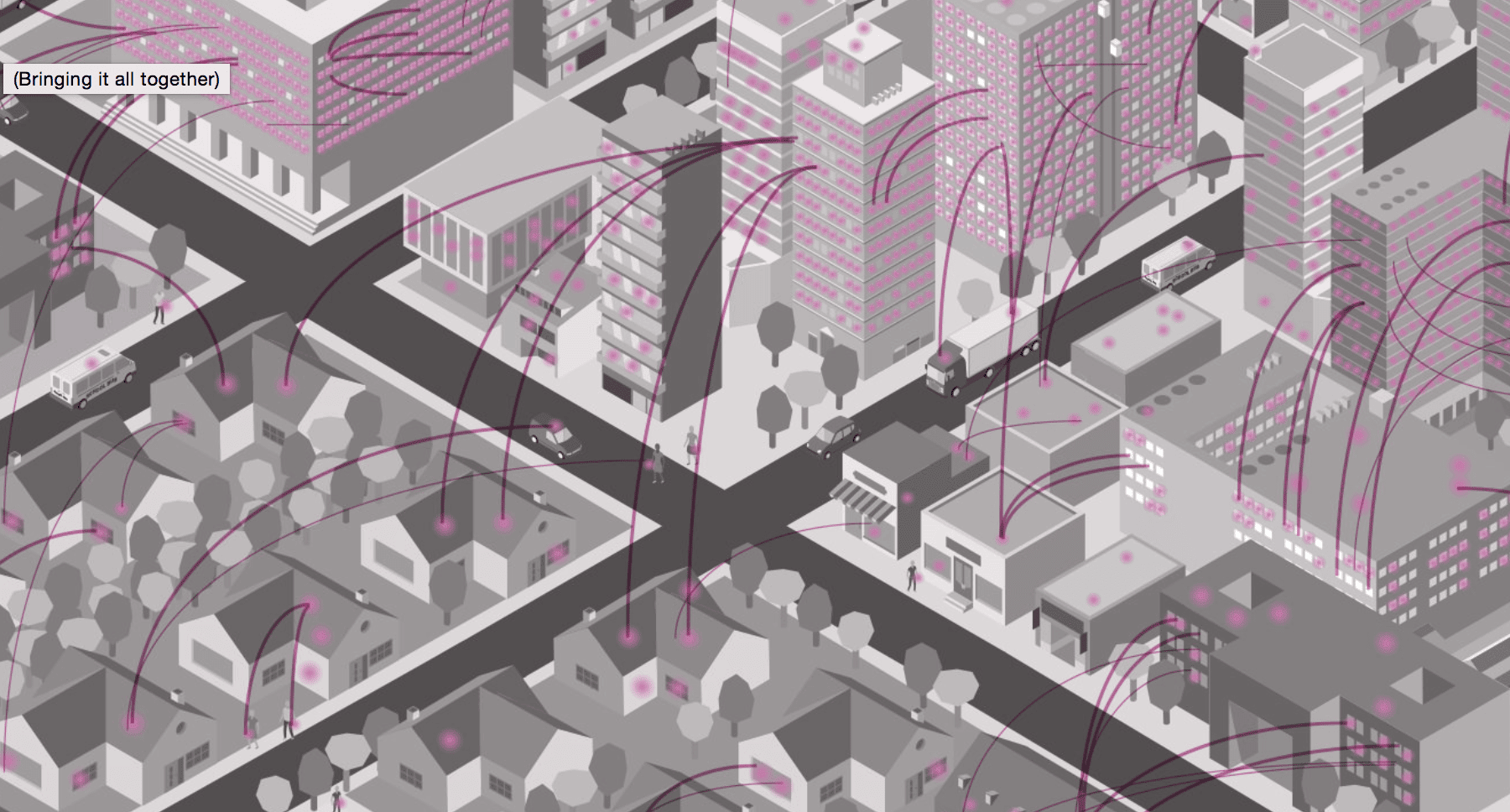
Instead of a complex infrastructure deployment, latent computing resources could be used to support the edge computing needs of the IoT

The data processing and storage needs of the internet of things (IoT) will quickly become more than our current model of centralized, data center-based can handle. Additionally, latency-sensitive use cases command geographically decentralized resources as a function of physics. Known as edge computing, this decentralization is seen as an integral part of future networks. But where does all of this equipment go?

To draw a parallel, think of the myriad problems carriers have had deploying small cells at scale. Access to power, backhaul and site acquisition, as well as varying regulatory regimes, have significantly slowed operator ambitions related to network densification. Take that same paradigm and apply it to the servers, gateways and other network equipment that comprise edge computing at scale. Where is all of this stuff supposed to live? And, following a traditional real estate-based deployment model, could it even be deployed with enough velocity to support a rapid commercialization and monetization of 5G?

Meet Robert MacInnis, CEO and co-founder of ActiveAether. This is a nascent venture, but MacInnis has already commercialized AetherStore, a software solution that combines unused space on existing networked computers to create on-premise storage. So, in an enterprise context, say you have 1,000 workstations that are used 10 hours a day. Why not use the pooled, unused storage of those terminals to solve your storage needs and save a hefty, monthly bill from Amazon Web Services? Now, extend that concept beyond storage to compute power.

“Our technology,” MacInnis told RCR Wireless News, “enables the utilization of any computational resource whether it be a laptop, a tablet, even a smart phone, or a work station PC, or a server, or indeed your cloud endpoint, or any technology in the future for that matter, to be utilized as a provider of software services.”

The Search for Extraterrestrial Intelligence (SETI) is a collective-based approach to the monitoring and analysis of electromagnetic radiation for any markets that would suggest communications from aliens. UC Berkeley runs a project called SETI at Home wherein people like you or me can download a program that runs software to analyze data collected by radio telescopes.

“That is grid computing over the top of this end user resource pool,” MacInnis explained. “It has some success, some worldwide uptake, but it’s all donation-based, it’s all people lending their computing resources for free either for fun or for some good will activity.”

In the context of the IoT, projections vary but the long view is billions of devices will be connected to global networks in the coming years. Fun and goodwill won’t support that kind of scale.

“The easiest way do that is to pay them, basically,” MacInnis said. “In order to do that, for it be a truly global marketplace for compute, we need to have a truly global currency. For that we’ve got blockchain, and the technology of blockchain has been, by and large, proven out over the last few years.”

To fulfill this need, MacInnis has developed FogCoin, which will see an Initial Coin Offering (ICO) on Nov. 30. The goal is to support decentralized access to compute resources via a transactional medium that pays people who allow access to their machines.

“We’re trying to solve the bottleneck that’s coming with the 27 million new IoT devices everyday and 20 billion by 2020 that are going to be clogging the internet with data. I think edge computing infrastructure is not only important, but with 5G coming, that it’s already in place. We’ve already got five billion end user computing devices. If you link these up to a 5G network and use ActiveAether and FogCoin to get to the correct services onto the correct machines to process data, you’re already there. That’s my vision of the 5G future.” 

MacInnis and the ActiveAether team set up a booth at the recent Fog World Congress in Santa Clara, Calif. During that same conference, Alicia Abella, AT&T vice president of advanced technology realization, gave a keynote address, which largely covered AT&T’s vision of edge computing in support of 5G. Towards the end of her talk, Abella started to go into where this infrastructure would live–central offices, customer premises, on buildings and in data centers. We need to “take more advantage of the real estate that’s already there…to get closer to where the computation needs to happen.”

Then Abella brought up blockchain.. “When you think about bitcoins, they are an asset class that is providing a way to have transaction between peers in a distributed, decentralized manner. If the edge is distributed and decentralized, can we imagine now being allow for services to develop–think of it as crowd-souring your compute power you have in your pocket and your briefcases. What if you can crowd source that? I can now access your personal device to run some kind of computation that I might need to run some application or service. I compensate you for the fact that I’ve used this” with Bitcoins.

At the end of her talk, Abella only had time to take one question. MacInnis didn’t get called but had his hand raised high.

You Might Also Like
  • Thursday (telco diary) | APAC telcos pile into AI infrastructure
  • Starlink Mobile – what is Musk actually building, beyond the chatter?
  • SpaceX targets US carriers with small-cell terrestrial rollout and mega demand from physical AI
  • Tuesday (telco diary) | More about ISAC – on battlefields and sportsfields
  • Intelligent RAN Forum 2026
  • NTN Integration Forum 2026
Share 0 LinkedinEmail
Sean Kinney
Sean Kinney, Principal Analyst

Sean focuses on multiple subject areas including 5G, 6G, Open RAN, hybrid cloud, edge computing, and Industry 4.0. Prior to his work at RCR, Sean studied journalism and literature at the University of Mississippi then spent six years based in Key West, Florida, working as a reporter for the Miami Herald Media Company. He currently lives in Fayetteville, Arkansas.

previous post
Tracking Interference in the Field From One Device Made Possible by Keysight Technologies
next post
Sigfox partner deploys LPWA network in Hong Kong

White Papers

  • Norton eBook: The 2026 Telco Playbook

  • Enea White Paper: Why Intelligent AAA is the Swiss Army Knife of Telecom

  • CSG White Paper: Telco AI Enabler: Mediation’s Defining Role

  • Enea White Paper: Scalable Database Design for 5G and Beyond

  • Supermicro and NVIDIA Whitepaper: Powering sovereign AI at scale

Editorial Reports

  • Report: NTN in motion — evolving standards, expanding services

  • Market Pulse Report: Telco AI in 2026 – Trends, Challenges and Opportunities

  • Nvidia Report: The State of AI in Telecommunications: 2026 Trends

Webinars

  • Webinar: Building 6G — aligning technology, policy and purpose

  • SIMCom Webinar: Scaling your next deployment – from plastic to provisioning

  • Webinar: Rethinking the RAN as AI, cloud and openness converge

  • Webinar: Scale-Up, Scale-Out, Scale-Across – Building AI-Era Network Fabrics

  • Webinar: NTN in motion – evolving standards, expanding services

Since 1982, RCR Wireless News has been providing wireless and mobile industry news, insights, and analysis to mobile and wireless industry professionals, decision makers, policy makers, analysts and investors.

Facebook Twitter Youtube Linkedin Envelope Rss

Useful Links

  • Subscribe
  • About RCR Wireless News
  • Contact Us
  • Advertise
  • Editorial Calendar
  • Archive
  • RSS
  • Wireless News Archive
  • Subscribe
  • About RCR Wireless News
  • Contact Us
  • Advertise
  • Editorial Calendar
  • Archive
  • RSS
  • Wireless News Archive

Edtior's Picks

The Agentic Network — NVIDIA on the full-stack path to telecom autonomy
Ericsson named sole global tech partner in SK Telecom-led AI-RAN pilot
Bell advances AIDC strategy as fiber and enterprise AI drive Q2

Latest Articles

The Agentic Network — NVIDIA on the full-stack path to telecom autonomy
Ericsson named sole global tech partner in SK Telecom-led AI-RAN pilot
Bell advances AIDC strategy as fiber and enterprise AI drive Q2
Context before control – Blue Planet maps AI architecture for autonomous networks

© 2026 RCR Wireless News All Right Reserved. Developed by Eight Hats.

Cookie Policy | Privacy Policy

RCR Wireless
  • News
  • Channels
    • 5G
    • 6G
    • BSS OSS
    • Carriers
    • IoT
    • Network Infrastructure
    • Open RAN
    • Private 5G
    • Telco AI
    • Telco Cloud
    • Test & Measurement
  • Resources
    • Reports
    • Webinars
    • White papers
    • AI Fundamentals
    • Analyst Angle
    • Editorial Calendar
    • Fundamentals
      • 5G NR Release 17
      • AI
        • Telco AI in 2025
    • Podcasts
      • Let’s Get Digital with Carrie Charles
      • Wireless Connectivity to Enable Industry 4.0 for the Middleprise
      • Well Technically…
      • Will 5G Change the World
      • Accelerating Industry 4.0 Digitalization
  • AI Infrastructure
  • Programs
  • Events
  • RCRtv
  • Advertise
  • Subscribe
RCR Wireless
  • News
  • Channels
    • 5G
    • 6G
    • BSS OSS
    • Carriers
    • IoT
    • Network Infrastructure
    • Open RAN
    • Private 5G
    • Telco AI
    • Telco Cloud
    • Test & Measurement
  • Resources
    • Reports
    • Webinars
    • White papers
    • AI Fundamentals
    • Analyst Angle
    • Editorial Calendar
    • Fundamentals
      • 5G NR Release 17
      • AI
        • Telco AI in 2025
    • Podcasts
      • Let’s Get Digital with Carrie Charles
      • Wireless Connectivity to Enable Industry 4.0 for the Middleprise
      • Well Technically…
      • Will 5G Change the World
      • Accelerating Industry 4.0 Digitalization
  • AI Infrastructure
  • Programs
  • Events
  • RCRtv
  • Advertise
  • Subscribe
@2020 - All Right Reserved. Designed and Developed by PenciDesign