

RCR Wireless
  • News
  • Channels
    • 5G
    • 6G
    • BSS OSS
    • Carriers
    • IoT
    • Network Infrastructure
    • Open RAN
    • Private 5G
    • Telco AI
    • Telco Cloud
    • Test & Measurement
  • Resources
    • Reports
    • Webinars
    • White papers
    • AI Fundamentals
    • Analyst Angle
    • Editorial Calendar
    • Fundamentals
      • 5G NR Release 17
      • AI
        • Telco AI in 2025
    • Podcasts
      • Let’s Get Digital with Carrie Charles
      • Wireless Connectivity to Enable Industry 4.0 for the Middleprise
      • Well Technically…
      • Will 5G Change the World
      • Accelerating Industry 4.0 Digitalization
  • AI Infrastructure
  • Programs
  • Events
  • RCRtv
  • Advertise
  • Subscribe
Thursday, July 23, 2026
RCR Wireless
  • News
  • Channels
    • 5G
    • 6G
    • BSS OSS
    • Carriers
    • IoT
    • Network Infrastructure
    • Open RAN
    • Private 5G
    • Telco AI
    • Telco Cloud
    • Test & Measurement
  • Resources
    • Reports
    • Webinars
    • White papers
    • AI Fundamentals
    • Analyst Angle
    • Editorial Calendar
    • Fundamentals
      • 5G NR Release 17
      • AI
        • Telco AI in 2025
    • Podcasts
      • Let’s Get Digital with Carrie Charles
      • Wireless Connectivity to Enable Industry 4.0 for the Middleprise
      • Well Technically…
      • Will 5G Change the World
      • Accelerating Industry 4.0 Digitalization
  • AI Infrastructure
  • Programs
  • Events
  • RCRtv
  • Advertise
  • Subscribe
Add RCR Wireless as a preferred source on Google
  • Qualcomm 6G Insights
  • Huawei Content Hub
  • Qualcomm – 6G Vision
  • OSS/BSS Channel
  • RCRTech Roundtable: AI Infrastructure
RCR Wireless
RCR Wireless
  • Advanced Mimo
  • Mobile mmWave
  • 5G Positioning
  • Green Networks
  • Metaverse
  • Automotive
  • Industrial and Wide-area IoT
Copyright 2021 - All Right Reserved
Home - Looking beyond fingerprint sensors: ways to enhance smartphone security
5G Developments from Qualcomm

Looking beyond fingerprint sensors: ways to enhance smartphone security

by Phillip Tracy October 13, 2016
written by Phillip Tracy October 13, 2016 Share
LinkedinEmail
Share 0LinkedinEmail
89

The Motorola Atrix 4G was the first smartphone with a fingerprint scanner for quicker, more secure log in authentication. But the security feature’s widespread use came about when Apple introduced it in its iPhone 5s back in 2013. Since then, Snapdragon-powered Android phones have made it a stock feature in premium models, trickling down to mid-range and even budget devices for a new level of smartphone security. That new feature alone has the important function of keeping our ever-increasingly important devices safe from breaches.
source: Qualcomm

source: Qualcomm

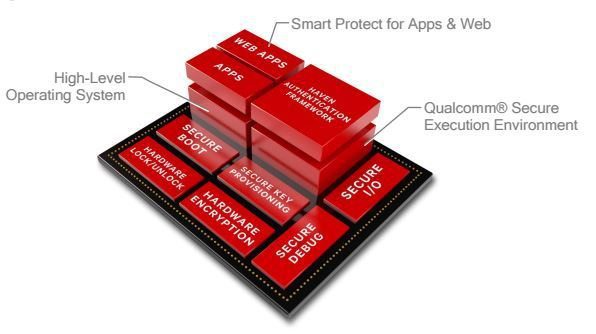
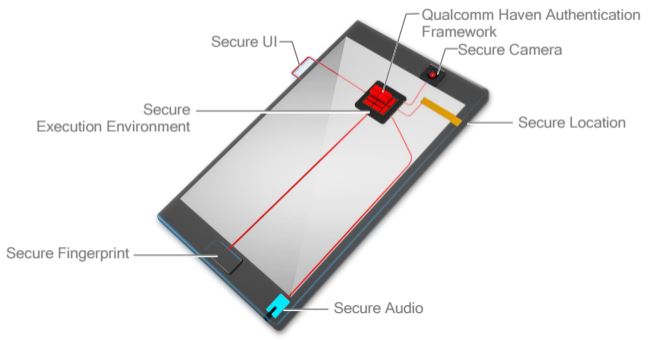
But even a fingerprint sensor is not 100% reliable, or secure. In a session on security and machine learning at the Qualcomm 4G/5G Summit, Sy Choudhury, senior director of product management at Qualcomm, spoke of alternative and complementary methods for fortifying security for connected devices. Choudhury likened security to hygiene, questioning where a company should start, and where to end, when putting resources into security.

He said the only way to make sure a device is secure is by doing three things:

  • Ensure that hardware is securely integrated into the device.
  • The authenticator code has to run in a secure execution environment.
  • Data has to be stored in a secure file system.

It is also important to make sure OEMs work with their vendors as Choudhury claims half the devices currently released are not doing all three steps.

One way Qualcomm is looking to enhance its security efforts is by encrypting on a file-by-file basis (file-level encryption or Direct Boot), instead of looking at the full disk, a necessary requirement for Android O (the OS update after 7.0 Nougat), according to Choudhury. This allows different files to be encrypted with different keys that can be unlocked independently. Google previously required mandatory full-disk encryption for devices running its 6.0 Marshmallow operating system.

Choudhury said security companies are working to trial new features and push regulations. Enterprises are another segment looking for better device security by using data from the devices to know about the state of the handset (Attestation).

Both security companies and enterprises are coming to Qualcomm to find out the state of users, answering important questions like, Is user the correct user? What is the state of device? Has there been malware on this device and when? Where is it located?

Of course, it is important that smartphones authenticate only the appropriate users wanting to access devices and the private data they house. According to Choudhury, the fingerprint sensor is a use case for securing a device, it is not an outright solution. OEMs are looking for ways to further secure devices beyond the fingerprint sensor using both software and hardware. He gave a number of up-and-coming use cases for smartphone security by making Authentication and Attestation richer:

Iris

  • The iris, a structure within your eye, has more entropy (randomness) in data than fingerprints, according to Choudhury. He claims many tech providers already have iris-based authentication, and its compact size allows for continuous security within the execution environment. One disadvantage is that iris scanning requires a second IR camera, which currently costs between three and four dollars of materials. It also has some nuances, like inaccuracy when wearing glasses. The now recalled Samsung Galaxy Note was the first commercial smartphone to use iris scanning for security.

Retina

  • Retina authentication uses the shape of the eye and its veins. According to Choudhury, only a few tech provider are working on reliable, consume level retina authentication. There is currently no bill of materials for retina as you can use a standard RGB camera. One disadvantage is that it requires high levels of computation using algorithms, making it push both the device’s CPU and GPU.

Face detection

  • Your face isn’t unique enough to be used by itself like your fingerprint. However, using the sides of your face can do much more unique authentication. One downside is that most payment companies will not accept face, as they look for something with more entropy.

Choudhury said that your eye won’t singularly replace fingerprint authentication, in fact, the goal is to use multi-factor, or strong authentication, to increase accuracy, especially for high transaction payments.


You Might Also Like
  • Empowering the connected future: 5 key technology inventions in 5G Advanced Release 18
  • Qualcomm Webinar: Wireless AI Revolution: Towards an AI-native communications system design
  • Qualcomm Webinar: What’s next with 5G mmWave – The state of global commercialization
  • Wi-Fi 7 has arrived: Here’s exactly what that means for gaming
  • Unlocking spectrum innovations for 5G Advanced and 6G to support future wireless growth
  • How 5G sidelink benefits public safety and critical communications
Share 0 LinkedinEmail
Phillip Tracy

previous post
Verizon IoT solution enables fleet tracking for landscaping company
next post
Smart cities need smart regulation (content provided by RCR and WIA)

White Papers

  • Norton eBook: The 2026 Telco Playbook

  • Enea White Paper: Why Intelligent AAA is the Swiss Army Knife of Telecom

  • CSG White Paper: Telco AI Enabler: Mediation’s Defining Role

  • Enea White Paper: Scalable Database Design for 5G and Beyond

  • Supermicro and NVIDIA Whitepaper: Powering sovereign AI at scale

Editorial Reports

  • Market Pulse Report: Telco AI in 2026 – Trends, Challenges and Opportunities

  • Nvidia Report: The State of AI in Telecommunications: 2026 Trends

  • Report: Scaling Optical Networks For The Hyperscale And AI Era

Webinars

  • Webinar: Building 6G — aligning technology, policy and purpose

  • SIMCom Webinar: Scaling your next deployment – from plastic to provisioning

  • Webinar: Rethinking the RAN as AI, cloud and openness converge

  • Webinar: Scale-Up, Scale-Out, Scale-Across – Building AI-Era Network Fabrics

  • Webinar: NTN in motion – evolving standards, expanding services

Since 1982, RCR Wireless News has been providing wireless and mobile industry news, insights, and analysis to mobile and wireless industry professionals, decision makers, policy makers, analysts and investors.

Facebook Twitter Youtube Linkedin Envelope Rss

Useful Links

  • Subscribe
  • About RCR Wireless News
  • Contact Us
  • Advertise
  • Editorial Calendar
  • Archive
  • RSS
  • Wireless News Archive
  • Subscribe
  • About RCR Wireless News
  • Contact Us
  • Advertise
  • Editorial Calendar
  • Archive
  • RSS
  • Wireless News Archive

Edtior's Picks

The Agentic Network — Rakuten Mobile on turning data into outcomes
AI drives new demands on optical networks, Ciena says
Market Pulse Report: Telco AI in 2026 – Trends, Challenges and Opportunities

Latest Articles

The Agentic Network — Rakuten Mobile on turning data into outcomes
AI drives new demands on optical networks, Ciena says
Market Pulse Report: Telco AI in 2026 – Trends, Challenges and Opportunities
Nokia nips and tucks, and sees supercycle upside – as AI and cloud orders double

© 2026 RCR Wireless News All Right Reserved. Developed by Eight Hats.

Cookie Policy | Privacy Policy

RCR Wireless
  • News
  • Channels
    • 5G
    • 6G
    • BSS OSS
    • Carriers
    • IoT
    • Network Infrastructure
    • Open RAN
    • Private 5G
    • Telco AI
    • Telco Cloud
    • Test & Measurement
  • Resources
    • Reports
    • Webinars
    • White papers
    • AI Fundamentals
    • Analyst Angle
    • Editorial Calendar
    • Fundamentals
      • 5G NR Release 17
      • AI
        • Telco AI in 2025
    • Podcasts
      • Let’s Get Digital with Carrie Charles
      • Wireless Connectivity to Enable Industry 4.0 for the Middleprise
      • Well Technically…
      • Will 5G Change the World
      • Accelerating Industry 4.0 Digitalization
  • AI Infrastructure
  • Programs
  • Events
  • RCRtv
  • Advertise
  • Subscribe
RCR Wireless
  • News
  • Channels
    • 5G
    • 6G
    • BSS OSS
    • Carriers
    • IoT
    • Network Infrastructure
    • Open RAN
    • Private 5G
    • Telco AI
    • Telco Cloud
    • Test & Measurement
  • Resources
    • Reports
    • Webinars
    • White papers
    • AI Fundamentals
    • Analyst Angle
    • Editorial Calendar
    • Fundamentals
      • 5G NR Release 17
      • AI
        • Telco AI in 2025
    • Podcasts
      • Let’s Get Digital with Carrie Charles
      • Wireless Connectivity to Enable Industry 4.0 for the Middleprise
      • Well Technically…
      • Will 5G Change the World
      • Accelerating Industry 4.0 Digitalization
  • AI Infrastructure
  • Programs
  • Events
  • RCRtv
  • Advertise
  • Subscribe
@2020 - All Right Reserved. Designed and Developed by PenciDesign