
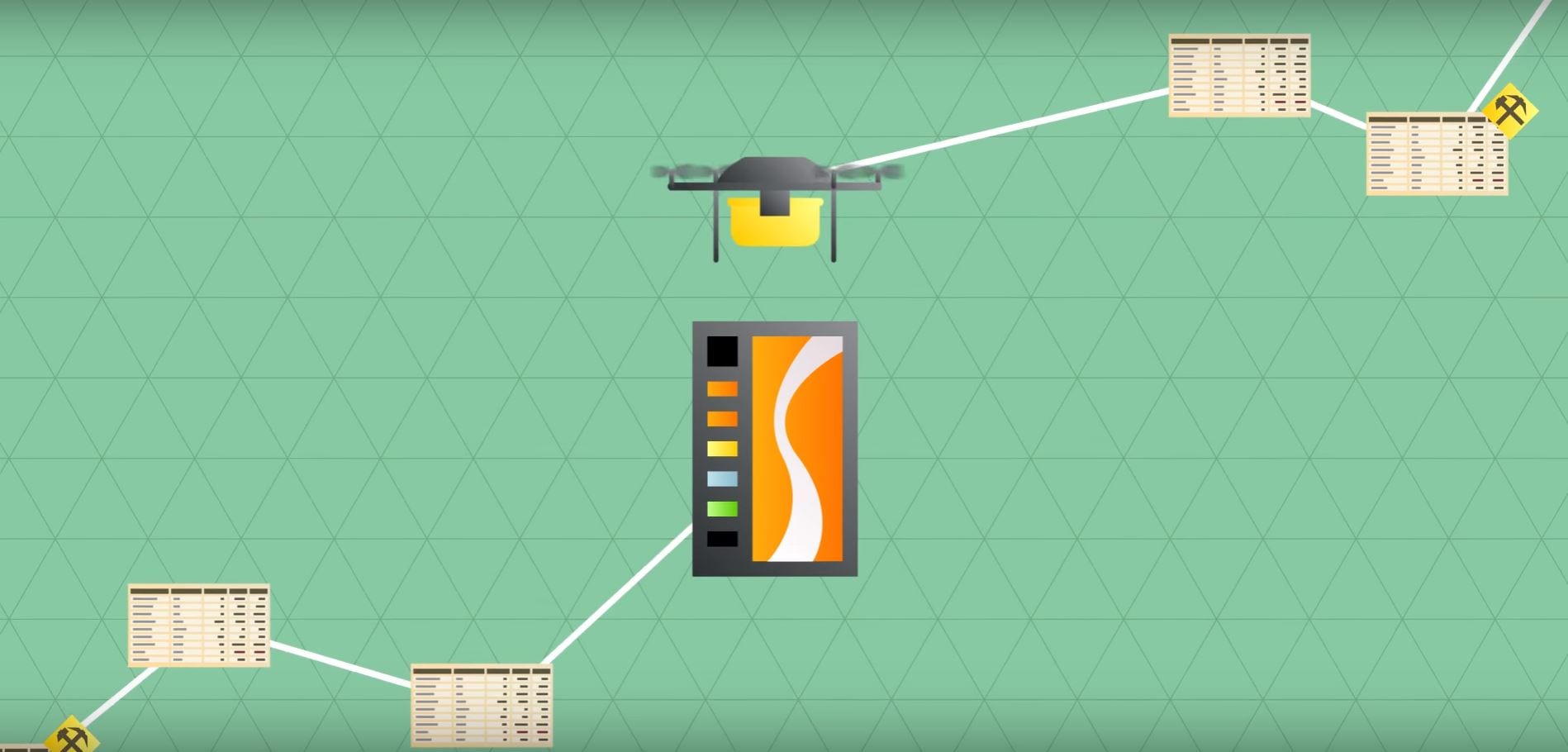
Just about everyone is familiar with Bitcoin, or at least knows of its controversial history. Behind the most popular and polarizing cryptocurrency in existence is blockchain, a framework that could revolutionize the internet of things. Blockchain differs from most IoT solutions in that it proposes a decentralized computing approach to verifying all transactions between two machines.
What is blockchain and how does it work?
Before getting into blockchain, it is important to provide some background on Bitcoin. Bitcoin enables a network of computers to maintain collective “bookkeeping” via the internet. All information is neither closed nor in the hands of one party, it is public and available in a digital ledger, which is distributed across the network.
That ledger is called the blockchain. In the blockchain, all transactions are logged, including information on the time, date, participants and amount of every transaction. A full copy of the blockchain holds a record of every transaction ever completed in a network, and every node can maintain its own copy of the ledger depending on the capability, need and preference of data. Every transaction that occurs between nodes is verified by “bitcoin miners,” or mathematical principles that maintain the ledger. They make sure all nodes in a network automatically, and continuously, agree about the current state of the ledger and every transaction in it.
If anyone attempts to corrupt a transaction, the nodes will not arrive at a consensus, and will refuse to incorporate the transaction in the blockchain. What this means is that all transactions are public, and that thousands of nodes all agree that a transaction has occurred on a specific date at a specific time. This way, everyone has access to a shared, single source of truth.
It is important to emphasize that the blockchain verifies all orders made to a ledger without any centralized authority. In so doing, the blockchain solves what security experts thought was an unsolvable problem – preventing the double spend of electronic cash without a central monetary authority, wrote Steve Wilson, vice president and principal analyst at Constellation Research.

source: IBM
To ensure every block is being kept in check, blocks in shorter chains are automatically invalidated by virtue of there being a longer chain – all participants adopt the longest available chain.
What this means for the industrial internet of things
The industrial internet of things is taking off at breakneck speeds, with billions of devices connecting to centralized networks around the world. Eventually, those networks will need to be expanded to accommodate the millions of interactions occurring between machines, or face slowdowns. Unfortunately, slowdowns in IIoT can be disastrous, especially with deployment in medical care and automobile automation. A decentralized approach proposed by blockchain replaces an internet approach with local communication between devices, increasing speed and reducing cost.

source: IBM
What makes blockchain so ready for the IIoT is that the ledger doesn’t care what a bitcoin represents. Each bitcoin is divisible into 100 million units, and is individually identifiable and programmable. The blockchain APIs also allow other data to be written into Bitcoin transactions, and thus tracked. So the suggested applications for blockchain extend far beyond payments, to the management of almost any asset imaginable. This gives users the ability to decide what each unit of a bitcoin represents – Euro cent, share in a company, a kilowatt hour of energy, digital certificate of ownership, barrels of oil, award credits or a vote during election.
Applying the blockchain concept to the world of IIoT offers fascinating possibilities, says IBM. As soon as a product completes final assembly, it can be registered by the manufacturer into a universal blockchain representing its beginning of life. Once sold, a dealer or end customer can register it to a regional blockchain (a community, city or state). When registered, the product remains a unique entity within the blockchain throughout its life. The possibility of maintaining product information, history, product revisions, warranty details and end-of-life in the blockchain means the blockchain itself can become the trusted product database.
Bitcoin gives machines the trust they otherwise don’t possess. For example, the fortified verification that makes up blockchain gives a drone delivering a package 100 percent accuracy that the package was devliered to the correct person and that the correct monetary transaction was made.
Another potential use case is implementing blockchain in vending machines. A vending machine could monitor when it is getting low on a particular product, reach out to a vendor to order more, and even make the necessary payment.
Verification from IBM and Microsoft
IBM, with the help of Samsung, has been testing blockchain technology with a proof-of-concept initiative called ADEPT, or Autonomous Decentralized Peer-to-Peer Telemetry.

source: IBM
The project successfully demonstrated four use cases using Samsung’s home products, according to IBM’s report titled Empowering the edge Practical insights on a decentralized Internet of Things:
- A W9000 Samsung washer autonomously reordering detergent (B2C)
- A W9000 Samsung washer autonomously reordering service parts (B2C)
- A W9000 Samsung washer autonomously negotiating power usage (B2C)
- Samsung Large Format Displays (LFDs) autonomously displaying advertising content (B2B).
IBM concludes that, “by empowering devices to engage autonomously in markets – both financial and nonfinancial – and react to changes in markets, the IoT will create an “Economy of Things.” Virtually every device and system can potentially become a point of transaction and economic value creation for owners and users. These capabilities will be crucial to everything from enabling sharing economies to energy efficiency and distributed storage.”

source: IBM
To perform the functions of traditional IoT solutions without a centralized broker, any decentralized approach must support three foundational functions
- Peer-to-peer messaging
- Distributed file sharing
- Autonomous device coordination
IBM’s proof-of-concept used three open source protocols to completed the tasks: Telehash for messaging, BitTorrent for file sharing and Ethereum, a blockchain protocol for autonomous device coordination functions such as device registration, authentication, proximity-based and consensus-based rules of engagement, contracts and checklists.
Microsoft has also strongly backed applications founded on blockchain, and says its Azure cloud can be used to develop, test, and deploy blockchain-based applications.
Blockchain as a Service (BaaS) provides a rapid, low-cost, low-risk, and fail-fast platform for organizations to collaborate together by experimenting with new business processes—backed by a cloud platform with the largest compliance portfolio in the industry, according to Microsoft.
Obstacles to overcome
A decentralized IoT approach like blockchain offers increased speeds, fortified authentication, while getting rid of the need to continually increase server requirements. But there are still some problems that need to be addressed before the technology can fight to replace any centralized-IoT ecosystem.

Because device’s computing power, network capabilities, storage, etc vary so much, IBM identified three broad categories of devices and defined the decentralized IoT capabilities of each.
Scalability and security are the most glaring. In fact, Bitcoin itself is trying to figure out a way to scale the blockchain model. Variability between devices could also present problems – every device has varying processing powers meaning that not all units will be able to communicate in the same ways. Also, running encryption algorithm at required speeds could present problems if under-powered IoT devices don’t have sufficient processing ability, and since the ledger is stored on each device, those devices will need some amount of storage.
And then, of course, there is security, an area where Bitcoin doesn’t necessarily have a clean track record.
“Remember what blockchain was specifically designed to do: resolve the order of entries in the ledger, in a peer-to-peer mode, without an administrator,” Wilson said. “When it comes to all-round security, blockchain falls short. It’s neither necessary nor sufficient for any enterprise security application I’ve yet seen. For instance, there is no native encryption for confidentiality; neither is there any access control for reading transactions, or writing new ones.”
Table of Contents