

RCR Wireless
  • News
  • Channels
    • 5G
    • 6G
    • BSS OSS
    • Carriers
    • IoT
    • Network Infrastructure
    • Open RAN
    • Private 5G
    • Telco AI
    • Telco Cloud
    • Test & Measurement
  • Resources
    • Reports
    • Webinars
    • White papers
    • AI Fundamentals
    • Analyst Angle
    • Editorial Calendar
    • Fundamentals
      • 5G NR Release 17
      • AI
        • Telco AI in 2025
    • Podcasts
      • Let’s Get Digital with Carrie Charles
      • Wireless Connectivity to Enable Industry 4.0 for the Middleprise
      • Well Technically…
      • Will 5G Change the World
      • Accelerating Industry 4.0 Digitalization
  • AI Infrastructure
  • Programs
  • Events
  • RCRtv
  • Advertise
  • Subscribe
Friday, July 10, 2026
RCR Wireless
  • News
  • Channels
    • 5G
    • 6G
    • BSS OSS
    • Carriers
    • IoT
    • Network Infrastructure
    • Open RAN
    • Private 5G
    • Telco AI
    • Telco Cloud
    • Test & Measurement
  • Resources
    • Reports
    • Webinars
    • White papers
    • AI Fundamentals
    • Analyst Angle
    • Editorial Calendar
    • Fundamentals
      • 5G NR Release 17
      • AI
        • Telco AI in 2025
    • Podcasts
      • Let’s Get Digital with Carrie Charles
      • Wireless Connectivity to Enable Industry 4.0 for the Middleprise
      • Well Technically…
      • Will 5G Change the World
      • Accelerating Industry 4.0 Digitalization
  • AI Infrastructure
  • Programs
  • Events
  • RCRtv
  • Advertise
  • Subscribe
Add RCR Wireless as a preferred source on Google
  • Qualcomm 6G Insights
  • Huawei Content Hub
  • Qualcomm – 6G Vision
  • OSS/BSS Channel
  • RCRTech Roundtable: AI Infrastructure
RCR Wireless
RCR Wireless
  • Advanced Mimo
  • Mobile mmWave
  • 5G Positioning
  • Green Networks
  • Metaverse
  • Automotive
  • Industrial and Wide-area IoT
Copyright 2021 - All Right Reserved
Home - Reality Check: 5G – the history of the future
5GFeaturedOpinionReality Check

Reality Check: 5G – the history of the future

by Reality Check February 24, 2015
written by Reality Check February 24, 2015 Share
LinkedinEmail
Share 0LinkedinEmail
100

Over 50% of the world’s LTE subscribers today are in the U.S. With its aggressive 4G deployments aided by the thriving application ecosystem, the U.S. was able to wrestle back the leadership mantle of the mobile world.

While consumers are enjoying their mobile broadband devices and services, chatter around “5G” has begun. Some new to the industry might be perplexed by all the talk of a technology cycle that is years away, however, if we study the 35-year-old history of the mobile industry, things are going according to plan.

All the major mobile markets have started to focus on defining 5G and the subsequent launch dates. Even Europe, which still has a long way to go before its 4G networks are built out, has set its sights on 5G to recapture the mantle and the pride of the GSM days. Korea and Japan led the world in 3G, but lost the lead of 4G to the U.S., but both countries are eager to be considered leaders in 5G. The Japanese government has set the ambitious goal of having 5G before the Tokyo Olympics in 2020 (Russia wants it by 2018 for the FIFA World cup). U.S regulators have also started to talk about 5G and the future spectrum needs as well.

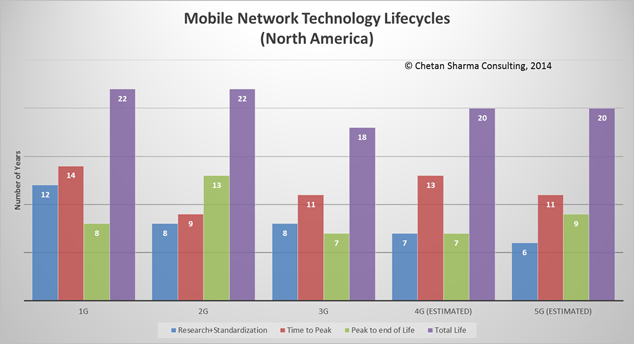
Students of the industry will observe that these network technologies evolve over a 20-year cycle. In general, the time to peak – the point at which the net revenue for the technology peaks and starts dropping – is generally slower than the time from peak to sunset. This is primarily because as the last generation is peaking, investments and rollouts of the new generation of technology start, taking away the share at a faster pace. On average, the time-to-peak has been 12 years, while the time from peak-to-sunset has been seven years. Obviously, there are shifts in different countries – depending on spectrum auctions, competitive dynamics and investment availability – but they largely follow the 20-year cycle.

For each of these 20-year cycles, the research and development, and standardization time period of seven to eight years typically precedes the first major deployments of the network technology. So overall, these are big cycles of 25 to 30 years from initial concepts to the last subscription leaving the network technology. The research work for 5G got started in 2012, and we might have our first networks by 2018-2020.
chetan 1

While there is no consensus yet on what 5G will feel and look like, there is some agreement on the types of performance criterion that are worth considering. Some of the performance goals for 5G under discussion are:

• Average speeds of between 500 megabits per second, up to 10 gigabits per second
• Less than 1 millisecond latency
• (Almost) 100% network coverage
• 1,000 times reduction in power consumption
• Very high reliability in all circumstances especially indoors (99.999%)
• Deep indoor coverage (+20dB)
• 30 times higher device density
• 10 to 100 times as many connected devices
• Significantly higher security requirements

The first four generations have largely followed the same business model, that of “metering.” The operator typically invested in assets such as spectrum, network build-out, operational capacity, etc., and then built the business based on the usage. In the early days, it was more of a linear model with a tight correlation between the usage and the cost of the usage, but as the markets matured, the past revenue curves melded into the new ones. That’s the reason voice and messaging are offered as unlimited packages designed around the data services.

Will 5G offer new business models, or explore a different relationship between usage and cost? Will consumers warm up to the idea of value-based pricing? Or, will access just become a commodity layer like water and electricity with most of the value residing in the platform and application layers? Although we have started to see the shifts, how fast will the future accelerate? Will the ecosystem landscape be markedly different from what we have in place today? These questions will be answered in due course.

Another important question for the industry will be around the control points. From 1G to 3G, the industry clearly revolved around the operators. Almost all of the revenue in the industry flowed through the operators, which controlled more than 75% of the industry revenue. However, primarily because of the broadband capability of the networks, the emergence of the powerful computing platforms in Apple’s iOS and Google’s Android, and the very powerful computing devices they power, the picture in the 4G era is changing. We estimate that the overall control of the industry revenue by the operators will shrink to 50% or lower within the next five years. That doesn’t mean operator revenue will decline in aggregate as we think they will continue to increase 1-3% globally. But, the ecosystem is growing much faster and, as such, the operator share will decline.

With 5G, it is very likely that a highly distributed application and services ecosystem will become the dominant industry source of revenue around which the rest of the mobile solar system will evolve. The tectonic shifts are likely to result in fewer mobile operators in the 5G technology era. Most countries will have two or three major operators, and since so much mobile traffic is indoors, we will see the wireline and wireless operators merge at a frantic pace in the next five years. Many will also become content owners, banks and might even operate car companies. On the flip side, we might see the rise of nontraditional mobile virtual network operators wherein vertical industry players will bundle IP access with their services.

The noise around 5G will only grow louder in 2015, but that is normal. All mobile network technology evolutions have gone through the same cycle in the last 35 years and 5G will be no different. However, the ecosystem and the control points in 2025 are likely to look markedly different from the first three cycles. Tighten your seat belts and enjoy the ride.

5G

Chetan Sharma is the president and CEO of Chetan Sharma Consulting – a global management consulting firm focused on the mobile space. Sharma has been in the industry since the 1G days and is often found working with clients around the globe on strategies applicable to 4G, 5G and beyond. He is the author of over a dozen books and over 150 papers/articles on wireless. @chetansharma.

Editor’s Note: The RCR Wireless News Reality Check section is where C-level executives and advisory firms from across the mobile industry share unique insights and experiences.


You Might Also Like
  • Mimosa Networks and Viaero Wireless demonstrate scalable 5 GHz and 6 GHz fixed wireless broadband with AFC
  • How the FCC can protect IoT innovation and GPS resilience in the 900 MHz band (Reader Forum)
  • What defines network performance in 5G and beyond? A CTO Perspective
  • Elisa says AI automation has cut network incidents by over 80%
  • Huawei outlines AI-centric network roadmap for telecom monetization
  • Indosat outlines AI Grid vision as 5G modernization targets nationwide AI-ready network
Share 0 LinkedinEmail
Reality Check

Subject to editorial review and copy edit, RCR Wireless News accepts bylined thought leadership articles, up to 1000 words, from industry executives. Submitted articles become property of RCR Wireless News. Submit articles to [email protected] with "Reality Check" in subject line.

previous post
Reality Check: Verizon’s spectrum, small cell plans; T-Mobile US’ math
next post
Reality Check: Getting consumers past device recycling barriers

White Papers

  • Enea White Paper: Why Intelligent AAA is the Swiss Army Knife of Telecom

  • CSG White Paper: Telco AI Enabler: Mediation’s Defining Role

  • Enea White Paper: Scalable Database Design for 5G and Beyond

  • Supermicro and NVIDIA Whitepaper: Powering sovereign AI at scale

  • VIAVI Whitepaper: RAN scenario generators and their critical role for future-proofing AI-native RAN in Advanced 5G and 6G networks

Editorial Reports

  • Report: Scaling Optical Networks For The Hyperscale And AI Era

  • Test And Measurement Market Pulse Report

  • Editorial Report: Securing telecom infrastructure for the quantum era

Webinars

  • SIMCom Webinar: Scaling your next deployment – from plastic to provisioning

  • Webinar: Rethinking the RAN as AI, cloud and openness converge

  • Webinar: Scale-Up, Scale-Out, Scale-Across – Building AI-Era Network Fabrics

  • Webinar: NTN in motion – evolving standards, expanding services

  • Webinar: Noise-Figure Measurements with RFmx and PXI VSTs

Since 1982, RCR Wireless News has been providing wireless and mobile industry news, insights, and analysis to mobile and wireless industry professionals, decision makers, policy makers, analysts and investors.

Facebook Twitter Youtube Linkedin Envelope Rss

Useful Links

  • Subscribe
  • About RCR Wireless News
  • Contact Us
  • Advertise
  • Editorial Calendar
  • Archive
  • RSS
  • Wireless News Archive
  • Subscribe
  • About RCR Wireless News
  • Contact Us
  • Advertise
  • Editorial Calendar
  • Archive
  • RSS
  • Wireless News Archive

Edtior's Picks

OCUDU aims to resolve the ‘last bottlenecks of proprietary software’
Optical advances won’t eliminate need for new fiber, says Dell’Oro
SIMCom Webinar: Scaling your next deployment – from plastic to provisioning

Latest Articles

OCUDU aims to resolve the ‘last bottlenecks of proprietary software’
Optical advances won’t eliminate need for new fiber, says Dell’Oro
SIMCom Webinar: Scaling your next deployment – from plastic to provisioning
GSMA Industry Insight: Enabling seamless cellular wearable experiences

© 2026 RCR Wireless News All Right Reserved. Developed by Eight Hats.

Cookie Policy | Privacy Policy

RCR Wireless
  • News
  • Channels
    • 5G
    • 6G
    • BSS OSS
    • Carriers
    • IoT
    • Network Infrastructure
    • Open RAN
    • Private 5G
    • Telco AI
    • Telco Cloud
    • Test & Measurement
  • Resources
    • Reports
    • Webinars
    • White papers
    • AI Fundamentals
    • Analyst Angle
    • Editorial Calendar
    • Fundamentals
      • 5G NR Release 17
      • AI
        • Telco AI in 2025
    • Podcasts
      • Let’s Get Digital with Carrie Charles
      • Wireless Connectivity to Enable Industry 4.0 for the Middleprise
      • Well Technically…
      • Will 5G Change the World
      • Accelerating Industry 4.0 Digitalization
  • AI Infrastructure
  • Programs
  • Events
  • RCRtv
  • Advertise
  • Subscribe
RCR Wireless
  • News
  • Channels
    • 5G
    • 6G
    • BSS OSS
    • Carriers
    • IoT
    • Network Infrastructure
    • Open RAN
    • Private 5G
    • Telco AI
    • Telco Cloud
    • Test & Measurement
  • Resources
    • Reports
    • Webinars
    • White papers
    • AI Fundamentals
    • Analyst Angle
    • Editorial Calendar
    • Fundamentals
      • 5G NR Release 17
      • AI
        • Telco AI in 2025
    • Podcasts
      • Let’s Get Digital with Carrie Charles
      • Wireless Connectivity to Enable Industry 4.0 for the Middleprise
      • Well Technically…
      • Will 5G Change the World
      • Accelerating Industry 4.0 Digitalization
  • AI Infrastructure
  • Programs
  • Events
  • RCRtv
  • Advertise
  • Subscribe
@2020 - All Right Reserved. Designed and Developed by PenciDesign