Communications service providers are currently focused on the practical use of AI to reduce opex; the next step is leveraging AI to create new revenue streams
Telecommunications infrastructure is being recast as AI infrastructure, and communications service providers (CSPs) have a significant, but timebound, opportunity to participate in the AI value chain both as consumer and seller. Increasingly sophisticated generative and agentic AI tools are being used to automate complex network processes, which reduces opex while increasing key performance indicators. And given that CSPs control performant, distributed connectivity and compute infrastructure, there’s an opportunity to provide AI-enabled services to end users seeking control, data localization, low latency and security.
The current industry-wide focus is on streamlining operations which, in and of itself, requires a structured approach to data preparation, use case identification, systems integration, validation and organizational realignment. It’s a complex process but CSPs around the world are making significant progress at the sub-domain and domain level; the longer-term goal is end-to-end, cross-domain automation.
The TM Forum consortium of CSPs, hyperscalers and solution providers uses a six-level maturity index as part of its Autonomous Networks Project. The majority of CSPs self-report at Level 1 or 2, which generalizes the degree of automation across the entire network; however, leading CSPs have validated Level 4 “highly autonomous” network processes.
China Mobile, for instance, has achieved Level 4 in its network operations centers using agentic and generative AI. This has delivered a 30% reduction in operations and maintenance manpower and a 30% reduction in fault and customer complaint mean time to repair. Rakuten Mobile has achieved Level 4 in RAN energy efficiency, which is expected to deliver a 20% increase in radio access network energy efficiency. Swisscom has achieved Level 4 in IP transport, which has led to cost savings and faster time to market for service extensions. There are many other examples.
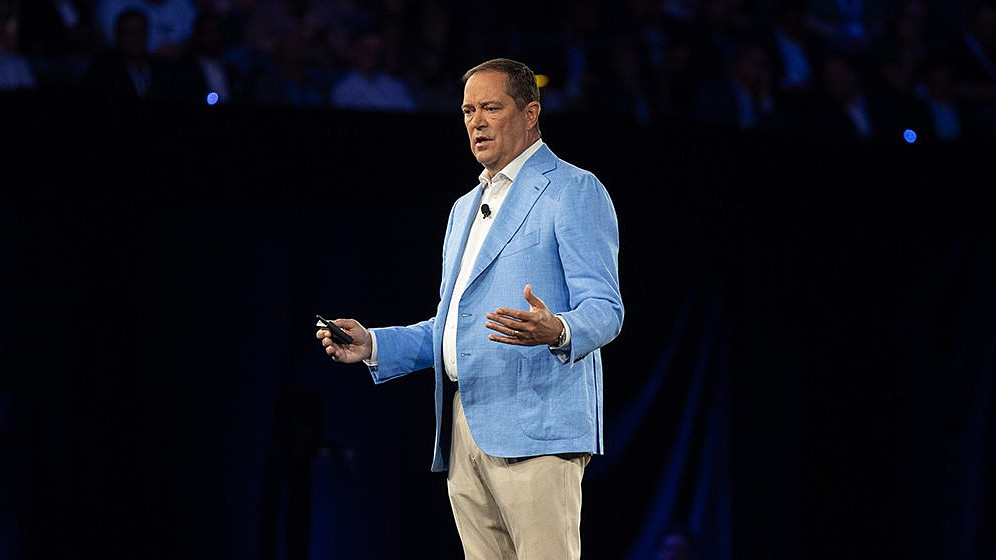
As AI for operations scales and delivers value, CSPs are now looking to leverage their core assets to deliver connectivity and AI, including sovereign AI offerings, GPU-as-a-Service and edge-based combinations of connectivity and AI compute capacity. During the recent Cisco Live event, company Chair and CEO Chuck Robbins put this shift in strategic terms. CSPs, he said, are beginning to see “a path towards what their role is in monetizing AI.” The encouraging part, according to Robbins, is that this is “not a stretch for the business model. AI requires bandwidth, distributed infrastructure, security connectivity and proximity to users, devices and data — all CSP strengths.”
To the idea of telecom infrastructure being recast as AI infrastructure, Robbins pointed to “old central offices and mini data centers all over their networks,” that can be put to new use in the AI era. The opportunity is “evolving right now,” he said.
AT&T’s Andy Forester, general manager of strategic managed services at AT&T, framed the current moment as a break from earlier edge cycles. “Edge compute has been like a use case looking for a market for the last 10 to 15 years,” he said. But now, there’s material demand from enterprises trying to determine where AI workloads should live: on-premises, near the edge, in a specialized AI data center or across a hybrid architecture.
That question—where should the thing live?—is becoming central to enterprise AI strategy. It is also a natural place for CSPs to create value, provided they avoid the mistakes of prior technology cycles. Forester was explicit on this point: MEC and private 5G were often treated as “build it and they will come” propositions. AI is different because the market is still forming, costs are real, and the right architecture depends on the use case, the data, the latency profile, the security model and the business outcome.
The rise of agentic AI raises the stakes further. As software agents begin acting on behalf of people, applications and organizations, they will create traffic patterns that are more dynamic, more distributed and more symmetrical. That makes the network not just a transport layer, but a control point for performance, security, policy and cost.
The present of AI-enabled network automation is opex reduction and operational discipline. The future is monetization.
For more information, read this blog, “The path to autonomous networking: Meet the agents helping win the AIOps race.”