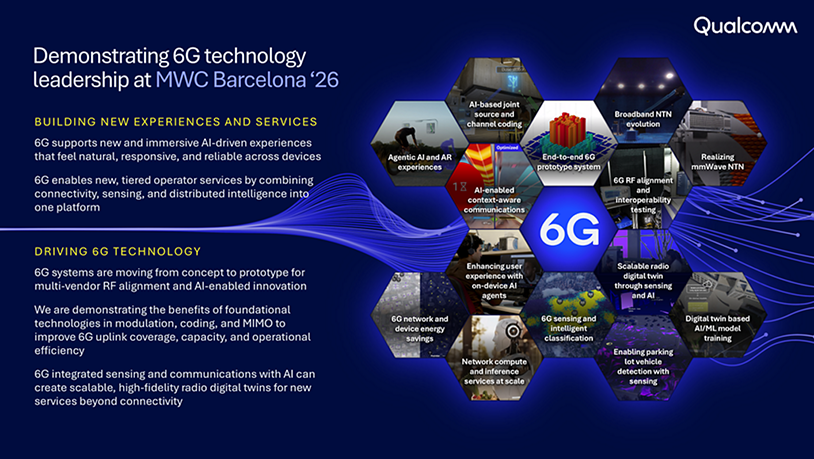
From air-interface foundations to AI-native services, Qualcomm’s MWC technology demonstrations show how they are engineering 6G for intelligence and efficiency
What you should know:
- As 3GPP’s 6G study activities define requirements, KPIs and evaluation approaches, 6G systems are moving from concept to prototype through early, multi-vendor RF alignment.
- Qualcomm Technologies is designing 6G as an AI-native system that enables new agentic AI and augmented reality experiences, not just peak data rates.
- We are expanding 6G beyond connectivity through sensing, digital twins and physical AI, creating new service opportunities.
Wireless connectivity continues to evolve as devices, services and networks become more intelligent and more essential to daily life. As AI raises expectations at the edge, future wireless systems must deliver more than higher data rates. They must improve efficiency, adapt to context and support new classes of services across devices and infrastructure.
At MWC Barcelona 2026, Qualcomm Technologies is showcasing cutting-edge wireless research that strengthens the foundations of 6G and advances AI-native experiences, sensing-enabled services and system-wide efficiency improvements. Please visit our stand at Hall 3 at Booth 3E10 to experience our latest innovations and learn more from our team.
This year’s demonstrations connect around three themes: foundational 6G evolution, AI-native design for new experiences, and sensing-enabled digital twin platforms for efficiency and new services.
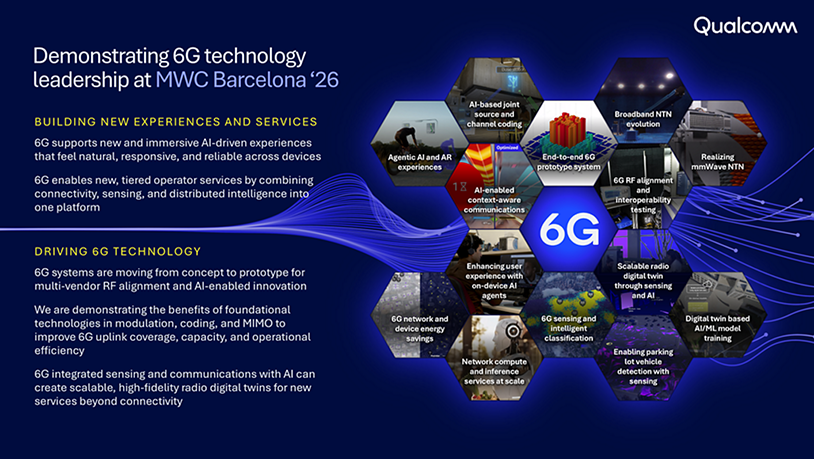
Foundational 6G evolution: new spectrum, new techniques, early ecosystem alignment
6G begins with system design choices that scale: how wide bandwidths are used, how spectral efficiency improves and how the air interface evolves toward intelligent operation.
End-to-end 6G prototype system
A central system-level prototype this year explores how new spectrum use, wide bandwidth and advanced techniques can deliver the next leap in wireless performance. The prototype showcases Giga‑MIMO, probabilistic shaping and sub‑band full duplex, combining higher spectral efficiency with improved uplink and downlink throughput. These foundational innovations point toward a smarter, more efficient 6G system designed to support future data‑intensive applications.
Watch the end-to-end 6G prototype system demo ⯈
6G RF alignment and interoperability testing
In parallel, our early ecosystem validation is advancing through 6G RF alignment and interoperability testing with leading infrastructure vendors. By validating new spectrum use, wide bandwidths and key front‑end performance targets, these tests mark an important step toward realizing the performance leap expected from 6G.
Watch the 6G RF alignment and interoperability testing demo ⯈
AI-based joint source and channel coding
A complementary proof-of-concept, developed through a collaboration between Qualcomm Technologies and Nokia Bell Labs, applies AI-based joint source‑channel coding to HARQ feedback. By learning real-world network conditions and adapting feedback signaling in real time, the system reduces errors and unnecessary retransmissions. This improves reliability and efficiency today while laying the groundwork for intelligent, AI-native air interfaces in future 6G networks.
Watch the AI-based joint source and channel coding demo ⯈
AI-native experiences and services: when connectivity adapts to intent, context and compute needs
As AI-driven applications evolve, the system challenge shifts from transporting bits to sustaining consistent experiences. This brings a new emphasis on distributed compute, collaborative communications and context-aware adaptation.
Agentic AI and AR experiences
Agentic AI and augmented reality (AR) experiences depend on continuous perception, memory and recall. Supporting these capabilities at scale requires rethinking how devices compute and connect. This demonstration shows an AI recall use case enabled by distributed compute, allowing AI workloads (such as creating and retrieving visual memories) to shift between devices and the network edge based on link conditions and power constraints. It also shows a “see‑what‑I‑see” use case enabled by collaborative communications, where multiple cellular-connected devices jointly support the experience to improve reliability, coverage and latency. Together, these capabilities illustrate how 6G can support AI-driven AR experiences while managing device constraints and network resources more effectively.
Watch the agentic AI and AR experiences demo ⯈
AI-enabled context-aware communications
A second demonstration explores AI-enabled context-aware communications for 6G, where on-device AI helps connectivity adapt to intent, context and changing conditions. The direction is toward AI-native protocols that enable more adaptive performance for applications such as video calling and cloud gaming, without relying solely on traditional QoS behavior. The goal is responsiveness aligned with the experience being delivered.
Watch the AI-enabled context-aware communications demo ⯈
Network compute and inference services at scale
As models scale in capability, future connectivity must do more than transport data. It must help intelligence flow to where it is needed. This demonstration provides insight into how 6G could enable devices to access greater AI capabilities while balancing energy, latency and reliability — by distributing intelligence across the device and edge network. It also points to new service opportunities for operators with privacy and security considerations remaining central.
Watch the network compute and inference services demo ⯈
Enhancing cellular experience with on-device AI agents
On-device agentic AI also points toward a more proactive model for continuity of experiences. This demonstration highlights how devices can combine app behavior, network conditions and environmental context to identify performance issues and apply preemptive adjustments, improving continuity in everyday mobile scenarios.
Watch the on-device AI agents cellular experience demo ⯈
Sensing plus digital twins: expanding service capability while improving efficiency
Integrated sensing and communications (ISAC) extends wireless beyond connectivity into perception. ISAC, together with AI and radio digital twins, creates a path to new service opportunities while also creating new ways for efficient wireless system operation.
6G sensing and intelligent classification
This demonstration highlights real-time detection, tracking and classification through three live scenarios: detection and classification of drones, detection of vehicles at large distances within defined zones, and precise tracking of a vehicle. The work extends mobile networks beyond connectivity to enable applications for safety, security and smart-city intelligence, and it opens the door to new services and new possibilities for digital twin platforms.
Watch the 6G sensing demo for drones and vehicles in a large area⯈
Watch 6G sensing demo for vehicle detection in a parking lot ⯈
Scalable radio digital twin through sensing and AI
Sensing-powered, high-fidelity radio digital twins can be leveraged for continuous tuning of network performance, reduction of system overheads and enablement of new classes of services. This demonstration shows how network-integrated RF sensing combined with AI enables the creation of scalable and continuously updated radio digital twins in 6G.
Watch the scalable radio digital twin demo ⯈
Digital twin-based AI/ML model training
As wireless environments become more dynamic, AI models used by devices, for example for beam prediction, must adapt efficiently without relying on large-scale over-the-air data collection. This demonstration highlights the use of synthetic training data from a radio digital twin to train environment-specific AI models at scale, reducing network traffic, energy consumption and operational overhead. Combining these pre-trained models with lightweight on-device adaptation supports a more efficient wireless AI model lifecycle direction for 6G.
Watch the digital twin-based AI/ML model training demo ⯈
6G network and device energy savings
Energy efficiency is a foundational requirement for 6G. This demonstration highlights how ISAC and radio digital twins can optimize power consumption across both network and device. By combining RF sensing and AI, digital twin aided radio modeling, and device-level low-power operating techniques such as wake-up receiver, 6G systems can dynamically adapt resources, reduce energy waste and maintain a strong experience.
Watch the 6G network and device energy savings demo ⯈
Evolving NTN: extending broadband beyond terrestrial boundaries
Non-terrestrial networks continue to evolve as the 3GPP ecosystem extends cellular connectivity beyond the reach of traditional terrestrial systems. This demonstration explores how millimeter-wave NTN can support high-performance links and increase access to reliable broadband communications.
Broadband NTN evolution
This demonstration explores how next-generation broadband access terminals can take advantage of millimeter-wave spectrum to deliver high-performance satellite connectivity. By leveraging compact hardware, advanced beam agility and real-time adaptation to a moving satellite, the results point toward robust, high-speed broadband access from a wider range of locations.
Watch the broadband mmWave NTN evolution demo ⯈
Realizing mmWave satellite-to-device NTN
This demonstration highlights how millimeter-wave NTN can expand global connectivity, enabling high-speed links for phones, vehicles, drones and more. Through demonstrations of satellite-to-handheld device communication, it shows what becomes possible when higher-frequency spectrum, advanced antenna technologies and 6G-era system design converge to deliver fast, reliable access across a broader range of conditions.
Watch the realizing mmWave NTN on the road to 6G demo ⯈
What’s next?
The momentum is real. In addition to actively participating in 3GPP studies on new capabilities and architectures for 6G, at Qualcomm Technologies we are proving how rapidly the technology can move from concept to prototype implementations through our advanced technology demonstrations. We are driving 6G progress to enable systems that are more adaptive, more intelligent and more efficient, backed by end-to-end prototypes and early interoperability work. In parallel, we are advancing AI-native experiences, sensing-enabled infrastructure and radio digital twins. We are driving this work with engineering discipline and confidence earned through multiple generations of mobile communications. Please join us at MWC Barcelona 2026 in Hall 3, Stand 3E10, and stay tuned for more insights into how connectivity, compute and AI will shape the decade ahead.
Learn more and get the latest updates
Check out our new 6G content hub
Access our YouTube playlist to watch our latest wireless technology demonstrations
Sign up for our wireless technology newsletter
Learn more about Qualcomm at MWC Barcelona
Table of Contents