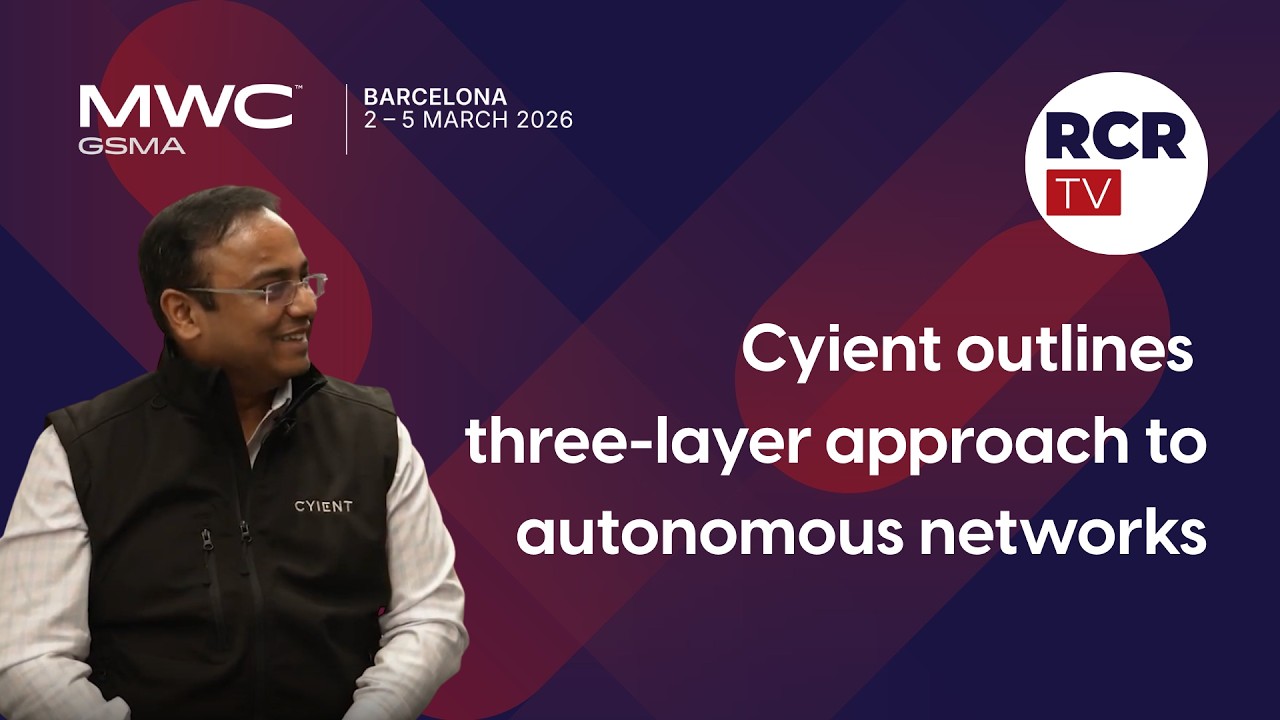
These three foundational layers connect engineering, operations and business outcomes to deliver practical autonomous networks
At MWC Barcelona 2026, discussions around artificial intelligence are shifting away from hype and toward practical implementation. For engineering and technology solutions company Cyient, that shift is reflected in a structured, three-layer strategy for advancing autonomous networks.
According to Arunav Roy, SVP and business unit head of connectivity at Cyient, the telecom industry has moved beyond early excitement about AI and is now focusing on real-world applications. “The industry has been… seeing for the last two years… a lot of AI hype,” Roy said. “In the last 12 to 18 months, the industry really has moved beyond that… It is more around what meaningful problems are we getting to solve as part of the journey.”
Cyient’s approach centers on embedding intelligence directly into the core challenges telecom operators are trying to solve. Rather than treating AI as a standalone technology initiative, the company frames autonomous networks through three foundational layers that connect engineering, operations, and business outcomes.
“Our position… is around embracing intelligence at the core of the business problems that we are trying to solve for our customers,” Roy said. “While autonomous networks is the buzzword, we are looking at it in a three-layer approach.”
The first layer focuses on intelligent network engineering, where operators design infrastructure with automation and AI capabilities built into the lifecycle from the beginning. “We have broken down the problem statement into three fundamental building blocks, which allows us to hit all of those three parameters,” Roy explained. “The core is how do you create intelligent network engineering, where we are able to address the entire value chain?”
Cyient’s engineering expertise spans both fiber and wireless networks. Roy said the company has supported more than 60 million fiber home passes globally, deployed more than 30,000 wireless sites, and optimized more than 60,000 sites worldwide. “At one point, an interesting data point is we have about 2.5 billion customers worldwide who are actually on a network which has been engineered in some shape or form by Cyient,” Roy said. “So, we understand the entire value chain.”
The second layer centers on operational transformation, where AI-driven tools help automate network management and improve operational metrics. “How do you then build the operational layer or the technology layer, which is the autonomous network modernization framework?” Roy said.
Cyient is building this layer through its Vismon platform, which includes tools such as a planner for automated network planning and design, as well as suites of rApps and xApps that integrate with service management and orchestration (SMO) platforms. “We are able to design it at a fundamental level which is more effective. And then really take it to the next level where we are now creating an ecosystem for autonomous networks where we are one vendor agnostic creating an interoperability ecosystem for our partners to come for working with different vendors to bring a solution on top,” Roy explained.
The final layer focuses on business outcomes, ensuring that operational efficiencies translate into measurable value for operators and their customers. “And then on top of that, how do you bring the cognitive layer ecosystem together, which allows us to hit the business metrics that really the customers are looking for as part of the autonomous networks ecosystem?” Roy said.
He noted that many telecom operators are still working to fully monetize their 5G investments, even as AI-driven network automation improves efficiency. “For the very first time in this industry, we are also seeing that people really are saying that, okay, we have invested a lot on 5G. Can we do more on monetization?” he said.
Ultimately, Roy emphasized that the industry’s challenge is not whether autonomous networks will arrive, but how quickly operators can turn emerging technologies into practical solutions. “I think the most important thing is how do we make it practical? How do we make it realistic?” he said. “You can’t solve all the problems in one go.”
| To know more on Cyient’s Intelligent Network Modernization playbook for Telcos, please click here. |