

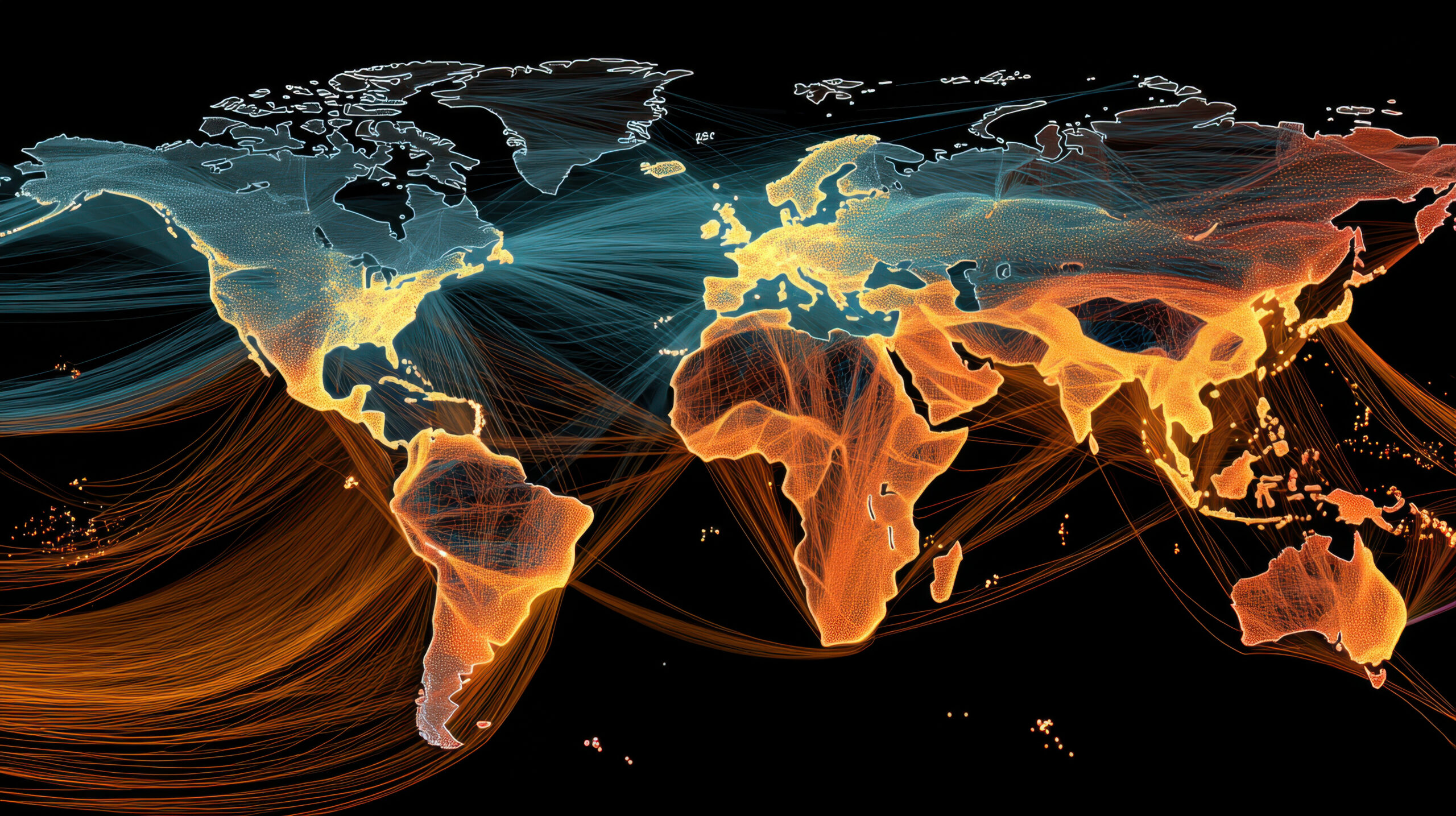
Nearly all international internet traffic – from cloud workloads to streaming video – voyages along a handful of submarine fibre-optic cable highways. These undersea trunks connect continents, power the internet, and underpin the so-called AI ‘supercycle’ – they also make terrestrial cross-border links look like country tracks.
In sum – what to know:
Sub-sea thoroughfares – transatlantic, transpacific, Africa–Europe, and intra-Asia subsea links carry hundreds of terabits per second, dwarfing terrestrial routes.
Land-based linkages – all terrestrial cross-border routes combined account for less than one percent of global internet traffic, making them a rounding error in comparison.
Money rules, not maps – data is routed through major ‘port’ exchanges, where hyperscalers and carriers interconnect and funnel it onto the submarine backbone.
So this article started as a primer about sub-sea fibre-optic cable – what it is, who makes it, who manages it, how it is changing – but got side-tracked by untangling a single statistic, which is, at once, both familiar, often quoted by the subsea industry, and also remarkable: that 99 percent of the world’s internet / data traffic flows on these subsea systems. Think about that; because, on a first pass, it sounds mad. It implies that all cross-border data flows within continental Europe, between neighbouring Asian states, across the Americas (etc) amount to less than one per cent of global traffic. It feels wrong, right? That is until you examine how the global internet works.
Because in the global internet, a small number of intercontinental routes carry overwhelmingly-more data than all regional terrestrial border-routes combined. Consider the biggest corridors: the transatlantic links between the US and Europe; the transpacific routes between the US and East Asia; the high-capacity ring between Japan, Korea, Hong Kong, and Singapore; the Europe-Asia systems via the Indian Ocean; and the Africa-Europe connections through the Mediterranean. These cables, and the hyperscale cloud and content platforms that ride on them, move breathtaking amounts of data – hundreds of terabits per second per system, with multiple systems laid in parallel.
By comparison, the terrestrial cross-border fibre links inside Europe, or Asia, or the Americas are minuscule. A German-French border crossing might see traffic peaks of a few terabits per second. Major submarine trunk routes – like MAREA (between the US and Spain; owned by Microsoft, Meta, Telxius), JUPITER (between the US, Japan, the Philippines; owned by Google, plus others), or 2Africa (a ring around Africa, connecting EMEA; owned by Meta, MTN, Vodafone, Orange) – moves hundreds of terabits per second. In pure arithmetic terms, one large subsea cable can out-carry the entire terrestrial cross-border infrastructure of a continent. With its eyes closed, to rob a phrase.
Which is why the statistic holds, and gets quoted. Terrestrial-continental cable infrastructure knits together cross-border flows, of course. But even when you add together every such terrestrial cross-border route – Germany-France, Poland-Germany, Italy-Austria, Thailand-Cambodia, US-Canada, and all the rest – the combined total is still tiny relative to this handful of giant sub-oceanic pathways. The imbalance is primarily a product of internet architecture: global traffic is concentrated on a handful of high-capacity submarine routes connecting the major data hubs. The biggest data flows are not between intern-continental country neighbours, but between hubs and whole continents.
The US-Europe and US-Asia subsea routes account for a giant share of all global international traffic, just on their own. Add intra-Asia subsea flows between major coastal hubs, plus the Europe-Asia corridors, and Africa’s dependence on Mediterranean landing stations, and well over 90 percent of global international capacity is accounted for. This is before you even consider a single land border.
It’s also a consequence of how operators route traffic, of course. Even in regions with extensive terrestrial systems – such as Europe, notably – networks are built to funnel data toward major coastal exchanges like London (a major landing point for transatlantic subsea cables, and a centre for hyperscaler cloud data centres), Amsterdam (a key peering hub between northern Europe and cables from the UK, US, and Scandinavia, with a dense carrier-neutral data centre ecosystem), Marseille (a southern European landing hub and gateway for the Mediterranean, Africa, and the Middle East), and Frankfurt (a central European backbone hub connecting multiple terrestrial and subsea routes).
These are the nodes where hyperscalers, content delivery networks (CDNs), and ‘tier-one’ carriers interconnect, and where cost and performance are optimised. The simplest and cheapest path in network terms is not necessarily the most direct one. In the end, the internet follows economics, not maps. Just to close, here: there is a useful analogy in freight logistics, where the global industry is dominated by container shipping between a small number of major ports, while cross-border trucking (everywhere on the roads) only accounts for a sliver of global tonnage. The same is true of data: regional terrestrial flows matter locally, but they are a rounding error next to the megaflows under the oceans.

