

China Mobile International is positioning itself as an enabler of cross-border private 5G deployments, helping Chinese enterprises build advanced industrial networks overseas while supporting global manufacturers entering China. The firm explains how China’s operator-led model, vast ecosystem, and turnkey delivery approach are reshaping private 5G adoption across global supply chains.
Leading 5G – China leads the world with around 64,000 private 5G networks, driven by regulatory alignment and deep operator–ecosystem collaboration.
Exporting 5G – Chinese enterprises expanding overseas require turnkey private 5G, with CMI partnering local carriers and global vendors to replicate China’s model.
Importing 5G – For international firms entering China, CMI works alongside their existing SIs, telcos, and vendors, offering local expertise and a unified application platform.
China’s private 5G market is the world’s largest and most advanced, yet much of its progress remains obscured (or else just missed in the trade press) from view outside the country. That makes the perspective of China Mobile International (CMI) – the global arm of China Mobile, the world’s biggest mobile operator and China’s leading private 5G provider – particularly significant as industrial enterprises seek to deploy private networks across borders.
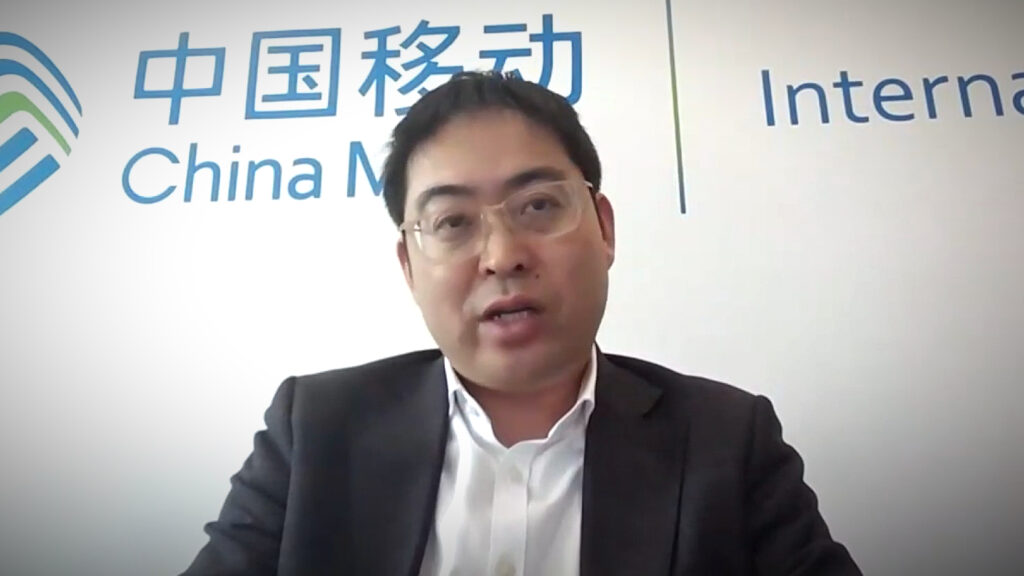
CMI essentially operates as a global systems integration business, hooked into its big parent group in China – much like the business divisions of any tier-one operator. Speaking at Industrial Wireless Forum last week, Sam Bao, deputy head and director of technical services for the firm in the UK (also representing its work in mainland Europe), explains: “We are responsible for all the international business, including support for Chinese businesses settling abroad as well as for international businesses going into China.”
As such, he has a unique global view of this market. China’s scale is unmatched, of course, driven by tight alignment between policymakers, major mobile operators, and an increasingly mature industrial ecosystem. “China leads the private 5G [market for] deployments… There are about 64,000 private 5G networks [in the country], which is the result of a combination of regulatory and industry efforts,” he explains.
“The regulatory support [has] created the ecosystem… and [the industry support] has seen a big effort to push [the solution]. We have worked closely with ecosystem partners, including application partners and equipment vendors, to build the whole ecosystem together. That has been key.” The structure of the domestic market is also important, skewing influence towards the carrier community in a way that it, perhaps, doesn’t in certain western markets.
Lessons from the China experience
It is operator-led, of course; enterprises do not have any regulatory recourse to access their own private industrial spectrum licences – as happens in the US, via the shared CBRS band, and in Germany, the UK, and certain other European Union member states via regulatory interventions to liberalise various chunks of mid-band spectrum for big domestic industrial operations. In China, mobile operators hold all the cards so far as spectrum goes.
The prime deployment models for private 5G are either network slicing, as a light-touch system where the enterprise gets a dedicated ‘slice’ of the operator’s public 5G network to run their more-critical data flows, or a hybrid or mixed private 5G setup, where some key functions (especially the user-plane) are deployed locally, on the enterprise site or at the network edge, sometimes with dedicated RAN, while other parts remain shared on the public 5G network.
The so-called ‘hybrid’ model, the dominant design for private 5G in China, can be pulled any number of ways, essentially, and is engaged variously in global markets where private/shared enterprise spectrum is not available, and also in markets where it is – notably, where operators are starting to roll out public 5G Advanced infrastructure, also with more sophisticated slicing mechanism. (See T-Mobile’s recent announcements in the US.)
Bao argues that, contrary to assumptions (press reporting) in Europe or North America, a hybrid-style operator approach can scale internationally. “Carriers lead the private 5G market in China because of the spectrum licensing… Not many countries have industrial spectrum; most rely on carriers to enable the deployment. The model can be mimicked in many countries – even where industrial spectrum is available, and the carriers steer the play.”
The argument goes that there is enough autonomy, control, and reliability in a hybrid setup, even for mission-critical Industry 4.0 operations, plus service and integration around spectrum, SIM, device, and backhaul management. The whole ecosystem in China is “turnkey”, and standardized, argues Bao – and there are lessons for the global market, as it engages with the model in China, and increasingly replicates it abroad.
Exporting and importing industrial 5G
For Chinese firms looking to build or equip their industrial operations abroad, private 5G has effectively become standard infrastructure, reckons Bao. For many, CMI is the natural partner, he argues. “It is a big trend; when they set up plants or ports or mining facilities [outside China], they will typically require private 5G…. We have a relationship with them in China already [so] we are a trusted partner when they want to enable private 5G abroad.”
In the context of a highly fragmented industrial supply market, he presents the idea of a “turnkey solution”. The logic is plain; enterprises setting up in new regions would prefer to avoid the complexity of building unfamiliar local supply chains from scratch in new markets – “which will potentially delay things”, he says. “In many cases, we would work with the local carriers, and bring our ecosystem partners together to supply and build the 5G applications for them.”
CMI caters for the opposite industrial workflow, as well. International firms looking to modernise operations in China need local partners, too – possibly even more so, given regulatory, cultural, even language barriers. “[In those scenarios] we are more than happy to work with their existing partners in the 5G space – the telcos and integrators they already work with. Actually, we prefer to work with them in China to help the enterprises to build their facilities.”
He adds: “It is a similar model to the other way; these enterprises have relationships with operators and integrators already, and they should utilize them. We have relationships with the big telcos as well. So the model works well.” It is about collaboration and teamwork, as the Industry 4.0 market likes to preach suddenly. But its open-handedness comes from its confidence, as well, that China Mobile is a primary conduit for enterprises on the ground in China.
Asked why an enterprise would choose CMI instead of a global system integrator or multinational telecoms operator, Bao is direct. “China Mobile has deployed more private 5G networks in China than anyone. So we have the best experience, and we have close relationships with the big (non-China based) telcos and integrators as well. And so we [are well positioned] to help their business expansion [into China].”
Vendor-neutral and application-driven
Despite perceptions that China’s private 5G ecosystem is dominated by Chinese vendors, Bao emphasizes that CMI runs an open procurement model, which is ultimately governed by enterprises’ own preferences and biases. “We are vendor agnostic. When we procure equipment in China, we have all the major telco equipment vendors – so Huawei obviously, but Ericsson and Nokia, as well. They are all on the plate… when we deploy private 5G in China.”
He goes on: “The enterprise may already work with a particular vendor in Europe, say, and prefer to keep the same vendor in China. We’ve seen that a lot, and we are happy to do that. That is what we do: we support the enterprises requirements and preferences.” What about smaller specialist vendors – which are numerous in the private 5G space, if not the public 5G space?
Bao responds: “There are plenty of smaller vendors in China, which often specialize in certain areas only – where the others put the whole solution together. We are open to those vendors in the international market, certainly; maybe less so in China, where they need to be on our short list, so to speak.” More important, perhaps, is the application ecosystem layered on top of the network. “The network alone is not [the whole story] for the end customer,” he says.
“The application is the key. That is what the customer sees. We work with partners to develop applications for different verticals.” Indeed, China Mobile International has a private 5G platform to link horizontal network functions and vertical system applications as a unified service and management model – and as the basis for its broader turnkey proposition. But even as CMI works to standardize the network architecture, every deployment is different.
Bao says: “We are trying to standardize it in terms of the network architecture… [but] all the industries are different, and all their requirements are different… The applications are highly customized because different enterprises in different industries have their different requirements – even different enterprises in the same industry may choose different applications with different features from different vendors.”
For CMI, the scalability comes in the modularity at the platform level and the flexibility at the application layer. “For Chinese enterprises going abroad, we are trying to do a turnkey solution. And we are working with telco ecosystem vendors for international businesses going to China, and open our local ecosystem to them so they have more and better choices,” he says.

