


RCR Wireless
  • News
  • Channels
    • 5G
    • 6G
    • BSS OSS
    • Carriers
    • IoT
    • Network Infrastructure
    • Open RAN
    • Private 5G
    • Telco AI
    • Telco Cloud
    • Test & Measurement
  • Resources
    • Reports
    • Webinars
    • White papers
    • AI Fundamentals
    • Analyst Angle
    • Editorial Calendar
    • Fundamentals
      • 5G NR Release 17
      • AI
        • Telco AI in 2025
    • Podcasts
      • Let’s Get Digital with Carrie Charles
      • Wireless Connectivity to Enable Industry 4.0 for the Middleprise
      • Well Technically…
      • Will 5G Change the World
      • Accelerating Industry 4.0 Digitalization
  • AI Infrastructure
  • Programs
  • Events
  • RCRtv
  • Advertise
  • Subscribe
Saturday, July 18, 2026
RCR Wireless
  • News
  • Channels
    • 5G
    • 6G
    • BSS OSS
    • Carriers
    • IoT
    • Network Infrastructure
    • Open RAN
    • Private 5G
    • Telco AI
    • Telco Cloud
    • Test & Measurement
  • Resources
    • Reports
    • Webinars
    • White papers
    • AI Fundamentals
    • Analyst Angle
    • Editorial Calendar
    • Fundamentals
      • 5G NR Release 17
      • AI
        • Telco AI in 2025
    • Podcasts
      • Let’s Get Digital with Carrie Charles
      • Wireless Connectivity to Enable Industry 4.0 for the Middleprise
      • Well Technically…
      • Will 5G Change the World
      • Accelerating Industry 4.0 Digitalization
  • AI Infrastructure
  • Programs
  • Events
  • RCRtv
  • Advertise
  • Subscribe
Add RCR Wireless as a preferred source on Google
  • Qualcomm 6G Insights
  • Huawei Content Hub
  • Qualcomm – 6G Vision
  • OSS/BSS Channel
  • RCRTech Roundtable: AI Infrastructure
RCR Wireless
RCR Wireless
  • Advanced Mimo
  • Mobile mmWave
  • 5G Positioning
  • Green Networks
  • Metaverse
  • Automotive
  • Industrial and Wide-area IoT
Copyright 2021 - All Right Reserved
Home - When wireless sensing meets communications: What new efficiencies and experiences can you expect in the 6G era?
6G

When wireless sensing meets communications: What new efficiencies and experiences can you expect in the 6G era?

by Qualcomm and RCR Wireless News (Sponsored) November 6, 2024
written by Qualcomm and RCR Wireless News (Sponsored) November 6, 2024 Share
LinkedinEmail
Share 0LinkedinEmail
180

Sensors have become seamlessly embedded into a wide array of devices, from smartphones and wearables to vehicles and more, making them integral to how we understand and interact with our surroundings. They enhance our daily experiences by supporting a diverse range of applications, enabling more informed decisions and efficient interactions with the environment around us.

The true value of sensors lies in their ability to ultimately generate actionable insights from the raw data they collect, highlighting the importance of constant connectivity. This is why wireless technologies, such as cellular, Wi-Fi, Bluetooth and ultra-wide band (UWB) have become the backbone of sensor connectivity.

Interestingly, did you know that the same radio frequency (RF) signals used for wireless communication can also function as sensors? This blog post uncovers the concept of wireless sensing and the potential of its integration with communications in the 6G era, a powerful combination known in the industry as Integrated Sensing and Communications (ISAC). Read on to discover how ISAC can bring many benefits and exciting new possibilities.
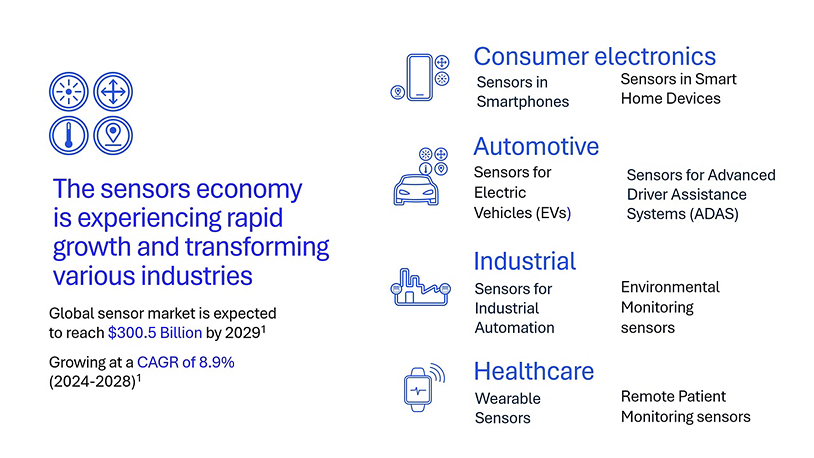
sensors economy growth transforming industries
When wireless sensing meets communications: What new efficiencies and experiences can you expect in the 6G era? 11

Figure 1. Strength of the sensor economy continues to grow and transform industries.

What is wireless sensing?

Wireless sensing is an innovative technology that utilizes RF signals to detect the environment — all without the need for active electronics on the sensing target. It can enable spatial monitoring without using cameras, and is capable of presence detection, motion and gesture recognition, and even environmental monitoring.

Wireless sensing works by detecting and analyzing changes in RF signals as they travel from a transmitter to a receiver. It can flexibly support different operation modes, tailoring to specific needs. Monostatic sensing integrates the transmitter and receiver within a single entity, allowing for self-contained, compact implementation. On the other hand, bistatic sensing supports the transmitter and receiver in different entities, offering more flexibility. Additionally, multistatic sensing utilizes multiple receivers to detect signals from one or more transmitters, further improving performance.
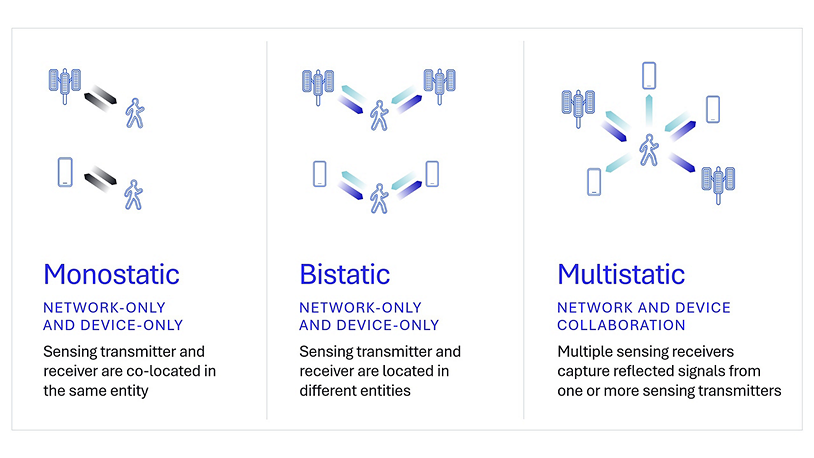
wireless sensing offer flexible operation modes
When wireless sensing meets communications: What new efficiencies and experiences can you expect in the 6G era? 12

Figure 2. Wireless sensing offers flexible operation modes for different use case scenarios.

What use cases can benefit from wireless sensing?

This emerging wireless capability is set to enable a wide range of use cases. For instance, wireless sensing can enhance drone operations by enabling collision avoidance, flight trajectory tracing and intrusion detection. Other use cases include intruder detection in smart homes, geo-fencing in smart factories, and unobtrusive vital monitoring in healthcare. There are many other examples shown in Figure 3 highlighting the diverse use of wireless sensing in enhancing safety, efficiency and convenience. Many of these are actively being studied in the wireless ecosystem and broader industries.
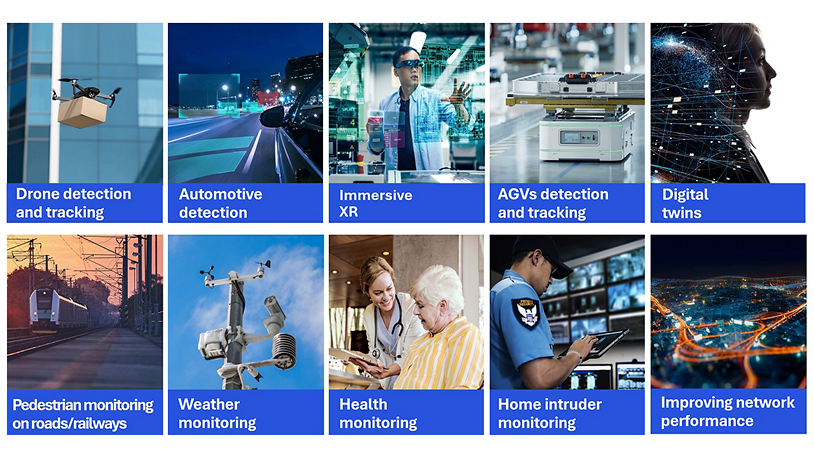
wireless sensing supports variety of use cases across industries
When wireless sensing meets communications: What new efficiencies and experiences can you expect in the 6G era? 13

Figure 3. Wireless sensing can support a variety of use cases across industries.

What is 6G ISAC and why is it important for the ecosystem?

The convergence of wireless sensing and communication presents an exciting opportunity, particularly as we approach the advent of 6G around 2030. This next-generation network will be designed with a native system architecture that supports a wide array of services beyond communications. From day one, 6G is expected to leverage the transformative potential of AI and advanced computing, while also incorporating wireless positioning and sensing capabilities.

By integrating wireless sensing and communication into a single system design, ISAC can significantly improve system efficiency, maximizing hardware reuse for both communications and sensing such as RF components and computation resources. Improved spectral efficiency is another benefit. ISAC can reduce wireless interference and eliminate the need for separate spectrum allocations for sensing and communications. Moreover, a unified system design can enhance energy efficiency by sharing power and processing resources, resulting in more streamlined operations.

The integration of sensing technology into wireless networks marks a significant leap forward in both economic and operational domains. Initially, it can bring new revenue streams by enabling innovative vertical use cases, such as enhanced drone operations and advanced healthcare monitoring. Furthermore, the integration of sensing capabilities with digital twin networks can substantially boost network efficiency. Digital twins, which are models of the physical systems in the digital realm, represent a key 6G application set to transform network management and operations. By leveraging real-time wireless sensing to continuously improve digital twins, network operators can significantly improve efficiency, performance and cost savings.
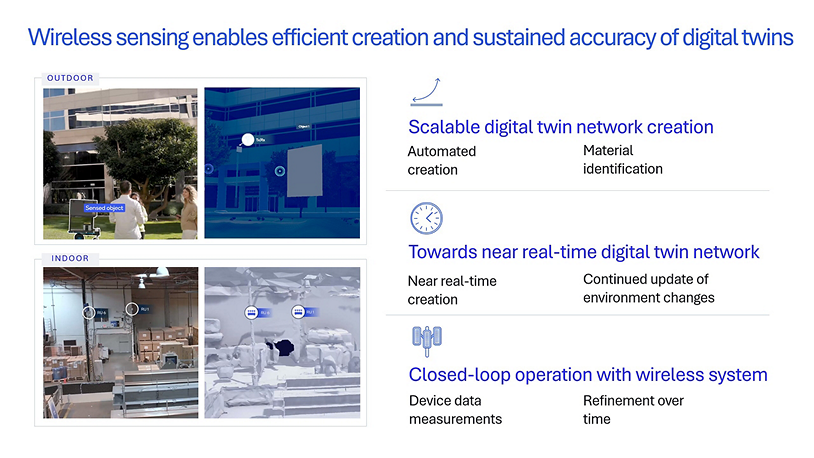
6G ISAC delivers tangible network efficiency benefits
When wireless sensing meets communications: What new efficiencies and experiences can you expect in the 6G era? 14

Figure 4. 6G ISAC delivers tangible network efficiency benefits.

Where are we now on the path to 6G ISAC?

The journey to 6G ISAC begins with the 5G Advanced Study Item focusing on wireless sensing services. Comprehensive studies on channel modeling, various sensing modes, robust system requirements, multiple use cases and specific key performance indicators (KPIs) are laying the groundwork for these next-generation capabilities.

At Qualcomm Technologies, we are advancing wireless sensing through cutting-edge research and prototyping. During Mobile World Congress 2024, we showcased our latest high-resolution sensing system utilizing higher-frequency bands, and capable of monostatic and bistatic operation modes and multiple objects identification. This advancement enables sophisticated applications like identifying material types based on their RF characteristics, which is very useful for the accurate creation and maintenance of digital twin models.
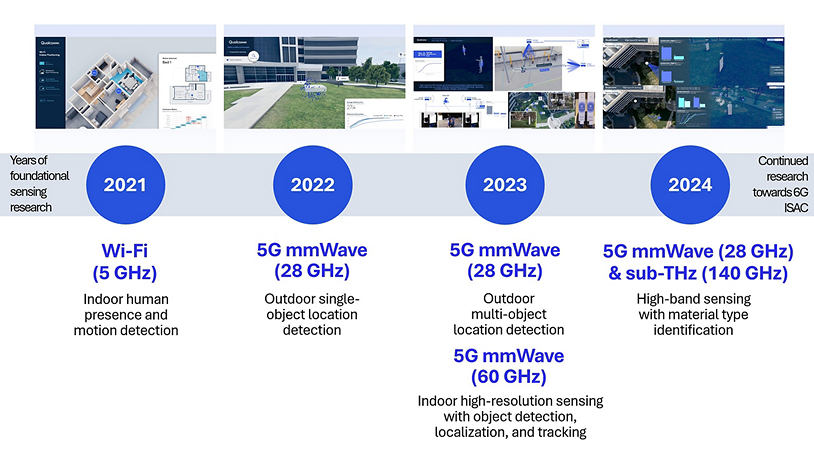
5g 6g wireless sensing timeline
When wireless sensing meets communications: What new efficiencies and experiences can you expect in the 6G era? 15

Figure 5. Advancing wireless sensing through cutting-edge research and prototyping.

What’s next?

The vast potential of wireless sensing, being developed as 6G ISAC, holds the promise of transformative impact across numerous industries. Realizing these breakthroughs will require substantial effort, and we are excited to be driving this progress forward. As we unlock the possibilities of 6G, we remain excited about its future and invite you to follow our journey as these innovations unfold.

Want to learn more?

Join our webinar to learn more about wireless sensing and ISAC

Learn more about our 6G vision

Sign up for our wireless technologies newsletter to stay up to date

You Might Also Like
  • Monday (telco diary) | Consolidation, orchestration, automation
  • Mimosa Networks and Viaero Wireless demonstrate scalable 5 GHz and 6 GHz fixed wireless broadband with AFC
  • Building the 6G standard: What 3GPP’s June 2026 plenary decisions mean for device makers
  • AI-native 6G needs joint network-compute orchestration, says China Telecom
  • Mobile sector to contribute $2.1tn to China’s economy by 2030
  • Taiwan ramps up 6G cooperation ahead of next-generation rollout

Table of Contents

  • What is wireless sensing?
  • What use cases can benefit from wireless sensing?
  • What is 6G ISAC and why is it important for the ecosystem?
  • Where are we now on the path to 6G ISAC?
  • What’s next?
      • Want to learn more?
Share 0 LinkedinEmail
Qualcomm and RCR Wireless News (Sponsored)

previous post
SK Telecom’s 5G subscriber base grows 10.5% y-o-y in Q3
next post
Vodafone to supply global IoT airtime to Oracle’s enterprise customers

White Papers

  • Norton eBook: The 2026 Telco Playbook

  • Enea White Paper: Why Intelligent AAA is the Swiss Army Knife of Telecom

  • CSG White Paper: Telco AI Enabler: Mediation’s Defining Role

  • Enea White Paper: Scalable Database Design for 5G and Beyond

  • Supermicro and NVIDIA Whitepaper: Powering sovereign AI at scale

Editorial Reports

  • Nvidia Report: The State of AI in Telecommunications: 2026 Trends

  • Report: Scaling Optical Networks For The Hyperscale And AI Era

  • Test And Measurement Market Pulse Report

Webinars

  • Webinar: Building 6G — aligning technology, policy and purpose

  • SIMCom Webinar: Scaling your next deployment – from plastic to provisioning

  • Webinar: Rethinking the RAN as AI, cloud and openness converge

  • Webinar: Scale-Up, Scale-Out, Scale-Across – Building AI-Era Network Fabrics

  • Webinar: NTN in motion – evolving standards, expanding services

Since 1982, RCR Wireless News has been providing wireless and mobile industry news, insights, and analysis to mobile and wireless industry professionals, decision makers, policy makers, analysts and investors.

Facebook Twitter Youtube Linkedin Envelope Rss

Useful Links

  • Subscribe
  • About RCR Wireless News
  • Contact Us
  • Advertise
  • Editorial Calendar
  • Archive
  • RSS
  • Wireless News Archive
  • Subscribe
  • About RCR Wireless News
  • Contact Us
  • Advertise
  • Editorial Calendar
  • Archive
  • RSS
  • Wireless News Archive

Edtior's Picks

Red Hat outlines AI-RAN roadmap
Ericsson wins role in £8bn UK’s defense upgrade as private 5G moves to...
Thursday (telco diary) | Satellite versus terrestrial

Latest Articles

Red Hat outlines AI-RAN roadmap
Ericsson wins role in £8bn UK’s defense upgrade as private 5G moves to frontline
Thursday (telco diary) | Satellite versus terrestrial
The Agentic Network — Deutsche Telekom on APIs for trusted AI

© 2026 RCR Wireless News All Right Reserved. Developed by Eight Hats.

Cookie Policy | Privacy Policy

RCR Wireless
  • News
  • Channels
    • 5G
    • 6G
    • BSS OSS
    • Carriers
    • IoT
    • Network Infrastructure
    • Open RAN
    • Private 5G
    • Telco AI
    • Telco Cloud
    • Test & Measurement
  • Resources
    • Reports
    • Webinars
    • White papers
    • AI Fundamentals
    • Analyst Angle
    • Editorial Calendar
    • Fundamentals
      • 5G NR Release 17
      • AI
        • Telco AI in 2025
    • Podcasts
      • Let’s Get Digital with Carrie Charles
      • Wireless Connectivity to Enable Industry 4.0 for the Middleprise
      • Well Technically…
      • Will 5G Change the World
      • Accelerating Industry 4.0 Digitalization
  • AI Infrastructure
  • Programs
  • Events
  • RCRtv
  • Advertise
  • Subscribe
RCR Wireless
  • News
  • Channels
    • 5G
    • 6G
    • BSS OSS
    • Carriers
    • IoT
    • Network Infrastructure
    • Open RAN
    • Private 5G
    • Telco AI
    • Telco Cloud
    • Test & Measurement
  • Resources
    • Reports
    • Webinars
    • White papers
    • AI Fundamentals
    • Analyst Angle
    • Editorial Calendar
    • Fundamentals
      • 5G NR Release 17
      • AI
        • Telco AI in 2025
    • Podcasts
      • Let’s Get Digital with Carrie Charles
      • Wireless Connectivity to Enable Industry 4.0 for the Middleprise
      • Well Technically…
      • Will 5G Change the World
      • Accelerating Industry 4.0 Digitalization
  • AI Infrastructure
  • Programs
  • Events
  • RCRtv
  • Advertise
  • Subscribe
@2020 - All Right Reserved. Designed and Developed by PenciDesign
