

RCR Wireless
  • News
  • Channels
    • 5G
    • 6G
    • BSS OSS
    • Carriers
    • IoT
    • Network Infrastructure
    • Open RAN
    • Private 5G
    • Telco AI
    • Telco Cloud
    • Test & Measurement
  • Resources
    • Reports
    • Webinars
    • White papers
    • AI Fundamentals
    • Analyst Angle
    • Editorial Calendar
    • Fundamentals
      • 5G NR Release 17
      • AI
        • Telco AI in 2025
    • Podcasts
      • Let’s Get Digital with Carrie Charles
      • Wireless Connectivity to Enable Industry 4.0 for the Middleprise
      • Well Technically…
      • Will 5G Change the World
      • Accelerating Industry 4.0 Digitalization
  • AI Infrastructure
  • Programs
  • Events
  • RCRtv
  • Advertise
  • Subscribe
Tuesday, July 7, 2026
RCR Wireless
  • News
  • Channels
    • 5G
    • 6G
    • BSS OSS
    • Carriers
    • IoT
    • Network Infrastructure
    • Open RAN
    • Private 5G
    • Telco AI
    • Telco Cloud
    • Test & Measurement
  • Resources
    • Reports
    • Webinars
    • White papers
    • AI Fundamentals
    • Analyst Angle
    • Editorial Calendar
    • Fundamentals
      • 5G NR Release 17
      • AI
        • Telco AI in 2025
    • Podcasts
      • Let’s Get Digital with Carrie Charles
      • Wireless Connectivity to Enable Industry 4.0 for the Middleprise
      • Well Technically…
      • Will 5G Change the World
      • Accelerating Industry 4.0 Digitalization
  • AI Infrastructure
  • Programs
  • Events
  • RCRtv
  • Advertise
  • Subscribe
Add RCR Wireless as a preferred source on Google
  • Qualcomm 6G Insights
  • Huawei Content Hub
  • Qualcomm – 6G Vision
  • OSS/BSS Channel
RCR Wireless
RCR Wireless
  • Advanced Mimo
  • Mobile mmWave
  • 5G Positioning
  • Green Networks
  • Metaverse
  • Automotive
  • Industrial and Wide-area IoT
Copyright 2021 - All Right Reserved
Home - Five core network design considerations from 5G to 6G
Fundamentals6GTelco Cloud

Five core network design considerations from 5G to 6G

by Sean Kinney, Principal Analyst April 16, 2024
written by Sean Kinney, Principal Analyst April 16, 2024 Share
LinkedinEmail
Share 0LinkedinEmail
6G core docomo
Image courtesy of Docomo Euro-Labs.
623

The evolution from 5G to 6G core networks includes new requirements for AI, interoperability, positioning, sensing, sustainability and more

The current emphasis on bringing cloud-native technology and operating principles into 5G—with the move to a Standalone 5G architecture and cloud-native 5G core the next major transition—will inform how 6G is designed, standardized and deployed. Beyond a number of 5G core enhancements that will go into 6G, the next generation of cellular will also include a number of new requirements. 

During the recent Telco Cloud and Edge Forum, available on-demand here, Riccardo Guerzoni, director of the core network group at Docomo Euro-Labs, laid out the path from 5G to 6G with an emphasis on core network considerations. He focused on five design considerations that, broadly speaking, speak to infrastructure/platform and 3GPP architectural perspectives. 

An overarching point, according to Guerzoni is that 6G, and the enhancements and new requirements that will come with it, need to be aligned with the economic reality operators are facing and need to deliver a clear return on investment. “These new requirements for beyond 5G are challenging in terms of environmental sustainability, which means energy efficiency, hardware longevity and economic viability,” he said. “These innovative services that are expected in the 2030s that required enhanced performance of the network and new functionalities, and that must be justified in terms of return of the investment. So the point is how to make these new services that are very demanding economically viable.” 
Screen Shot 2024 04 16 at 10.12.32 AM
Five core network design considerations from 5G to 6G 8

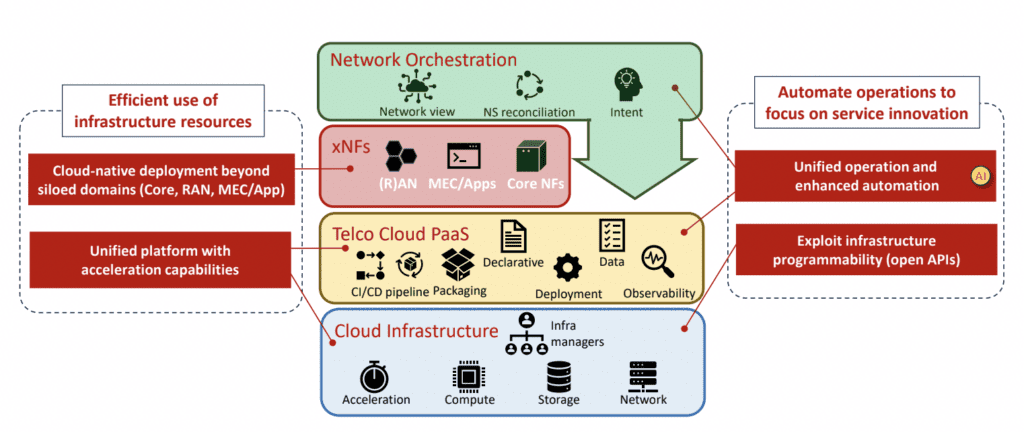
The first set of considerations articulated by Guerzoni speak to the infrastructure/platform piece. Efficient use of infrastructure resources contemplates cloud-native deployment that dispenses with legacy silos, e.g. core, RAN, mobile edge computing and network applications, and a unified underlying platform with acceleration capabilities. Then, automated operations that enable service innovations covers unified automation and operations, and explaining infrastructure programmability via network APIs. 

“There is a cloud infrastructure with the telco cloud platform as a service built on top of it, and that’s the enabler for a unified platform with acceleration capabilities,” Guerzoni explained. “So acceleration capabilities are important to deploy not only the core network functions like it is in 5G, but also run components [like open distributed units]…And also applications. So the idea is that these acceleration capabilities will be used not only to host RAN components, but also application-related components that can be provided by the operator itself, or also on behalf of third parties.” 
Screen Shot 2024 04 16 at 10.13.40 AM 1
Five core network design considerations from 5G to 6G 9

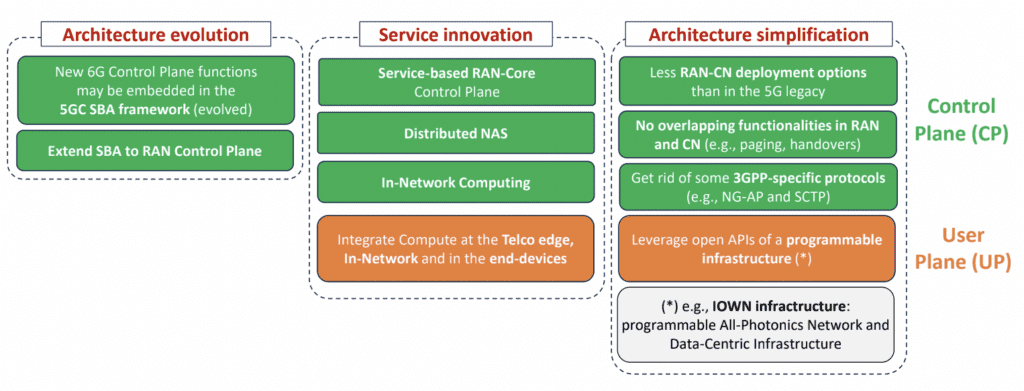
As it relates to the 3GPP-defined architecture, there are three primary considerations: 

  • Architecture evolution—new 6G control plane functions potentially embedded in an evolved 5G core service-based architecture framework, and extending the service-based architecture to the RAN control plane.
  • Service innovation—a service-based RAN/core control plane, distributed non-access stratum, in-network computing, and integration of compute at the telco edge, building on compute in-network and on-device.
  • Architecture simplification—fewer RAN/core deployment options, no overlapping RAN/core functions like paging and handover, removing some 3GPP-specific protocols like NG-AP and SCTP, leveraging the programmable infrastructure, and programmable all-photonics network and data center infrastructure.

“Regarding the extension of the SBA architecture defined for 5G to host the 6G control plane functions, the figure [above] shows a possible perspective that can be used as an approach in the 3GPP standardization, where 6G core network functions and 6G RAN controlpPlane function could be hosted in the same 5G SBA framework, enhanced of course,” Guerzoni said. “The enhancement is necessary if we consider that currently the 5G core functions are deployed in a centralized cloud, while if we involve the SBA framework also functions at the edge, like RAN control plane functions, then we need to potentially make the protocol stank more resilient.”  

He also pointed out that with 6G “there is no Non-standalone option…That’s a lesson learned from the 5G experience…The 6G RAN is only integrated with 6G core network functions, and it doesn’t interact directly with the 5G core network functions. And the interworking is realized by means of service-based interaction between the 5G core and the 6G core.”

Drawing from the cloud-native descriptor applied to 5G, 6G is often characterized as AI-native. Speaking to this point, Guerzoni said, “AI capabilities can be embedded to make more efficient the network…functionalities. And reduce the energy consumption, optimize the control plane behavior, quality of experience, quality of service, and so on and so on. So there will be AI models embedded in different part[s] of the network, and this is of course a big opportunity but it’s also a challenge from the mobile network operator point of view because these [machine learning] models need to be managed in order to build the models, deploy them, monitor the performance, make them controllable, train and evaluate the models. So this is a quite important topic for our mobile network operators—how to make controllable and observable these ML models that are deployed in the different parts of the network.”


You Might Also Like
  • Building the 6G standard: What 3GPP’s June 2026 plenary decisions mean for device makers
  • AI-native 6G needs joint network-compute orchestration, says China Telecom
  • Mobile sector to contribute $2.1tn to China’s economy by 2030
  • Taiwan ramps up 6G cooperation ahead of next-generation rollout
  • China launches 6G pilot program as field trials accelerate
  • 6G research advances, industry pushes for simpler migration path
Share 0 LinkedinEmail
Sean Kinney
Sean Kinney, Principal Analyst

Sean focuses on multiple subject areas including 5G, 6G, Open RAN, hybrid cloud, edge computing, and Industry 4.0. Prior to his work at RCR, Sean studied journalism and literature at the University of Mississippi then spent six years based in Key West, Florida, working as a reporter for the Miami Herald Media Company. He currently lives in Fayetteville, Arkansas.

previous post
Ericsson Q1 results: ‘RAN market to continue its decline’
next post
AST SpaceMobile streams an AT&T commercial from space to a smartphone

White Papers

  • Enea White Paper: Why Intelligent AAA is the Swiss Army Knife of Telecom

  • CSG White Paper: Telco AI Enabler: Mediation’s Defining Role

  • Enea White Paper: Scalable Database Design for 5G and Beyond

  • Supermicro and NVIDIA Whitepaper: Powering sovereign AI at scale

  • VIAVI Whitepaper: RAN scenario generators and their critical role for future-proofing AI-native RAN in Advanced 5G and 6G networks

Editorial Reports

  • Report: Scaling Optical Networks For The Hyperscale And AI Era

  • Test And Measurement Market Pulse Report

  • Editorial Report: Securing telecom infrastructure for the quantum era

Webinars

  • Webinar: Rethinking the RAN as AI, cloud and openness converge

  • Webinar: Scale-Up, Scale-Out, Scale-Across – Building AI-Era Network Fabrics

  • Webinar: NTN in motion – evolving standards, expanding services

  • Webinar: Noise-Figure Measurements with RFmx and PXI VSTs

  • Qualcomm Webinar – Building the 6G Standard: Key developments to know

Since 1982, RCR Wireless News has been providing wireless and mobile industry news, insights, and analysis to mobile and wireless industry professionals, decision makers, policy makers, analysts and investors.

Facebook Twitter Youtube Linkedin Envelope Rss

Useful Links

  • Subscribe
  • About RCR Wireless News
  • Contact Us
  • Advertise
  • Editorial Calendar
  • Archive
  • RSS
  • Wireless News Archive
  • Subscribe
  • About RCR Wireless News
  • Contact Us
  • Advertise
  • Editorial Calendar
  • Archive
  • RSS
  • Wireless News Archive

Edtior's Picks

Enea White Paper: Why Intelligent AAA is the Swiss Army Knife of Telecom
Huawei outlines AI-centric network roadmap for telecom monetization
Why consolidation will reshape MDU connectivity (part 3/3) – Analyst Angle

Latest Articles

Enea White Paper: Why Intelligent AAA is the Swiss Army Knife of Telecom
Huawei outlines AI-centric network roadmap for telecom monetization
Why consolidation will reshape MDU connectivity (part 3/3) – Analyst Angle
Quantum Safe Networks Forum 2026

© 2026 RCR Wireless News All Right Reserved. Developed by Eight Hats.

Cookie Policy | Privacy Policy

RCR Wireless
  • News
  • Channels
    • 5G
    • 6G
    • BSS OSS
    • Carriers
    • IoT
    • Network Infrastructure
    • Open RAN
    • Private 5G
    • Telco AI
    • Telco Cloud
    • Test & Measurement
  • Resources
    • Reports
    • Webinars
    • White papers
    • AI Fundamentals
    • Analyst Angle
    • Editorial Calendar
    • Fundamentals
      • 5G NR Release 17
      • AI
        • Telco AI in 2025
    • Podcasts
      • Let’s Get Digital with Carrie Charles
      • Wireless Connectivity to Enable Industry 4.0 for the Middleprise
      • Well Technically…
      • Will 5G Change the World
      • Accelerating Industry 4.0 Digitalization
  • AI Infrastructure
  • Programs
  • Events
  • RCRtv
  • Advertise
  • Subscribe
RCR Wireless
  • News
  • Channels
    • 5G
    • 6G
    • BSS OSS
    • Carriers
    • IoT
    • Network Infrastructure
    • Open RAN
    • Private 5G
    • Telco AI
    • Telco Cloud
    • Test & Measurement
  • Resources
    • Reports
    • Webinars
    • White papers
    • AI Fundamentals
    • Analyst Angle
    • Editorial Calendar
    • Fundamentals
      • 5G NR Release 17
      • AI
        • Telco AI in 2025
    • Podcasts
      • Let’s Get Digital with Carrie Charles
      • Wireless Connectivity to Enable Industry 4.0 for the Middleprise
      • Well Technically…
      • Will 5G Change the World
      • Accelerating Industry 4.0 Digitalization
  • AI Infrastructure
  • Programs
  • Events
  • RCRtv
  • Advertise
  • Subscribe
@2020 - All Right Reserved. Designed and Developed by PenciDesign