

There is a niche committee vote this week at a meeting of the 3rd Generation Partnership Project (3GPP) to decide whether ‘ambient’ IoT, to enable energy-harvesting in battery-less cellular devices, should be included as a work item in development of the Release 19 of the 5G NR standard. The vote is up in the air; ambient IoT could be worked into commercial products some time after 2025, when Release 19 is completed (and presented to the market as 5G Advanced), or it could be put on the back-burner as a study item for later releases. By the time the meeting closes on December 16, it might also be rendered as an in-between work-and-study pursuit, pegged for hard graft but not a hard deadline.
The last two options would be a mistake, reckons Israeli supply-chain IoT software developer Wiliot, which has provided an energy-harvesting model for dirt-cheap IoT tags, based on radio frequency identification (RFID) and low-energy Bluetooth (BLE), into the 3GPP mixer. Ambient cellular-based IoT should be an urgent work item in 3GPP circles, it says, if the cellular market wants to make good on the promise of ‘massive IoT’ in the 5G era – to cheaply connect masses of low-power IoT gadgetry, mostly in global supply chains, and to make a buck and save the planet along the way. Because, in the end, in simple terms, these are the opportunities – which will be taken or not come Christmas-break.
Steve Statler, chief marketing officer and ESG lead at Wiliot, explains: “Technically, it’s at the fat end of the IoT wedge – and a way to overcome this huge under-performance in the whole sector. I mean, it’s not like IoT is nothing. It’s billions of devices, but it is also the internet-of-expensive-things at the moment. Ambient IoT is [about] the things that go inside these appliances and containers – the food, the clothing, the medicine. And the addressable market is 10 trillion things. So, it’s several orders of magnitude bigger, and much more far-reaching in terms of our everyday lives, and much more disruptive in terms of the global economy.”
He goes on: “It goes from squeezing another five percent to doubling efficiency. It represents one of our most potent weapons against climate change. Because we’ve been running supply chains in the dark. We’ve had RFID, which gives a snapshot of one part of a supply chain. But with ambient IoT, you see the whole of it, end-to-end, in real time. It’s the difference between the old guy under a hood with a camera, taking black-and-white photos of your family looking all-stiff, and a smartphone streaming colour video in 4K of your whole life; the whole supply chain, all of the time.”

The 10-trillion forecast, quoted above, is from ABI Research, from a whitepaper sponsored by Wiliot. Statler is joined on the call with RCR Wireless by Dominique Bonte, in charge of global automotive and IoT research at the firm. He says: “The mobile industry has not really been able to monetise its investments in 5G, and is still seeking bandwidth for these metaverse-types of applications – which consumers, even enterprises, don’t really want to pay for. Ambient IoT offers massive improvements in efficiency. It doesn’t get the attention it deserves. The industry should be looking at these more structural longer-term opportunities.”
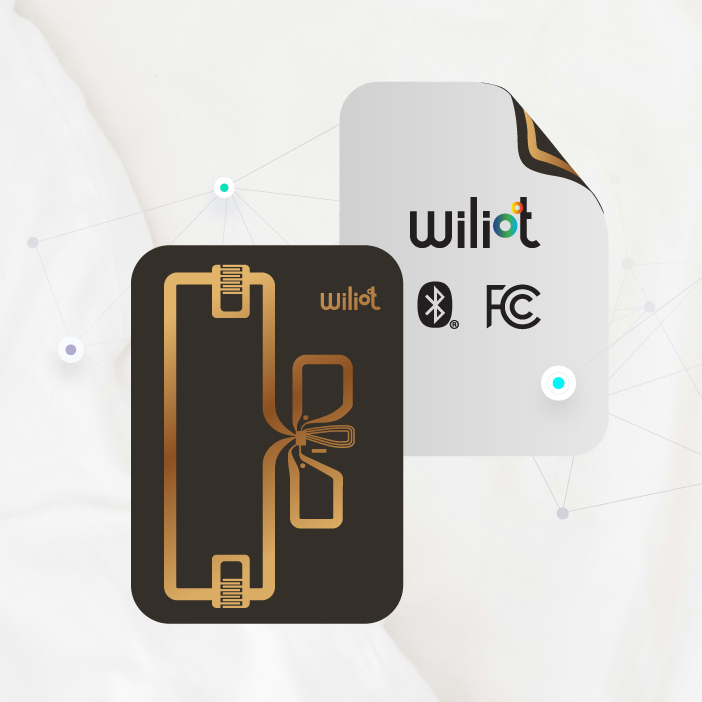
In his hand, Statler has an ambient BLE tag that Wiliot developed for an unnamed pharma firm in 2019/20 to track Covid-19 vaccines in-and-out of fridges. “There was never a government mandate, so the drug companies thanked us and paid up. And who knows how many were inoculated with vaccines that had been sitting around too long?” Wiliot is now selling them for 10 cents ($0.10) each. Statler mentions January meetings in the UK with “a really large” logistics company and an apparel company that wants to track inventory in shops. It will produce 100 million units in 2024, he says. But the company wants the same technology to be connected over low-power 5G.
He explains: “It is not like ambient IoT won’t happen without 3GPP. It is already happening with Bluetooth. We’re already going from IoT in the single-digit billions to IoT in the double- and triple-digit billions. But with cellular, it goes faster and bigger. What the telecoms industry brings is what IBM brought to the PC market all those years ago – brand awareness, quality of service, system of delivery. But most importantly, it brings all of that [global infrastructure] – to enable that open access so every product and every retailer can connect without having to go through a tiny handful of tech companies that own these home devices.”
Smart home devices are the logical Bluetooth gateway-hub for ambient IoT in the home, he reasons. “You know, we’re a firmware upgrade away from smart speakers being able to energise and read these tags – which is strategic for many use cases. The companies that own these devices could easily do that upgrade to connect these tags – whether for a vial of vaccine vial or a box of cornflakes.” But if 3GPP can organise itself to establish carrier-agnostic cellular connectivity for ambient IoT across the planet, then fragmented negotiations with the likes of Amazon and Apple can be sidestepped for a myriad of IoT providers. Plus users are not required to buy separate hub-hardware to route the traffic.
Bonte adds: “It is an ubiquitously-available public network. That’s the difference. Rather than a private network, like with Bluetooth. It’s like with your smartphone: do you still need Wi-Fi when you have an unlimited 5G data plan? No. You just use your cellular connection. The same will happen with IoT in the supply chain. It is about ease-of-use; plus the power of the ecosystem in terms of investment and standardisation. The scaling effects are very hard to match.” Exactly how the global carrier community monetises the pulse-like signal of masses of ambient IoT devices is not entirely explained. But Statler suggests trillions of IoT units will – one day, perhaps – pay better than millions of 5G smartphones.
“If ambient IoT becomes part of the carrier ecosystem and a recurring revenue generator of the kind of scale that ABI has outlined, then it will be a bigger revenue contributor than smartphone data plans. What we’re talking about with 5G-Advanced is true integration with a smartphone, which can energise and read the kind of tags we’re already making… We know it works. It’s not a science experiment. We are cross-pollinating from unlicensed to licensed spectrum.” Some use cases have been mentioned, and the initial focus is on exploding battery-less IoT into supply chains; but Statler references find-me and reveal-me apps for lost drills on worksites and failed double-glazing in homes.
“So that, 10 years later, when there is a leak, you know where you bought it from,” he says of the last scenario. But such scale will only come if the costs are rock-bottom. Are you saying the cellular equivalent of a BLE tag will be 10 cents as well? “I don’t know, but it will be pennies. We are a SaaS company. We design the chip and provide open source instances of the software on the edge. The chip designs are essentially free. We don’t sell the tag, so we don’t control the price. But we are working with some of the biggest and most cost-sensitive retailers in the world. And the price is low because there’s no printed circuit board; there’s one chip, so small you can barely see it, glued to an antenna.”
He goes on: “The whole process is borrowed from RFID, which produces tags at a rate of tens of thousands of units per hour. So, the bill-of-materials is pretty amazing. It is like the nails that go with the bolts and the rebar. We need the IoT nails to fix the IoT infrastructure to support the cloud – to really weld the physical and digital as part of this extended system for generative AI. And you can’t pay $10 or $1 for your nails. They’ve got to cost pennies.”
The other question – which has to be asked every time of massive IoT, as with any technology that proclaims its own green credentials – is about the environmental impact when 10 trillion long-life IoT tags eventually expire? Statler flips the angle. “Yeah, you have to be mindful. But it’s a bit like arguing against solar panels: you’re adding to the carbon footprint of the house to save energy. But the carbon footprint invariably corresponds directly to the price. If it’s a Hummer, then it is big; if it’s a Fiat 500, it is much lower. And with this, it is really, really low.”
But even point-something is something, at some point, if it is multiplied trillions of times. He loosely references studies Wiliot is doing in the academic realm with packaging company Avery Dennison, one of its investors (along with Qualcomm, NTT, Verizon), to to test the “recyclability” of its tags. “It is separable,” he says. “We have something with a minimal incremental footprint, which can also be recycled. The metallic elements in the antennas can be repurposed – when we get to a level where it becomes material in the lifecycle analysis.”
As with so much of IoT, the concept and the promise are hugely exciting. So what about this 3GPP vote this week? Realistically, is ambient IoT going to end up as a Release 19 work or a study item? “We’ll have to see. But I am optimistic. Because it is in everyone’s interest to find my-everything – my passport, my luggage, my gloves; my assets in transit. Ambient IoT will connect every tool, cage, crate. We will look back in five years and ask how we ever ran the economy when everything was offline. It’s like running a factory with a flashlight, versus having the lights on. Our call to action is to work it. Because visibility of supply chains means drastically cutting carbon emissions and costs.”
Dominic, what do you think: a work item or a study item? He raises a good point. “I don’t know. It depends on the lobbying from supply chain players, and the supply chain industry is more fragmented than the manufacturing or automotive industries, say, which are well represented in 3GPP. Because it’s about warehousing, and multimodal transportation – rail, maritime, air cargo. It’s about so many different things, and it is just harder for the global supply champion to speak with a single voice. So, there is a challenge to tie all of that together in 3GPP.”
Perhaps it will take these other sectors, strung all across the supply chain, plus the telecoms industry itself, which stands to do so well potentially, to make the case. Statler says: “Because, in the end, why should we be satisfied with a few billion IoT connections, when we can connect 10 trillion?”

