

RCR Wireless
  • News
  • Channels
    • 5G
    • 6G
    • BSS OSS
    • Carriers
    • IoT
    • Network Infrastructure
    • Open RAN
    • Private 5G
    • Telco AI
    • Telco Cloud
    • Test & Measurement
  • Resources
    • Reports
    • Webinars
    • White papers
    • AI Fundamentals
    • Analyst Angle
    • Editorial Calendar
    • Fundamentals
      • 5G NR Release 17
      • AI
        • Telco AI in 2025
    • Podcasts
      • Let’s Get Digital with Carrie Charles
      • Wireless Connectivity to Enable Industry 4.0 for the Middleprise
      • Well Technically…
      • Will 5G Change the World
      • Accelerating Industry 4.0 Digitalization
  • AI Infrastructure
  • Programs
  • Events
  • RCRtv
  • Advertise
  • Subscribe
Friday, July 24, 2026
RCR Wireless
  • News
  • Channels
    • 5G
    • 6G
    • BSS OSS
    • Carriers
    • IoT
    • Network Infrastructure
    • Open RAN
    • Private 5G
    • Telco AI
    • Telco Cloud
    • Test & Measurement
  • Resources
    • Reports
    • Webinars
    • White papers
    • AI Fundamentals
    • Analyst Angle
    • Editorial Calendar
    • Fundamentals
      • 5G NR Release 17
      • AI
        • Telco AI in 2025
    • Podcasts
      • Let’s Get Digital with Carrie Charles
      • Wireless Connectivity to Enable Industry 4.0 for the Middleprise
      • Well Technically…
      • Will 5G Change the World
      • Accelerating Industry 4.0 Digitalization
  • AI Infrastructure
  • Programs
  • Events
  • RCRtv
  • Advertise
  • Subscribe
Add RCR Wireless as a preferred source on Google
  • Qualcomm 6G Insights
  • Huawei Content Hub
  • Qualcomm – 6G Vision
  • OSS/BSS Channel
  • RCRTech Roundtable: AI Infrastructure
RCR Wireless
RCR Wireless
  • Advanced Mimo
  • Mobile mmWave
  • 5G Positioning
  • Green Networks
  • Metaverse
  • Automotive
  • Industrial and Wide-area IoT
Copyright 2021 - All Right Reserved
Home - Closing the rural digital divide with fiber XGS-PON (Reader Forum)
Network InfrastructureReader Forum

Closing the rural digital divide with fiber XGS-PON (Reader Forum)

by Björn Capens, Vice President of Europe Fixed Networks, Nokia December 9, 2022
written by Björn Capens, Vice President of Europe Fixed Networks, Nokia December 9, 2022 Share
LinkedinEmail
Share 0LinkedinEmail
5G fixed wireless rip-and-replace
136

There is much effort being put into closing the digital divide around the world. Governments recognize the importance of broadband connectivity for sustaining communities, not to mention the socio-economic benefits that it brings. But even in nations with the most advanced broadband networks, there is still work to do, especially in bridging the gap between urban and rural connectivity.

In the U.S., a Pew Research study found that almost 30% of rural Americans do not have a broadband internet connection at home. In Europe, the European Commission’s Digital Divide report estimates only 18% of citizens in rural areas have broadband of 30 Mb/s, which is barely adequate for modern digital living standards.

The business case has long been the challenge for deploying fiber broadband in rural locations, but recently, governments have been stepping up incentives with initiatives like the Rural Digital Opportunity Fund in the U.S. and the EU’s Recovery and Resilience Facility.

With demand for rural connectivity surging, both for residential and for modern agricultural and Industry 4.0 applications in rural areas, the business case for deploying fiber to rural communities is increasingly attractive, with the added benefit that the first operator to invest closes the door on competitors.

Recently, fiber broadband has seen an innovative application scenario in rural areas. For example, the town of Kayamandi in South Africa uses a fiber broadband network to deliver affordable, uncapped, ultra-fast broadband services accessible to everyone. Users can connect their devices (smartphones, personal computers, etc.) to township Wi-Fi, which is backhauled by the fiber access network, with time-based and pay-as-you-go pricing schemes. This is both more cost-effective and user-friendly than mobile data solutions.

The key question today for rural broadband deployment is whether to use Gigabit Passive Optical Network (GPON) or XGS-PON technology, which delivers 10 Gb/s.

Some argue that GPON, with its 2.5 Gb/s capacity and lower cost, is sufficient to serve the lower number of users and endpoints in rural areas in a cost-efficient way. However, the relative cost difference between GPON and XGS-PON is small because the biggest cost is in laying the underground optical fiber cables and building the outside plant — which is the same for both technologies.

So, if the cost difference is incremental, why not deploy XGS-PON from the start?

GPON is slowly running out of steam, especially with Gigabit speeds now becoming a standard service offering. PON is based on point-to-multipoint architecture, where multiple users (usually around 30) share the same fiber feeder. As bandwidth usage continues to grow, and each user on a PON needs to be able to access Gigabit speeds at any time, the GPON capacity will likely be insufficient in a few years. It is not long before XGS-PON will be necessary, making it the more future-proof option.

Moreover, there are other compelling reasons to go straight for XGS-PON. For a start, a market with 10 Gb/s services will not attract competition and new players, because it will be hard for them to compete on service quality. Therefore, XGS-PON protects the market.

The higher capacity brings more revenue, not just from higher-tier broadband services but from business and industry, and this capacity will be enough for many years, eliminating the need for a near-term upgrade. Additionally, 10 Gb/s is also enough for additional services to be run simultaneously on the same infrastructure, such as 4G/5G mobile backhaul. This also brings a new revenue opportunity or a cost saving for converged operators rolling out their mobile networks.

Incidentally, this converged approach is the future for fiber broadband networks, as fiber-to-the-home networks become fiber for everything, connecting homes, businesses, industries, smart cities, mobile cells, you name it, and making the business case even stronger. XGS-PON makes sense for a brand-new fiber deployment as the incremental cost over GPON is much smaller than the substantial capacity increase XGS-PON brings. All this is why XGS-PON will soon overtake GPON as the fiber technology most widely deployed.

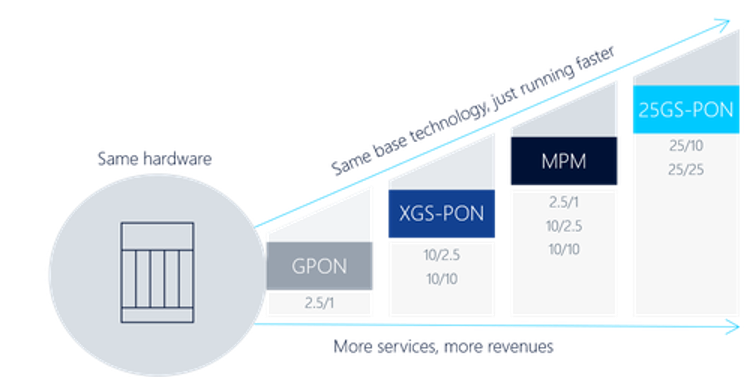
Operators nevertheless need a pragmatic approach to fiber deployments in rural areas to manage costs and maximize returns. Recent technology advances help. Multi-PON, for example, is a universal fiber solution that is seeing exponential growth. Every port on a Multi-PON blade can work in GPON mode, XGS-PON mode, both GPON and XGS-PON simultaneously, or 25G PON enabling operators to start with the most cost-optimized solution and still be able to boost the speeds when and where needed with minimal incremental investment.

For example, they can start with lower-cost GPON, which can still deliver very competitive speeds, and then introduce XGS-PON for power users like factories, or even 25G PON. This is a huge advantage for deployments because it gives operators flexibility and choice, applying each technology where it makes sense, and having a seamless, future-proof upgrade path.
Picture1
Source: Light Reading

Finally, the alternative to investing in rural fiber broadband is, well, to not invest. This prolongs the current situation with unserved and underserved communities left socially and economically disadvantaged; meanwhile, urban and suburban areas will continue to surge ahead.

Government and municipal broadband initiatives care deeply about rural broadband because of its direct benefits for citizens, the attractiveness for businesses, and the effect on population flows from rural to urban areas.

And shareholders invest in businesses with strong corporate social responsibility (CSR) agendas, so it helps that rural broadband not only improves lives, but it also decreases the world’s carbon emissions both directly, compared to alternative broadband technologies, and indirectly by enabling online and remote activities that would otherwise involve transportation.

Not investing in rural broadband does not mean status quo — it means going backward. The way forward is fiber and XGS-PON.


You Might Also Like
  • Spectrum supercycle – US opens floodgates; UK shares it out
  • Why throwing money at broadband speeds isn’t fixing America’s internet (Reader Forum)
  • Thursday (telco diary) | Telco pieces in the AI jigsaw
  • Nokia nips and tucks, and sees supercycle upside – as AI and cloud orders double
  • Only 50 of 170 digital infrastructure firms will exist in in five years (Reader Forum)
  • Wednesday (telco diary) | What AT&T and Lumen tell us about the AI fiber build-out
Share 0 LinkedinEmail
Björn Capens, Vice President of Europe Fixed Networks, Nokia

previous post
Shanghai reaches over 68,000 5G base stations: Report
next post
What is the right business case for mobile edge computing? (Part 1)

White Papers

  • Norton eBook: The 2026 Telco Playbook

  • Enea White Paper: Why Intelligent AAA is the Swiss Army Knife of Telecom

  • CSG White Paper: Telco AI Enabler: Mediation’s Defining Role

  • Enea White Paper: Scalable Database Design for 5G and Beyond

  • Supermicro and NVIDIA Whitepaper: Powering sovereign AI at scale

Editorial Reports

  • Market Pulse Report: Telco AI in 2026 – Trends, Challenges and Opportunities

  • Nvidia Report: The State of AI in Telecommunications: 2026 Trends

  • Report: Scaling Optical Networks For The Hyperscale And AI Era

Webinars

  • Webinar: Building 6G — aligning technology, policy and purpose

  • SIMCom Webinar: Scaling your next deployment – from plastic to provisioning

  • Webinar: Rethinking the RAN as AI, cloud and openness converge

  • Webinar: Scale-Up, Scale-Out, Scale-Across – Building AI-Era Network Fabrics

  • Webinar: NTN in motion – evolving standards, expanding services

Since 1982, RCR Wireless News has been providing wireless and mobile industry news, insights, and analysis to mobile and wireless industry professionals, decision makers, policy makers, analysts and investors.

Facebook Twitter Youtube Linkedin Envelope Rss

Useful Links

  • Subscribe
  • About RCR Wireless News
  • Contact Us
  • Advertise
  • Editorial Calendar
  • Archive
  • RSS
  • Wireless News Archive
  • Subscribe
  • About RCR Wireless News
  • Contact Us
  • Advertise
  • Editorial Calendar
  • Archive
  • RSS
  • Wireless News Archive

Edtior's Picks

AT&T and Ericsson use network sensing to spot drones with ordinary 5G towers
Huawei sees Mobile AI driving new wave of uplink network investment
Spectrum supercycle – US opens floodgates; UK shares it out

Latest Articles

AT&T and Ericsson use network sensing to spot drones with ordinary 5G towers
Huawei sees Mobile AI driving new wave of uplink network investment
Spectrum supercycle – US opens floodgates; UK shares it out
Why throwing money at broadband speeds isn’t fixing America’s internet (Reader Forum)

© 2026 RCR Wireless News All Right Reserved. Developed by Eight Hats.

Cookie Policy | Privacy Policy

RCR Wireless
  • News
  • Channels
    • 5G
    • 6G
    • BSS OSS
    • Carriers
    • IoT
    • Network Infrastructure
    • Open RAN
    • Private 5G
    • Telco AI
    • Telco Cloud
    • Test & Measurement
  • Resources
    • Reports
    • Webinars
    • White papers
    • AI Fundamentals
    • Analyst Angle
    • Editorial Calendar
    • Fundamentals
      • 5G NR Release 17
      • AI
        • Telco AI in 2025
    • Podcasts
      • Let’s Get Digital with Carrie Charles
      • Wireless Connectivity to Enable Industry 4.0 for the Middleprise
      • Well Technically…
      • Will 5G Change the World
      • Accelerating Industry 4.0 Digitalization
  • AI Infrastructure
  • Programs
  • Events
  • RCRtv
  • Advertise
  • Subscribe
RCR Wireless
  • News
  • Channels
    • 5G
    • 6G
    • BSS OSS
    • Carriers
    • IoT
    • Network Infrastructure
    • Open RAN
    • Private 5G
    • Telco AI
    • Telco Cloud
    • Test & Measurement
  • Resources
    • Reports
    • Webinars
    • White papers
    • AI Fundamentals
    • Analyst Angle
    • Editorial Calendar
    • Fundamentals
      • 5G NR Release 17
      • AI
        • Telco AI in 2025
    • Podcasts
      • Let’s Get Digital with Carrie Charles
      • Wireless Connectivity to Enable Industry 4.0 for the Middleprise
      • Well Technically…
      • Will 5G Change the World
      • Accelerating Industry 4.0 Digitalization
  • AI Infrastructure
  • Programs
  • Events
  • RCRtv
  • Advertise
  • Subscribe
@2020 - All Right Reserved. Designed and Developed by PenciDesign
