

RCR Wireless
  • News
  • Channels
    • 5G
    • 6G
    • BSS OSS
    • Carriers
    • IoT
    • Network Infrastructure
    • Open RAN
    • Private 5G
    • Telco AI
    • Telco Cloud
    • Test & Measurement
  • Resources
    • Reports
    • Webinars
    • White papers
    • AI Fundamentals
    • Analyst Angle
    • Editorial Calendar
    • Fundamentals
      • 5G NR Release 17
      • AI
        • Telco AI in 2025
    • Podcasts
      • Let’s Get Digital with Carrie Charles
      • Wireless Connectivity to Enable Industry 4.0 for the Middleprise
      • Well Technically…
      • Will 5G Change the World
      • Accelerating Industry 4.0 Digitalization
  • AI Infrastructure
  • Programs
  • Events
  • RCRtv
  • Advertise
  • Subscribe
Tuesday, July 21, 2026
RCR Wireless
  • News
  • Channels
    • 5G
    • 6G
    • BSS OSS
    • Carriers
    • IoT
    • Network Infrastructure
    • Open RAN
    • Private 5G
    • Telco AI
    • Telco Cloud
    • Test & Measurement
  • Resources
    • Reports
    • Webinars
    • White papers
    • AI Fundamentals
    • Analyst Angle
    • Editorial Calendar
    • Fundamentals
      • 5G NR Release 17
      • AI
        • Telco AI in 2025
    • Podcasts
      • Let’s Get Digital with Carrie Charles
      • Wireless Connectivity to Enable Industry 4.0 for the Middleprise
      • Well Technically…
      • Will 5G Change the World
      • Accelerating Industry 4.0 Digitalization
  • AI Infrastructure
  • Programs
  • Events
  • RCRtv
  • Advertise
  • Subscribe
Add RCR Wireless as a preferred source on Google
  • Qualcomm 6G Insights
  • Huawei Content Hub
  • Qualcomm – 6G Vision
  • OSS/BSS Channel
  • RCRTech Roundtable: AI Infrastructure
RCR Wireless
RCR Wireless
  • Advanced Mimo
  • Mobile mmWave
  • 5G Positioning
  • Green Networks
  • Metaverse
  • Automotive
  • Industrial and Wide-area IoT
Copyright 2021 - All Right Reserved
Home - The diversity of private network use cases demands multi-vendor solutions
5GEnterpriseInternet of Things (IoT)News & Event Coverage

The diversity of private network use cases demands multi-vendor solutions

by Sean Kinney, Principal Analyst May 15, 2022
written by Sean Kinney, Principal Analyst May 15, 2022 Share
LinkedinEmail
Share 0LinkedinEmail
private network qualcomm
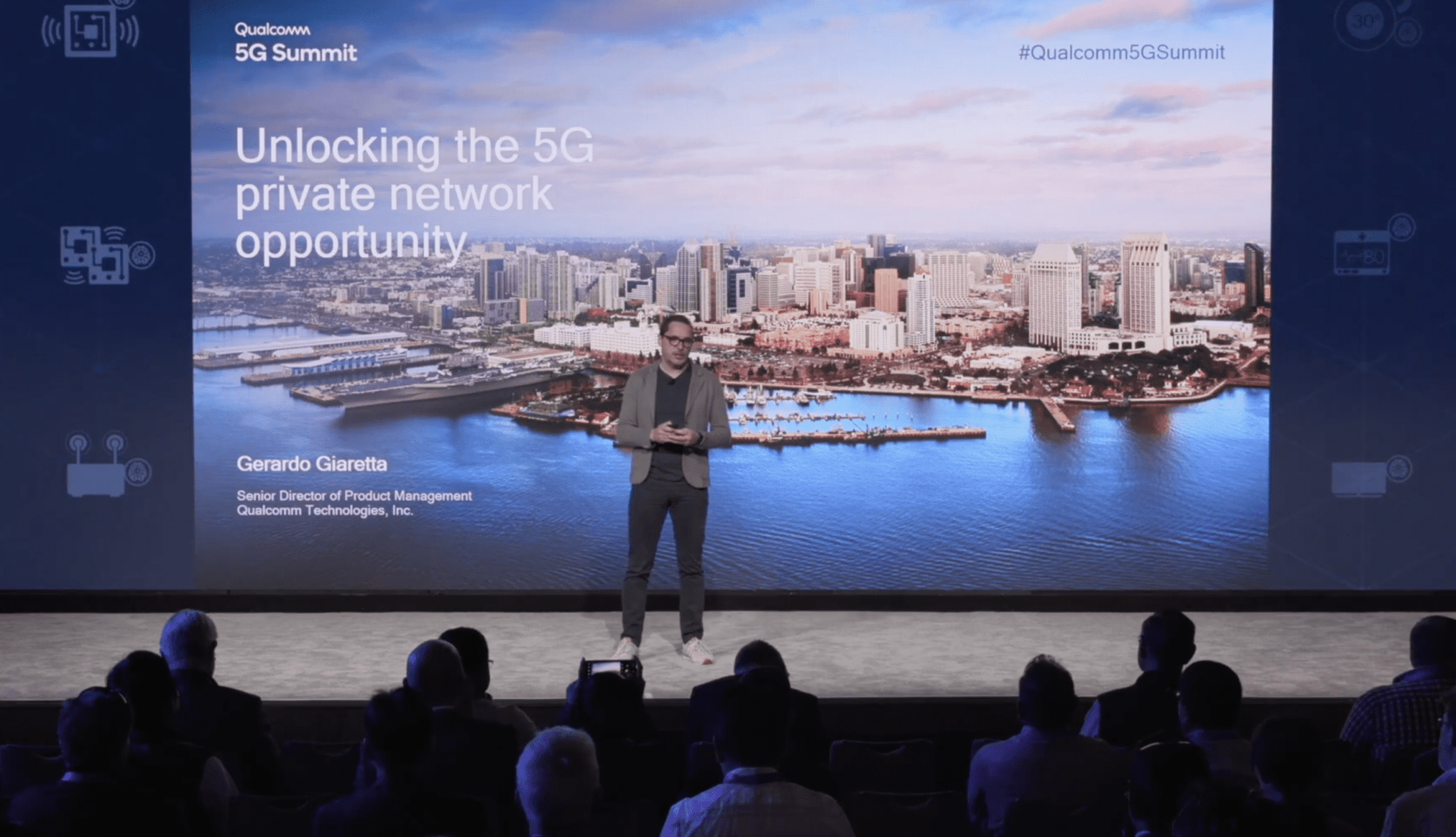
Qualcomm's Gerardo Giaretta discusses private network opportunities. Image courtesy of Qualcomm.
121

Qualcomm on how to hide technical complexity and deliver private network use cases to enterprise

Delivering a private network to carpeted enterprises and heavy industries is a multi-billion dollar, long-term opportunity. But the very notion of serving the needs of a college campus and an open-pit mining site with the same tech stack is wrong-headed on its face. This presents a problem of scale—how can relevant stakeholders on the vendor side create a set of solutions that meets their own economic imperatives of being replicable while meeting their buyers’ needs for customization?

Presenting during a master class session at the recent Qualcomm 5G Summit, Senior Director of Product Management Gerardo Giaretta presented his thesis and outlined how Qualcomm is collaborating with a range of partners to realize the potential of private networks for digital transformation. 

Whether you consider a private network as a slice of a public network, a VPN basically, or as an integrated private network where some elements are on-premise, some off, or as a fully-independent private network, the solution has to support the use cases the buyer wants. And those use cases are very likely much more specific than talk, text and data. To do this, Giaretta said, you’ve got to have a multi-vendor solution that doesn’t have the weaknesses of a multi-vendor solution. 

This bit is key: “Multi-vendor is going to be extremely important because of the diversity of use cases,” he said. “Private networks will end up using different products so they will be multi-vendor by nature.” The private network users, he continued, “don’t care about the technology itself and they shouldn’t care about the technology…They care about the use cases. They care about how the digital transformation evolves.”

A point so salient it’s worth making again. “The enterprise doesn’t care about the technology. It cares about the use case. The technology needs to hide but it needs to work perfectly. It needs to be very easy to deploy and very easy to manage exactly because there are not those hundreds or thousands of engineers whose job is to do that.” But how? 

Making four not-so-easy pieces look like four easy pieces

Giaretta distilled this complex machinery into four pieces, all of which Qualcomm is working on: partnerships, a 5G RAN platform, automation tools, and devices. 

In terms of partnerships, Qualcomm launched a private network Partner Ecosystem Program at Mobile World Congress in Barcelona. That calls back to the centrality of private networks as inherently multi-vendor. “There’s not going to be a single-vendor-fits-all solution,” Giaretta said. “The last thing that you want is…to tell the enterprise, ‘Pick the small cell from Vendor A, pick the core network from Vendor B, pick the orchestrator from Vendor C, and good luck.’” 

The goal of Qualcomm’s Partner Ecosystem Program is to pre-test, validate and certify specific vendor combinations in support of targeted use cases before anything is put in front of the buyer. “There is no implication that everything will work automatically in the enterprise,” Giaretta said. “There is still some customizable work that needs to happen…But the idea is that for different use cases, for different verticals, we have different blueprints that have been tested significantly in our lab so that when our partner, like [a] system integrator, takes that to the end customer, let’s say that 90 percent of the work has been done…You have to go there and only a few knobs need to be changed.”

To the second point on the 5G RAN platform—and not to under-emphasize it—but Qualcomm has a robust portfolio of small cell platforms, virtualized and compliant with Open RAN specifications, that are available from more than a dozen OEMs.

Now for the automation piece. When peddling product to an enterprise IT staff whose closest touchpoint is likely a Wi-Fi network which is a different animal from a virtualized core, RAN and cluster of small cells, automation is very important. Qualcomm’s Private Networks RAN Automation Platform, also announced at MWC, is a set of tools including TCO estimation, RF planning, device onboarding, installation, configuration, acceptance testing, and operational automation. 

“Think about this in the following way,” Giaretta said. “I said earlier it’s important to be easy to manage, easy to deploy, easy to optimize. But how do you do that if you have very different vendors?…Our platform provides that common layer…of API so as [an] enterprise, as a system integrator, or as a mobile network operator, you don’t have to learn the complexity…You just rely on the API of our platform so it doesn’t matter which vendor is underneath from a management perspective.”

That leaves the device. And, again, not to under-emphasize, but Qualcomm has that down and is doing all manner of future-leaning things around integration of 5G and artificial intelligence at the SoC level, as well as device system-level optimizations as industrial-tailored features go from being adopted as part of 3GPP standards to becoming standard in-market.

The operator’s advantage in delivering private networks

The private network space has, to degrees, morphed from the a Wild, Wild West to a Wild West. A few years ago, there was a question from major vendors as to whether to sell technology sets meant for enterprises through existing operator channels (and protect that relationship), sell straight to enterprises (and perhaps irritate your operator customers also seeking an enterprise revenue boost), or come at it from both directions at once. Similarly, system integrators with deep domain expertise of a particular industry could take the projects on, leveraging both their existing know-how and their vertical relationships. There’s also the DIY approach. Enterprises with sufficient technical know-how, resources and patience could pick their own vendors, integrate their own systems, and, well, good luck. 

Mirroring the need for seemingly simple solutions, maybe when it comes to selling private networks, the simplest answer is the right answer. Given their pedigree with planning, building and managing cellular networks, operators have the right mix of assets to drive private network adoption, Giaretta reckons, while also acknowledging and reiterating the importance of system integrators and a robust vendor ecosystem. 

When it comes to digital transformation of enterprises, “There is a lot of investment at the application level,” he said, “but you need connectivity…Private network is going to be the way, in the future, we will provide connectivity to many industries. You need a multi-vendor solution because the diversity of the use cases is such that there’s never going to be one-solution-fits-all…You need to simplify the way enterprises will adopt that technology. The complexity of the 5G performance, the multi-vendor aspects of it, and all the details of it we, as engineers, spend a lot of time on, can be abstracted.” 

Watch a recording of Giaretta’s master class here. 

You Might Also Like
  • Rakuten Mobile expands O-RAN footprint with 1Finity radios
  • Monday (telco diary) | Sovereign AI for Industry 4.0
  • When the push becomes the pull – private 5G and physical AI
  • Fast-growing private 5G offers blueprint for AI-era telecoms
  • Wednesday (telco diary) | What telcos want – and why they wait
  •  VodafoneThree puts P.I. Works’ SMO at the center of network transformation

Table of Contents

  • Qualcomm on how to hide technical complexity and deliver private network use cases to enterprise
  • Making four not-so-easy pieces look like four easy pieces
  • The operator’s advantage in delivering private networks
Share 0 LinkedinEmail
Sean Kinney
Sean Kinney, Principal Analyst

Sean focuses on multiple subject areas including 5G, 6G, Open RAN, hybrid cloud, edge computing, and Industry 4.0. Prior to his work at RCR, Sean studied journalism and literature at the University of Mississippi then spent six years based in Key West, Florida, working as a reporter for the Miami Herald Media Company. He currently lives in Fayetteville, Arkansas.

previous post
Rohde & Schwarz, Greenerwave collaborate to verify RIS modules
next post
How telco and auto are joining forces to take cars to the next level of connectivity (Reader Forum)

White Papers

  • Norton eBook: The 2026 Telco Playbook

  • Enea White Paper: Why Intelligent AAA is the Swiss Army Knife of Telecom

  • CSG White Paper: Telco AI Enabler: Mediation’s Defining Role

  • Enea White Paper: Scalable Database Design for 5G and Beyond

  • Supermicro and NVIDIA Whitepaper: Powering sovereign AI at scale

Editorial Reports

  • Nvidia Report: The State of AI in Telecommunications: 2026 Trends

  • Report: Scaling Optical Networks For The Hyperscale And AI Era

  • Test And Measurement Market Pulse Report

Webinars

  • Webinar: Building 6G — aligning technology, policy and purpose

  • SIMCom Webinar: Scaling your next deployment – from plastic to provisioning

  • Webinar: Rethinking the RAN as AI, cloud and openness converge

  • Webinar: Scale-Up, Scale-Out, Scale-Across – Building AI-Era Network Fabrics

  • Webinar: NTN in motion – evolving standards, expanding services

Since 1982, RCR Wireless News has been providing wireless and mobile industry news, insights, and analysis to mobile and wireless industry professionals, decision makers, policy makers, analysts and investors.

Facebook Twitter Youtube Linkedin Envelope Rss

Useful Links

  • Subscribe
  • About RCR Wireless News
  • Contact Us
  • Advertise
  • Editorial Calendar
  • Archive
  • RSS
  • Wireless News Archive
  • Subscribe
  • About RCR Wireless News
  • Contact Us
  • Advertise
  • Editorial Calendar
  • Archive
  • RSS
  • Wireless News Archive

Edtior's Picks

Blue Planet intros AI agents to fight OSS configuration drift – and stand-up...
Rakuten Mobile expands O-RAN footprint with 1Finity radios
Monday (telco diary) | Sovereign AI for Industry 4.0

Latest Articles

Blue Planet intros AI agents to fight OSS configuration drift – and stand-up telco trust
Rakuten Mobile expands O-RAN footprint with 1Finity radios
Monday (telco diary) | Sovereign AI for Industry 4.0
Friday (telco diary) | Verizon looks to AI horizon

© 2026 RCR Wireless News All Right Reserved. Developed by Eight Hats.

Cookie Policy | Privacy Policy

RCR Wireless
  • News
  • Channels
    • 5G
    • 6G
    • BSS OSS
    • Carriers
    • IoT
    • Network Infrastructure
    • Open RAN
    • Private 5G
    • Telco AI
    • Telco Cloud
    • Test & Measurement
  • Resources
    • Reports
    • Webinars
    • White papers
    • AI Fundamentals
    • Analyst Angle
    • Editorial Calendar
    • Fundamentals
      • 5G NR Release 17
      • AI
        • Telco AI in 2025
    • Podcasts
      • Let’s Get Digital with Carrie Charles
      • Wireless Connectivity to Enable Industry 4.0 for the Middleprise
      • Well Technically…
      • Will 5G Change the World
      • Accelerating Industry 4.0 Digitalization
  • AI Infrastructure
  • Programs
  • Events
  • RCRtv
  • Advertise
  • Subscribe
RCR Wireless
  • News
  • Channels
    • 5G
    • 6G
    • BSS OSS
    • Carriers
    • IoT
    • Network Infrastructure
    • Open RAN
    • Private 5G
    • Telco AI
    • Telco Cloud
    • Test & Measurement
  • Resources
    • Reports
    • Webinars
    • White papers
    • AI Fundamentals
    • Analyst Angle
    • Editorial Calendar
    • Fundamentals
      • 5G NR Release 17
      • AI
        • Telco AI in 2025
    • Podcasts
      • Let’s Get Digital with Carrie Charles
      • Wireless Connectivity to Enable Industry 4.0 for the Middleprise
      • Well Technically…
      • Will 5G Change the World
      • Accelerating Industry 4.0 Digitalization
  • AI Infrastructure
  • Programs
  • Events
  • RCRtv
  • Advertise
  • Subscribe
@2020 - All Right Reserved. Designed and Developed by PenciDesign
