


RCR Wireless
  • News
  • Channels
    • 5G
    • 6G
    • BSS OSS
    • Carriers
    • IoT
    • Network Infrastructure
    • Open RAN
    • Private 5G
    • Telco AI
    • Telco Cloud
    • Test & Measurement
  • Resources
    • Reports
    • Webinars
    • White papers
    • AI Fundamentals
    • Analyst Angle
    • Editorial Calendar
    • Fundamentals
      • 5G NR Release 17
      • AI
        • Telco AI in 2025
    • Podcasts
      • Let’s Get Digital with Carrie Charles
      • Wireless Connectivity to Enable Industry 4.0 for the Middleprise
      • Well Technically…
      • Will 5G Change the World
      • Accelerating Industry 4.0 Digitalization
  • AI Infrastructure
  • Programs
  • Events
  • RCRtv
  • Advertise
  • Subscribe
Thursday, July 23, 2026
RCR Wireless
  • News
  • Channels
    • 5G
    • 6G
    • BSS OSS
    • Carriers
    • IoT
    • Network Infrastructure
    • Open RAN
    • Private 5G
    • Telco AI
    • Telco Cloud
    • Test & Measurement
  • Resources
    • Reports
    • Webinars
    • White papers
    • AI Fundamentals
    • Analyst Angle
    • Editorial Calendar
    • Fundamentals
      • 5G NR Release 17
      • AI
        • Telco AI in 2025
    • Podcasts
      • Let’s Get Digital with Carrie Charles
      • Wireless Connectivity to Enable Industry 4.0 for the Middleprise
      • Well Technically…
      • Will 5G Change the World
      • Accelerating Industry 4.0 Digitalization
  • AI Infrastructure
  • Programs
  • Events
  • RCRtv
  • Advertise
  • Subscribe
Add RCR Wireless as a preferred source on Google
  • Qualcomm 6G Insights
  • Huawei Content Hub
  • Qualcomm – 6G Vision
  • OSS/BSS Channel
  • RCRTech Roundtable: AI Infrastructure
RCR Wireless
RCR Wireless
  • Advanced Mimo
  • Mobile mmWave
  • 5G Positioning
  • Green Networks
  • Metaverse
  • Automotive
  • Industrial and Wide-area IoT
Copyright 2021 - All Right Reserved
Home - How are C-band deployments changing the 5G landscape in the US?
Spectrum5GFeatured

How are C-band deployments changing the 5G landscape in the US?

by Catherine Sbeglia Nin April 27, 2022
written by Catherine Sbeglia Nin April 27, 2022 Share
LinkedinEmail
Share 0LinkedinEmail
opensignal 5g america
241

On January 19th 2022, Verizon and AT&T activated their C-band networks, and in doing so, finally shook up the 5G dynamic in the U.S.

At the end of last year, an Ookla report positioned the U.S. as the world leader for 5G availability, but when compared to other early 5G adopting countries, it fell short in the category of 5G speed, ranking dead last.

However, something big has happened in the U.S. since December that changed the 5G game: C-band. C-band is mid-band spectrum between 3.7 and 4 GHz, and when further considered alongside CBRS, which is mid-band spectrum from 3.5 GHz to 3.7 GHz that was authorized for wireless service provider commercialization in 2020, the overall 5G spectrum landscape in the U.S. is rapidly evolving. And because the lack of available mid-band spectrum for 5G in the U.S. is the likely culprit behind the country’s poor speed performance, this year’s speed rankings might look different than last year’s.

Midband has been described as “the goldilocks of spectrum” because while you can only get the speed with the high band and only coverage with the low band, the midband is almost like a combination of the two. In other words, you get much better coverage than possible with millimeter wave (mmWave,), but also enough allocated spectrum to achieve some of the speeds promised by 5G.

“While Europe and Asia were focusing on midband, the U.S. was focused on mmWave and doing the best they could with that spectrum, but now with C-band and CBRS, the game has changed completely,” said Sebastien Prieur, the group manager of 5G Transport and RF at EXFO. “In the end, everyone will mix high band, midband and low band because each band is complementary to each other.”

Explaining the global spectrum climate further, Reiner Stuhlfauth, technology marketing manager at Rohde & Schwarz, commented: “In the first years when 5G started, mmWave was only in Korea and the U.S. But now the mmWave range is expanding, spreading into other countries. The opposite trend, the big hype in the U.S. with the C-band. In Europe we don’t care because this was our primary band for 5G.” 

AT&T and Verizon deploy C-band

On January 19th 2022, Verizon and AT&T activated their C-band 5G networks, and in doing so, finally shook up the dynamic in which T-Mobile was the only U.S. carrier using large swaths of mid-band spectrum for 5G in the form of the 2.5 GHz spectrum that is got its hands on following the April 2020 acquisition of Sprint.

It became clear just how important mid-band spectrum would be for nationwide coverage when the C-band auction raised a gross total of $81.17 billion, far surpassing the previous auction record of $44 billion raised in the AWS-3 auction that ran in 2014-2015.

Verizon, alone, spent more on C-band spectrum than the AWS-3 auction raised from all bidders — $52.9 billion. That amount of money got Verizon 3,511 licenses in all of the 406 geographic Partial Economic Areas (PEA) that make up the United States. Other top bidders, in terms of dollar amounts, include AT&T, which spent $23.4 billion for 1,621 licenses in 406 PEAs; T-Mobile US, which spent $9.3 billion for 142 licenses in 72 PEAs; and US Cellular, which spent $1.3 billion for 252 licenses in 99 PEAs.

AT&T secured 80 megahertz of spectrum and a 29% share of the available licenses during the C-band auctions, and the carrier said it plans to deploy this mid-band spectrum starting at the end of 2021.

At the end of March 2022, Opensignal released a report that explored the 5G speeds seen on each carrier’s mid-band 5G networks, concluding that the carriers are using their C-band spectrum in “very different ways.” T-Mobile had a two-year head start using the previously mentioned 2.5 GHz spectrum, but now, Opensignal said it observed “widespread” C-band use by Verizon users, resulting in a visible improvement to 5G Download Speeds. AT&T’s users, however, appear to connect to mid-band 5G very rarely.
zl7GdiXtpMNKNCQdgYtbwSKK0RiEh0Xoe8cPEluhy7upnFN3rBaZipck9BA RRjjYR8MJh6tAr uJ1VInsDJ8 Ydaj6rMN4KilKy42klvp47B2Zfd7r6wzsfPrZlzoZSkqSIuzEv

This difference in approach is consistent with the firm’s previous findings related to Verizon’s and AT&T strategy, as well as with RCR Wireless News’ reporting. In January 2022, for instance, Verizon CEO Hans Vestberg said its C-band coverage will initially reach more than 90 million potential customers and boost its ability to bring Fixed Wireless Access broadband to another 9 million households. AT&T, meanwhile, said at the time that it is kicking off its C-Band deployments on a smaller scale, with operations beginning in parts of only eight cities.

Opensignal’s Verizon users observed a significant increase in the 5G Download Speed experienced on the network following the activation of C-band spectrum but did not see the same in the carrier’s 5G Upload Speed. AT&T users did not experience a statistical change in either average 5G download and upload speeds. 

By activating C-band, Verizon achieved an upward shift in its national 5G Download Speed score by about 15 Mbps (26.7%), rising from an average of 55.7 Mbps seen in the six weeks before, to an average of 70.6 Mbps afterwards. Again, no such shift was detected on AT&T’s 5G network.

“We are off to a fast start with C-Band and we are seeing better than expected performance,” Verizon SVP and Chief Engineer Lynn Cox told RCR Wireless News. “Right now, on sites where we have deployed C-Band we are seeing more than 30 percent of overall traffic leveraging this spectrum– even more than we expected. This is not only giving our customers a great experience on C-Band, but our LTE bands are freed up and we are seeing better performance on those bands as a result. The massive capacity of C-Band leads to more opportunity across the board.

5xUNf8fAyI3rQwCOgn Vi8OqjLgScEyLJ7nKMG65QQMQrtN50XKVKI2soPHPo8avZuUIhgx84eIgHGcBUT58nI9wO8 m752Tvzyalr7TThrxwFaRz

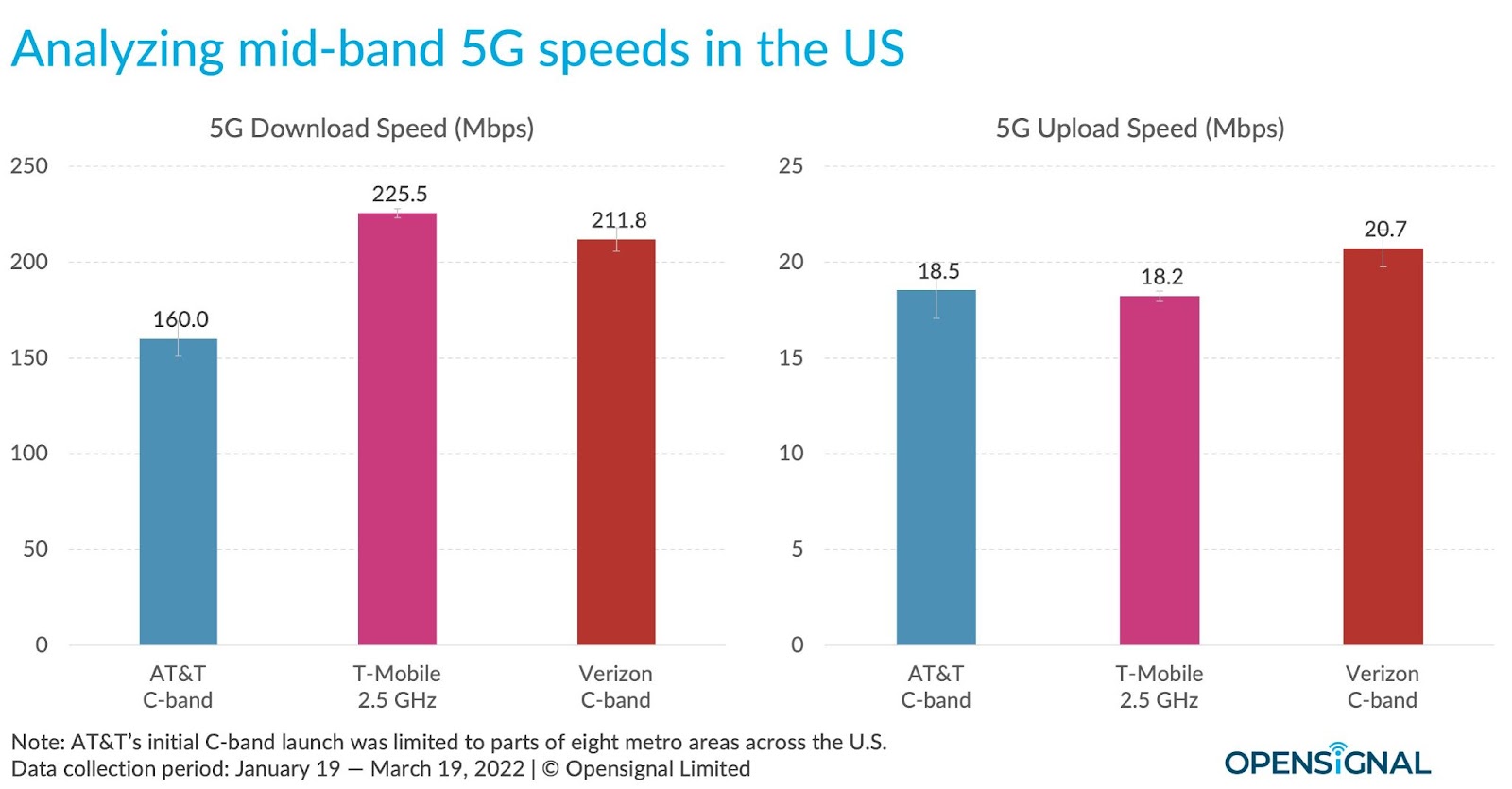
While Opensignal’s reporting has consistently shown that T-Mobile users have the fastest overall 5G download speeds, that story starts to change slightly when comparing only the mid-band 5G speeds for each carrier. That’s because the bottom line is that mobile users on all three of the carriers’ networks — although in limited markets in the case of AT&T — enjoy much faster 5G speeds when connected to mid-band 5G, Opensignal found. On T-Mobile’s mid band spectrum, users experienced average 5G download speeds of 225.5 Mbps, while Verizon users saw an average speed of 211.8 Mbps and AT&T users an average of 160 Mbps. On the other hand, Verizon’s 5G Upload Speed on mid-band 5G was 20.7 Mbps, while AT&T and T-Mobile’s scores were statistically similar at 18.5 Mbps and 18.2 Mbps, respectively.

Cox revealed that Verizon currently has 60 megahertz of C-Band spectrum deployed, with plans to average 161 megahertz per market. “This is more than double our sub-6 spectrum holdings before the C-Band auction,” she said.


You Might Also Like
  • South Korea launches AI-RAN project to advance industrial AI
  • Rakuten Mobile expands O-RAN footprint with 1Finity radios
  •  VodafoneThree puts P.I. Works’ SMO at the center of network transformation
  • Operators are seeking greater control of NTN: GSMA Intelligence
  • Mimosa Networks and Viaero Wireless demonstrate scalable 5 GHz and 6 GHz fixed wireless broadband with AFC
  • What defines network performance in 5G and beyond? A CTO Perspective
Share 0 LinkedinEmail
Catherine Sbeglia Nin

Catherine Sbeglia Nin is the Managing Editor for RCR Wireless News, where she covers topics such as Wi-Fi, network infrastructure, AI and edge computing. She also produced and hosted Arden Media's podcast Well, technically... After studying English and Film & Media Studies at The University of Rochester, she moved to Madison, WI. Having already lived on both coasts, she thought she’d give the middle a try. So far, she likes it very much.

previous post
Bell signs 5G MEC partnership with AWS
next post
BT and Toshiba launch quantum secured network trial

White Papers

  • Norton eBook: The 2026 Telco Playbook

  • Enea White Paper: Why Intelligent AAA is the Swiss Army Knife of Telecom

  • CSG White Paper: Telco AI Enabler: Mediation’s Defining Role

  • Enea White Paper: Scalable Database Design for 5G and Beyond

  • Supermicro and NVIDIA Whitepaper: Powering sovereign AI at scale

Editorial Reports

  • Nvidia Report: The State of AI in Telecommunications: 2026 Trends

  • Report: Scaling Optical Networks For The Hyperscale And AI Era

  • Test And Measurement Market Pulse Report

Webinars

  • Webinar: Building 6G — aligning technology, policy and purpose

  • SIMCom Webinar: Scaling your next deployment – from plastic to provisioning

  • Webinar: Rethinking the RAN as AI, cloud and openness converge

  • Webinar: Scale-Up, Scale-Out, Scale-Across – Building AI-Era Network Fabrics

  • Webinar: NTN in motion – evolving standards, expanding services

Since 1982, RCR Wireless News has been providing wireless and mobile industry news, insights, and analysis to mobile and wireless industry professionals, decision makers, policy makers, analysts and investors.

Facebook Twitter Youtube Linkedin Envelope Rss

Useful Links

  • Subscribe
  • About RCR Wireless News
  • Contact Us
  • Advertise
  • Editorial Calendar
  • Archive
  • RSS
  • Wireless News Archive
  • Subscribe
  • About RCR Wireless News
  • Contact Us
  • Advertise
  • Editorial Calendar
  • Archive
  • RSS
  • Wireless News Archive

Edtior's Picks

Wednesday (telco diary) | What AT&T and Lumen tell us about the AI...
South Korea launches AI-RAN project to advance industrial AI
AT&T’s bets on “best tech” (fiber) pay off with record adds, improving margins 

Latest Articles

Wednesday (telco diary) | What AT&T and Lumen tell us about the AI fiber build-out
South Korea launches AI-RAN project to advance industrial AI
AT&T’s bets on “best tech” (fiber) pay off with record adds, improving margins 
The most expensive wireless system is the one you install twice (Reader Forum)

© 2026 RCR Wireless News All Right Reserved. Developed by Eight Hats.

Cookie Policy | Privacy Policy

RCR Wireless
  • News
  • Channels
    • 5G
    • 6G
    • BSS OSS
    • Carriers
    • IoT
    • Network Infrastructure
    • Open RAN
    • Private 5G
    • Telco AI
    • Telco Cloud
    • Test & Measurement
  • Resources
    • Reports
    • Webinars
    • White papers
    • AI Fundamentals
    • Analyst Angle
    • Editorial Calendar
    • Fundamentals
      • 5G NR Release 17
      • AI
        • Telco AI in 2025
    • Podcasts
      • Let’s Get Digital with Carrie Charles
      • Wireless Connectivity to Enable Industry 4.0 for the Middleprise
      • Well Technically…
      • Will 5G Change the World
      • Accelerating Industry 4.0 Digitalization
  • AI Infrastructure
  • Programs
  • Events
  • RCRtv
  • Advertise
  • Subscribe
RCR Wireless
  • News
  • Channels
    • 5G
    • 6G
    • BSS OSS
    • Carriers
    • IoT
    • Network Infrastructure
    • Open RAN
    • Private 5G
    • Telco AI
    • Telco Cloud
    • Test & Measurement
  • Resources
    • Reports
    • Webinars
    • White papers
    • AI Fundamentals
    • Analyst Angle
    • Editorial Calendar
    • Fundamentals
      • 5G NR Release 17
      • AI
        • Telco AI in 2025
    • Podcasts
      • Let’s Get Digital with Carrie Charles
      • Wireless Connectivity to Enable Industry 4.0 for the Middleprise
      • Well Technically…
      • Will 5G Change the World
      • Accelerating Industry 4.0 Digitalization
  • AI Infrastructure
  • Programs
  • Events
  • RCRtv
  • Advertise
  • Subscribe
@2020 - All Right Reserved. Designed and Developed by PenciDesign