
Open RAN is much more than just an opportunity to diversify vendor supply chains and introduce open standards into networks. It is an opportunity to innovate within what has always been a very hardware-centric and fixed part of the network. Part of that innovation pertains to automation, which can enable operators to move to an IT-based model of operation.
To enable this deployment and maintenance automation in Open RAN, operators must follow the enterprise disaggregation path as seen with data centers. Once hardware and software were disaggregated in the enterprise sector in the 2000s, two similar challenges needed to be addressed:
1. How to integrate software and radio and server hardware from different vendors.
2. How to automate the upgrades to that software from different vendors.
This is where cloudification, ZTP (zero-touch provisioning), AI (artificial intelligence) and ML (machine learning), coupled with analytics come in to enable automation in Open RAN. Today these elements are becoming increasingly important to mobile operators as they look to roll-out and scale network sites.
The following are the stages where automation is key for mobile networks.
Figure 1. Stages of network to automate
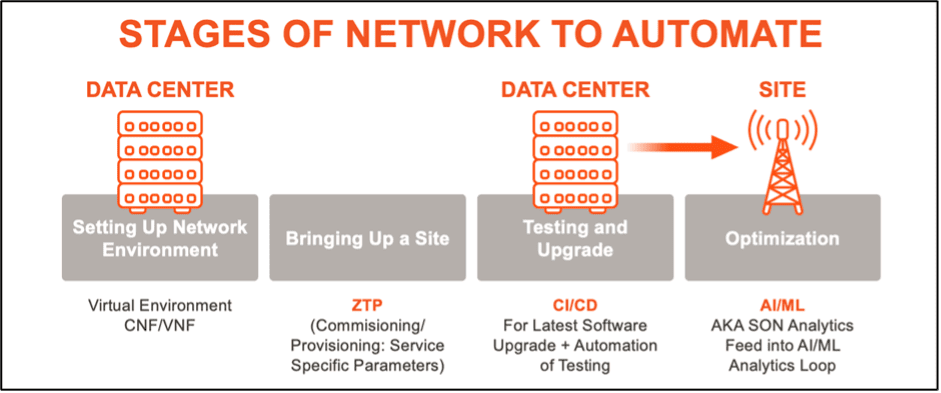
We will first discuss the automation enablers for the RAN, including a deep dive into each one and the network components that can enable it, then steps where RAN automation can happen.
Automation enablers
1. Cloudification is the foundation for the initial stage of setting up an automated network environment.
Cloudification via cloud-native functions (containers and microservices) is the foundation of Open RAN, and will help with effective automation and the move to cloud native networks.
To optimize performance, in an enterprise software environment, software implementation went from monolithic, self-contained applications running on dedicated servers to a new model that was built on webscale models. It eventually evolved to microservices — a decomposition of an application into a multitude of separate parts, each one of them running in a lightweight container-like environment — for example, Docker or rkt or Linux LXD.
Telecoms virtual machines (VMs), which run telecoms workloads in the cloud, with a whole OS to boot, are simply too heavyweight to host microservices. By deconstructing a RAN service into microservices, it’s easy to address any performance issue by spinning up multiple instances of the RAN microservice that might be creating a performance issue, as demonstrated in the graphic below.
Different RAN function components can be implemented as separate microservices, not as one monolithic virtual machine. Because of that, they can be scaled up in any way required to optimize the RAN function’s performance.
A microservices architecture allows mobile operators to continuously innovate by embracing an agile DevOps model. A mobile operator can automate and push out RAN upgrades to as many sites as needed, as testing a microservice involves very few test cases. Testing an entire monolithic (though virtualized) application takes many days of testing.
Each microservice can be deployed, upgraded, scaled and restarted independently of other microservices in the RAN application, using an automated system, enabling frequent updates to live applications without impacting SLAs.
Figure 2. Evolution of virtualization.
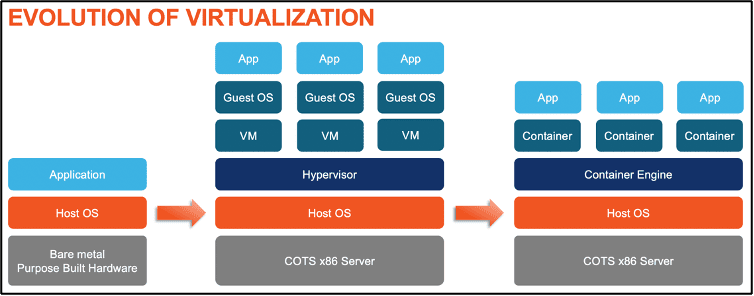
As demonstrated, the RAN function cannot be automated unless it’s containerized and microservices based. Once it’s done, the network deployment automation will follow the following steps:
Automation enablers such as ZTP (Zero Touch Provisioning), CI/CD (Continuous Integration/Continuous Development) and AI/ML are important enablers for software-based cloud-native networks across all stages of network deployment.
Deep dive into automation enablers
ZTP ensures that sites are configured quickly and automatically. By reducing or eliminating the need to send engineers on-site, the ongoing maintenance costs will be reduced for mobile operators.
ZTP will be critical for dense 5G deployments when hundreds of sites will need to be configured.
Once sites are configured, CI/CD is utilized to automate updates and reduce any manual labor involved on-site or in the data center through automated distribution of software upgrades. CI/CD frameworks have been used in IT and enterprise industries for years. The DevOps movement inspired large enterprises with agile practices to allow developers to make quick changes. However, it was very difficult to get full benefit, as their legacy development process was not designed for supporting short software development delivery cycles and frequent production releases.
To release software into production quickly but reliably and — most importantly — repeatably, the DevOps movement developed the CI/CD methodology. Jez Humble and David Farley covered these principles and practices in their book “Continuous Delivery: Reliable Software Releases through Build.”
DevOps is a set of practices developed for IT that combines software development (Dev) and information-technology operations (Ops) which aims to shorten the systems development lifecycle and provide continuous delivery with high software quality. DevOps requires a mindset shift; as traditionally separated departments within an organization now need to work very closely together. They will need to implement a set of new automation tools to be used across the group for monitoring and testing the application and keeping it secure.
Cloud-native data center technology, adopted by enterprises in 2000, offers the flexibility that paves the path forward to realize new services for mobile operators. Implementation of this data center inspired approach is the next step in evolving legacy RAN to fully automated Open RAN with CI/CD.
Figure 3. DevOps model.

DevOps and CI/CD enable fast changes to software. The updates delivered to sites can be monitored to evaluate how they impact end-users and whether they are achieving the pre-determined business goals.
However, data center technologies introduce a level of operational complexity in the RAN, so there are two important factors to keep in mind as CI/CD is adopted for Open RAN. The first factor is the disaggregation itself, as hardware and software components are coming from different vendors. The second consideration is around physical components such as servers and radios in the RAN.
Software upgrades with CI/CD
When applying CI/CD models to RAN upgrades, they need to holistically feed into the overall CI/CD strategy across all network segments — RAN, transport and core. So, in addition to creating a cohesive RAN CI/CD strategy, a mobile operator needs to create an overall network CI/CD strategy.
The combined power of containers and CI/CD simplifies automation by providing validated stack templates for containers to host microservices. These upgrades will be automated with CI/CD. The combination of software being pushed via CI/CD to containers allows MNOs to easily define their own architecture and make Open RAN easier and more cost-effective to deploy and maintain. The main benefit will be in sites running as a service with software updates being pushed to hundreds of sites automatically instead of scheduling them for upgrades when a crew is available to go on site and upgrade manually.
Automation of testing with CI/CD
The integration, software upgrades and lifecycle management of these disaggregated software components, running on COTS hardware is enabling a new testing model: software from the different groups within an organization is no longer tested in silos, but tested under an overall CI/CD umbrella. As a result, CI/CD will significantly reduce development time from hours to minutes of effort, eliminating most of the manual tasks.
By implementing CI/CD, mobile operators embrace greater collaboration between different ecosystem members, which fosters innovation. It supports multi-vendor, cloud-native network function onboarding and lifecycle management of software from different vendors. This approach minimizes risk through frequent delivery of new features and new optimizations while increasing efficiency via automation that leads to the faster introduction of new services to keep end-users happy.
Table of Contents