


Integrated Access and Backhaul (IAB) can open doors to a more flexible densification strategy, allowing operators to quickly add new base stations using wireless backhaul
5G New Radio (NR) is a global standard that enhances the 5G wireless air interface. NR will provide a much faster mobile experience in the low- (below 1 GHz), mid- (1GHz to 6GHz) and high- (above 24GHz mmWave) bands. In this article, we will discuss frequencies above the high-band mmWave spectrum, showing how Integrated Access and Backhaul (IAB) can open doors to a more flexible densification strategy, allowing operators to quickly add new base stations using wireless backhaul.
Challenges in expanding 5G NR mmWave network coverage
One key challenge, to broadly expanding 5G NR mmWave network coverage, is the cost of deploying additional mmWave base stations. The following are some other primary mobile 5G mmWave problems and how they are being overcome:
- An important aspect of this deployment will require solid backhaul installations using new wireless backhaul infrastructures which make mmWave densification more cost-efficient.
- There will be path loss limiting coverage that will require many small cell deployments; however, analog beamforming will help to overcome that path loss.
- mmWave needs line-of-sight (LOS) which can lead to limits in signal propagation. Advanced beamforming and beam tracking will help by leveraging path diversity and reflections.
- mmWave works only for fixed use. The solution here is handoff with adaptive beam steering and switching which overcomes blockages.
- Large form factor is needed for mmWave, which is power hungry and has thermal challenges in a small form factor. The solution is modems, RF and antenna solutions to meet form factor and thermal limits via the commercialization of the smart phone.
What is 5G IAB?
Recently 3GPP has suggested a process of standardizing multi-hop IAB networks. This article will provide an overview of the main features of the multi-hop IAB which is proposed by the 3GPP release-16 standard along with the reasoning behind these design choices.
3GPP 5G Release 16 introduced IAB that enables a base station to provide both wireless access for devices and wireless backhaul connectivity, thereby eliminating the need for a more costly wired backhaul installation. IAB is when a part of access spectrum is used as backhaul.
Reasons to deploy wireless IAB vs. fiber IAB
5G has promised the ability of high bandwidth which comes from high frequencies in the mmWave bands. A problem exists in that high-frequency deployments are coverage-limited and will need denser placement of base stations. This will increase rollout cost significantly. A major contributing factor to this cost is the deployment of fiber which requires installations below the ground.
IAB, in which part of the wireless spectrum is used for the backhaul connection of base stations instead of fiber, now becomes an attractive solution that could enable dense deployments that are economically viable.
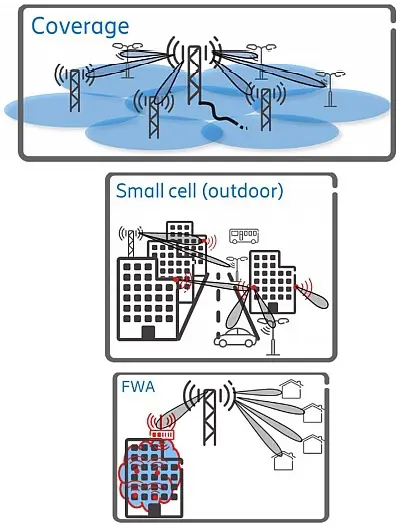
A major benefit of IAB is that it enables flexible and very dense deployments of New Radio (NR) cells without having to densify the transport network proportionately. We can envision a broad range of deployment scenarios, including support for outdoor small cell deployments, coverage extension, indoor deployments and fixed wireless access (FWA). This is illustrated in Figure 1.
The first release of 3GPP Release 16 features:
- Multi-hop backhauling that will allow flexibility in range extension.
- Quality of Service (QoS) differentiation and enforcement so that 5G QoS is met especially in multi-hop situations.
- Support for network topology adaptation and redundant connectivity that enables optimum backhaul performance as well as fast adaptation to backhaul radio link overload and failure.
- In- and out-of-band relaying by use of the same or different carrier frequency for the access (such as UE links) as well as backhaul links (link to other network nodes) of the IAB node, respectively.
- Support for legacy terminals where deployment of IAB nodes need to be transparent to User Equipment (UE), so no new UE features or standardizations are needed.
Verizon’s plans are a good example of deploying wireless IAB vs. fiber IAB
Verizon has embraced the deployment of IAB technology. This is important because the operator, thus far, is using a massive amount of fiber connections to backhaul traffic from its 5G transmission sites.
That’s a costly and potentially limiting requirement considering it means that Verizon can only install 5G antennas into locations where it will be able to access connections to fiber and electricity.
By deploying a wireless IAB, Verizon could potentially install 5G transmitters in locations that only have electricity, and not fiber, because the wireless antennas could backhaul their traffic via a wireless link to a nearby receiver. That receiver would most likely need to be connected to a fiber network.
IAB deployment would allow Verizon to install 5G antennas into locations where routing a fiber cable could be difficult or expensive. A good example would be the difficulty of embedding fiber cables across a set of train tracks.
IAB is far better than current wireless backhaul technologies, such as those that use the 60-90GHz E-band, since it will not require a separate antenna for the backhaul link. As indicated by the “integrated” term in the “integrated access backhaul” process, IAB can support wireless connections both for regular 5G users and also for backhaul links by using the same antenna.
Deploying a wireless IAB infrastructure in smart cities
Urbanization is increasing rapidly as people are fleeing rural areas from suburban communities. This has placed a burden on infrastructures in these urban regions. Smart city deployments may be the savior for urban growth since they will alleviate these burdens.
5G technology is expected to be a turning point that will propel smart city technology into the mainstream while accelerating new deployments. 3GPP NR Release 16 instituted wireless IAB which is a key part of new deployments.
A smart city is a framework, mainly composed of Information and Communication Technologies (ICT) that enables sustainable development practices to address growing urbanization challenges.
The ICT framework is composed of an intelligent network of connected objects and machines that can transmit data using wireless technology and the cloud. Smart city residents will engage with smart city ecosystems via smartphones and mobile devices as well as connected cars and homes.
Deploying many Internet-of-Things (IoT) devices throughout the Smart City will enable monitoring and management of environmental conditions as well as infrastructure. This effort can be costly. Smart City survival will depend on reducing costs.
Smart Cities need IoT devices to be connected to the Internet to access the data coming from those devices. Deploying a wireless IAB here allows a base station to provide both wireless access for devices and wireless backhaul connectivity, thereby eliminating the need for a costly wired backhaul. Wireless IAB also enables base stations of all sizes to be deployed more quickly, providing the community with full coverage in the timeliest manner. Multi-hop IAB networks are now becoming standardized due to 3GPP rel-16.
Smart cities also provide an infrastructure for optimum energy distribution, improved trash collection, decreased vehicle traffic congestion, with improved air quality from the IoT via a true wireless communication deployment.
Connected traffic lights will receive data from sensors and automobiles by adjusting timing for light cadence, enabling quick reaction to real-time traffic while reducing traffic congestion.
Connected cars will wirelessly connect with parking meters and electric vehicle (EV) charging docks, directing drivers to the nearest available recharging and parking areas.
Smart trash cans will wirelessly send data to waste management locations to optimally schedule pick-up.
Resident’s smartphones become a mobile driver’s license and ID card with digital credentials for quicker access to the city and local government services.
So, by using part of the large spectrum available at mmWave frequencies for wireless backhauling, IAB will greatly reduce the deployment costs of 5G networks, while enabling a comparable performance to fiber deployment.
Looking forward to 5G Release 17
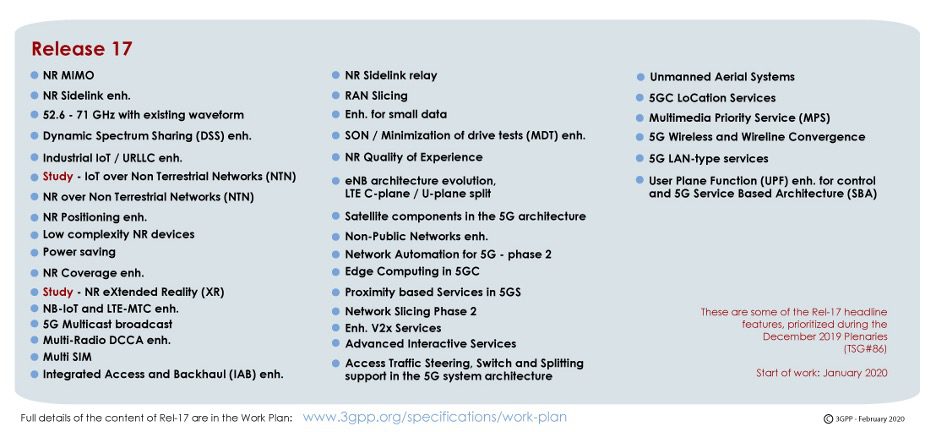
5G 3GPP Release 17 (Figure 2) has a new schedule as a result of e-meetings which delayed progress because of cancellation of face-to-face meetings due to the Coronavirus. 3GPP hopes to return to face-to-face meetings in the second half of 2021. The good news is that the content of Release 17 remains approved as of December 2019 meetings. For more details, please see Release 17 timeline agreed on the 3GPP website.
Conclusion
We looked at the many challenges facing the daunting task of expanding 5G NR mmWave network coverage in this article.
Fiber was an initial, but costly, choice option until the 5G 3GPP Release 16 came along with integrated access and backhaul as a very viable, lower-cost option. We have shown that wireless IAB is a far better solution in cost as well as performance as compared to fiber or any other proposals. A good example was provided with Verizon’s solution.
One major, and relatively new area of deployment of 5G communications, is the smart city. This article demonstrated how a wireless IAB is a perfect example of dense deployment with comparable performance, at 5G mmWave frequencies, without the need for a more costly fiber connection to each base station.
Table of Contents

