RCR Wireless
  • News
  • Channels
    • 5G
    • 6G
    • BSS OSS
    • Carriers
    • IoT
    • Network Infrastructure
    • Open RAN
    • Private 5G
    • Telco AI
    • Telco Cloud
    • Test & Measurement
  • Resources
    • Reports
    • Webinars
    • White papers
    • AI Fundamentals
    • Analyst Angle
    • Editorial Calendar
    • Fundamentals
      • 5G NR Release 17
      • AI
        • Telco AI in 2025
    • Podcasts
      • Let’s Get Digital with Carrie Charles
      • Wireless Connectivity to Enable Industry 4.0 for the Middleprise
      • Well Technically…
      • Will 5G Change the World
      • Accelerating Industry 4.0 Digitalization
  • AI Infrastructure
  • Programs
  • Events
  • RCRtv
  • Advertise
  • Subscribe
Friday, July 31, 2026
RCR Wireless
  • News
  • Channels
    • 5G
    • 6G
    • BSS OSS
    • Carriers
    • IoT
    • Network Infrastructure
    • Open RAN
    • Private 5G
    • Telco AI
    • Telco Cloud
    • Test & Measurement
  • Resources
    • Reports
    • Webinars
    • White papers
    • AI Fundamentals
    • Analyst Angle
    • Editorial Calendar
    • Fundamentals
      • 5G NR Release 17
      • AI
        • Telco AI in 2025
    • Podcasts
      • Let’s Get Digital with Carrie Charles
      • Wireless Connectivity to Enable Industry 4.0 for the Middleprise
      • Well Technically…
      • Will 5G Change the World
      • Accelerating Industry 4.0 Digitalization
  • AI Infrastructure
  • Programs
  • Events
  • RCRtv
  • Advertise
  • Subscribe
Add RCR Wireless as a preferred source on Google
  • Qualcomm 6G Insights
  • Huawei Content Hub
  • Qualcomm – 6G Vision
  • OSS/BSS Channel
  • RCRTech Roundtable: AI Infrastructure
RCR Wireless
RCR Wireless
  • Advanced Mimo
  • Mobile mmWave
  • 5G Positioning
  • Green Networks
  • Metaverse
  • Automotive
  • Industrial and Wide-area IoT
Copyright 2021 - All Right Reserved
Home - T-Mo, Halo set the pace with an autonomous 5G-connected car
5GCarriersConnected CarsFeatured

T-Mo, Halo set the pace with an autonomous 5G-connected car

by Kelly Hill January 17, 2022
written by Kelly Hill January 17, 2022 Share
LinkedinEmail
Share 0LinkedinEmail
Halo 5G autonomous pace car
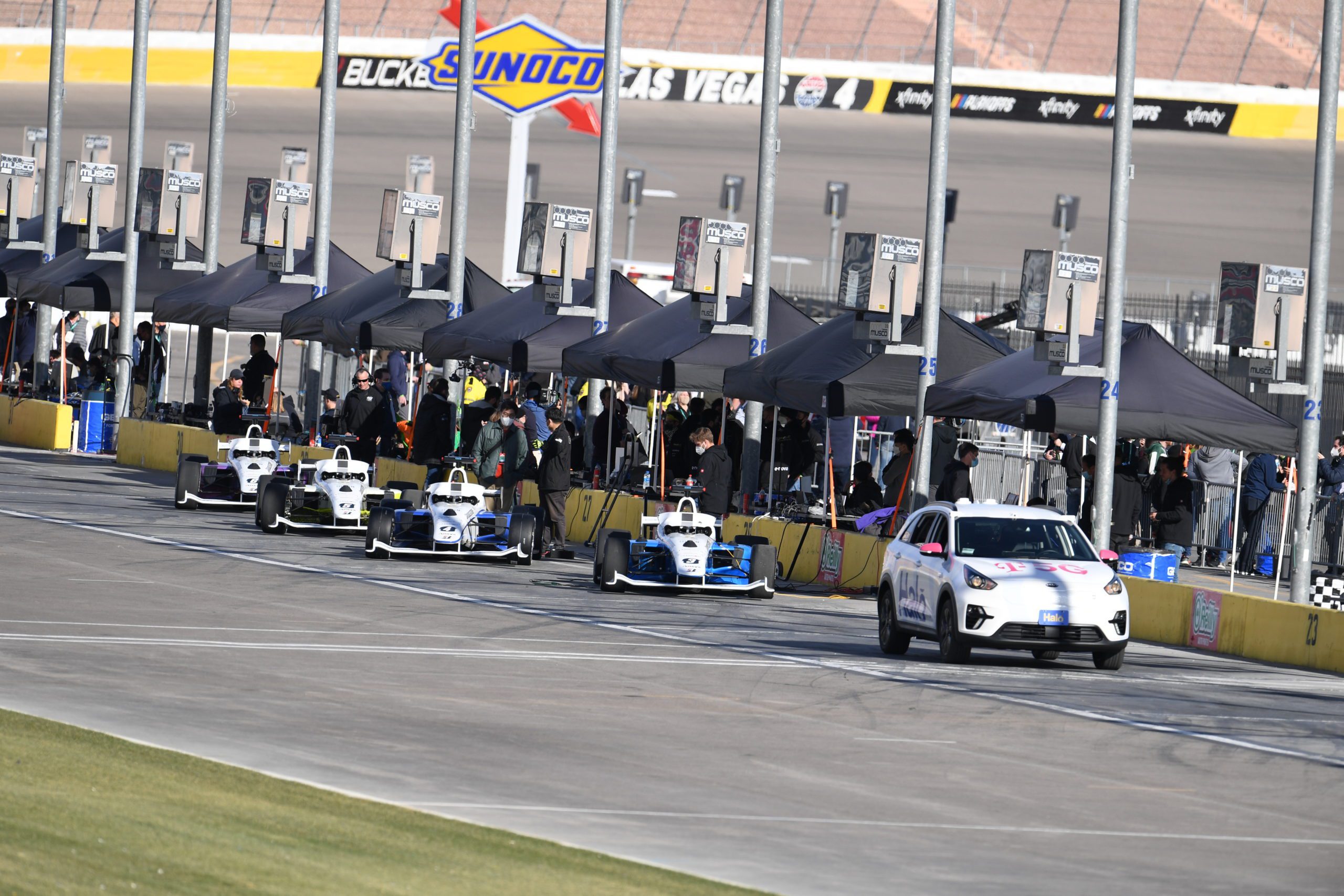
Halo pace car leading autonomous race cars. (Image courtesy T-Mobile US)
322

Autonomous Halo pace car led the Autonomous Racecar Challenge during CES 2022

The line of sleek, Formula-One-style autonomous vehicles at the Las Vegas Motor Speedway took to the track one by one. Their small size and compressed cockpits were the major giveaways that these were autonomous vehicles, zooming around the track without drivers behind their wheels.

Among the vehicles taking turns around the track and making pit stops was a white Kia sedan, with “T 5G” splashed across the hood and its side-mirrors painted in T-Mobile US’ signature magenta. The Kia, too, had no driver in its front seat — at least, not physically. The car, from start-up Halo, was remotely piloted by a driver who was connected to the car via T-Mobile US’ 5G network.

The vision for 5G-connected vehicles often assumes that completely autonomous vehicles are going to make use of the technology. But fully autonomous (Level 5) vehicles may still be years away. What if there is an intermediate step available in the short-term that uses 5G to connect a vehicle that is driven by a remote pilot, who can make use of extensive advanced vision capabilities to safely pilot a vehicle with the reflexes and experience of a human driver — and then turn it over to a physical driver in the car at-will?

This is the vision of Halo, which is leveraging T-Mobile US’ 5G network to connect remote pilots to drive its vehicles.

As Halo’s founder and CEO Anand Nandakumar has put it: “Full autonomy is a massive challenge from both a technical and social trust perspective that won’t be solved for years to come. But Halo has been designed to address these challenges by building automation over time starting with a solution that consumers will feel comfortable using today.”

“I love this use case, and I talk as much as I can about it publicly,” said John Saw, EVP of advanced and emerging technologies at T-Mobile US. He added that the ability to enable a vehicle-based 5G use “is something that Verizon and AT&T are struggling to do, because they don’t have as big a 5G footprint.”

Screen Shot 2022 01 17 at 1.18.33 PM
Halo’s pace car at the Indy Autonomous Challenge at CES. (Screenshot from broadcast stream)

He went on, “When you’re sitting in a driverless car, driven over a 5G network, you really need to make sure that you have a big enough coverage footprint that it doesn’t ping-pong between LTE and 5G. That would cause a lot of jitter.”

Saw also shares Nandakumar’s view that full vehicle autonomy isn’t the most immediate of 5G use cases. “Candidly, I think Level 5 cars are not going to be a reality any time soon,” he says. “I think people are beginning to realize that, after you go through the hype cycle.”

In contrast, Saw said, Halo takes what he describes as a “very pragmatic approach” that both gives people full control of the vehicle that they are in — which helps to address people’s comfort levels around autonomous vehicles — and achieves a remotely-driven vehicle at a much lower cost than the multi-million-dollar autonomous race cars that shared the track with Halo’s Kia Niro electric sedan.

Nandakumar said that Las Vegas-based Halo is still in discussions on when it will officially deploy, but the concept is a mash-up between Uber and Zip Car: Use a smartphone app to summon an electric car, which is driven by a remote pilot to your location. You get in and drive the car in full manual control, just as you would drive any other car. But once you arrive at your destination, the remote pilot takes over again to drive the vehicle away to its next customer.

“Once they get to their destination, parking is always a problem,” Nandakumar explains. “What if we can solve that, too? Why not just walk away from the car and go away? Don’t worry about the car, the car just disappears. That gives so much time back to us.” He says that Halo is targeting multiple aspects with its service: Being completely on-demand and convenient, with “very affordable pricing” that introduces people to electric vehicles and can be used globally.

The remote driver, meanwhile, can sit in an air-conditioned room in what looks like an elaborate video-game driving set up, and is connected to T-Mobile US’ 5G network. “They literally see the car in real life, and we innovated so much technology into these vehicles to allow us to connect over 5G and connect that remote pilot, they feel like they’re inside the car,” Nandakumar says, adding that because of external cameras, the remote pilots can actually have a better view than a driver sitting inside the car — while earning more money than a driver accepting ride-shares.

nr hero 5GNow Halo V2 1 11 22
Halo’s pace car, flanked by autonomous race cars at the Indy Autonomous Challenge. (Image via T-Mobile US)

At the Indy Autonomous Challenge, the Halo team put its pace car and technology stack to the test and successfully achieved speeds of 95 miles an hour. While the car would not normally travel at speeds anywhere near that, Nandakumar said, Halo still wanted to see how the vehicle would do under more extreme conditions and showcase to the world how far its tech had come. “No glitches, no problems, no issues. The stack was completely consistent, all on the T-Mobile 5G network,” Nandakumar said.

Saw said that Halo is using both NSA and SA 5G access to T-Mobile US’ network at this time. Both companies see a path to 5G Standalone over time, and a continued collaboration that began with Halos’ participation in T-Mo’s 5G Open Innovation Lab.

“As a younger company, a super, super early-stage company, it’s really difficult to unlock large partnerships, like with big brands, big companies,” said Nandakumar. “We need some form of help, with people who have already done that in the past.”

“We are always looking for new innovations to best use our 5G network,” Saw said, adding, “We’re spending upwards of $60 billion building this network, so someone has to figure out what to do with it. How do we use it?

“We knew from the onset when the [T-Mobile/Sprint] merger closed, that we had to build something bigger than ourselves,” he continued. “So we co-founded the 5G Open Innovation Lab —we have our own T-Mobile accelerator, to really work with innovators and start-ups on the cool ideas that they have, and hopefully take their ideas to the next level by giving them access to our engineers and our 5G network.”

“This is all possible because we’re on T-Mobile’s Ultra-Capacity 5G network,” Nandakumar said. “It’s incredible for us, it’s going to be powerful for us, and it’s able to make this futuristic vision happen today, and not 10 years from now. Today.”

nr hero 5GNow Halo 1 11 22
Halo’s pace car with a remote pilot. Image via T-Mobile US

You Might Also Like
  • Thursday (telco diary) | Vodafone resets, AT&T reloads
  • AI-RAN takes shape as Open RAN, Cloud RAN and AI converge
  • The Agentic Network — Boost Mobile on the right data for AI
  • Wednesday (telco diary) | Orange leads Euro telco revival
  • The 6G AI uplink panic (Analyst Angle)
  • Tuesday (telco diary) | D2D in 3D – Amazon appeals to telcos
Share 0 LinkedinEmail
Kelly Hill

Kelly Hill reports on network test and measurement, AI infrastructure and regulatory issues, including spectrum, for RCR Wireless News. She began covering the wireless industry in 2005, focusing on carriers and MVNOs, then took a few years’ hiatus and returned to RCR Wireless News to write about heterogeneous networks (remember those?) and network infrastructure. Kelly is an Ohio native with a masters degree in journalism from the University of California, Berkeley, where she focused on science writing and multimedia. She has written for the San Francisco Chronicle, The Oregonian and The Canton Repository. She lives in northern Virginia, not far from Data Center Alley.

previous post
5G monetization requires the right blend of technology, partners and market positioning: Nokia Q&A
next post
Welcome to the Future of Shared Digital Infrastructure with Rod Hanson of Cityside Networks

White Papers

  • Norton eBook: The 2026 Telco Playbook

  • Enea White Paper: Why Intelligent AAA is the Swiss Army Knife of Telecom

  • CSG White Paper: Telco AI Enabler: Mediation’s Defining Role

  • Enea White Paper: Scalable Database Design for 5G and Beyond

  • Supermicro and NVIDIA Whitepaper: Powering sovereign AI at scale

Editorial Reports

  • Market Pulse Report: Telco AI in 2026 – Trends, Challenges and Opportunities

  • Nvidia Report: The State of AI in Telecommunications: 2026 Trends

  • Report: Scaling Optical Networks For The Hyperscale And AI Era

Webinars

  • Webinar: Building 6G — aligning technology, policy and purpose

  • SIMCom Webinar: Scaling your next deployment – from plastic to provisioning

  • Webinar: Rethinking the RAN as AI, cloud and openness converge

  • Webinar: Scale-Up, Scale-Out, Scale-Across – Building AI-Era Network Fabrics

  • Webinar: NTN in motion – evolving standards, expanding services

Since 1982, RCR Wireless News has been providing wireless and mobile industry news, insights, and analysis to mobile and wireless industry professionals, decision makers, policy makers, analysts and investors.

Facebook Twitter Youtube Linkedin Envelope Rss

Useful Links

  • Subscribe
  • About RCR Wireless News
  • Contact Us
  • Advertise
  • Editorial Calendar
  • Archive
  • RSS
  • Wireless News Archive
  • Subscribe
  • About RCR Wireless News
  • Contact Us
  • Advertise
  • Editorial Calendar
  • Archive
  • RSS
  • Wireless News Archive

Edtior's Picks

Building the AI backbone, waiting on the AI billions
Ensuring colocation success by eliminating network observability blind spots (Reader Forum)
Thursday (telco diary) | Vodafone resets, AT&T reloads

Latest Articles

Building the AI backbone, waiting on the AI billions
Ensuring colocation success by eliminating network observability blind spots (Reader Forum)
Thursday (telco diary) | Vodafone resets, AT&T reloads
SK Telecom’s A.X K2 is South Korea’s biggest bet yet on sovereign AI

© 2026 RCR Wireless News All Right Reserved. Developed by Eight Hats.

Cookie Policy | Privacy Policy

RCR Wireless
  • News
  • Channels
    • 5G
    • 6G
    • BSS OSS
    • Carriers
    • IoT
    • Network Infrastructure
    • Open RAN
    • Private 5G
    • Telco AI
    • Telco Cloud
    • Test & Measurement
  • Resources
    • Reports
    • Webinars
    • White papers
    • AI Fundamentals
    • Analyst Angle
    • Editorial Calendar
    • Fundamentals
      • 5G NR Release 17
      • AI
        • Telco AI in 2025
    • Podcasts
      • Let’s Get Digital with Carrie Charles
      • Wireless Connectivity to Enable Industry 4.0 for the Middleprise
      • Well Technically…
      • Will 5G Change the World
      • Accelerating Industry 4.0 Digitalization
  • AI Infrastructure
  • Programs
  • Events
  • RCRtv
  • Advertise
  • Subscribe
RCR Wireless
  • News
  • Channels
    • 5G
    • 6G
    • BSS OSS
    • Carriers
    • IoT
    • Network Infrastructure
    • Open RAN
    • Private 5G
    • Telco AI
    • Telco Cloud
    • Test & Measurement
  • Resources
    • Reports
    • Webinars
    • White papers
    • AI Fundamentals
    • Analyst Angle
    • Editorial Calendar
    • Fundamentals
      • 5G NR Release 17
      • AI
        • Telco AI in 2025
    • Podcasts
      • Let’s Get Digital with Carrie Charles
      • Wireless Connectivity to Enable Industry 4.0 for the Middleprise
      • Well Technically…
      • Will 5G Change the World
      • Accelerating Industry 4.0 Digitalization
  • AI Infrastructure
  • Programs
  • Events
  • RCRtv
  • Advertise
  • Subscribe
@2020 - All Right Reserved. Designed and Developed by PenciDesign