

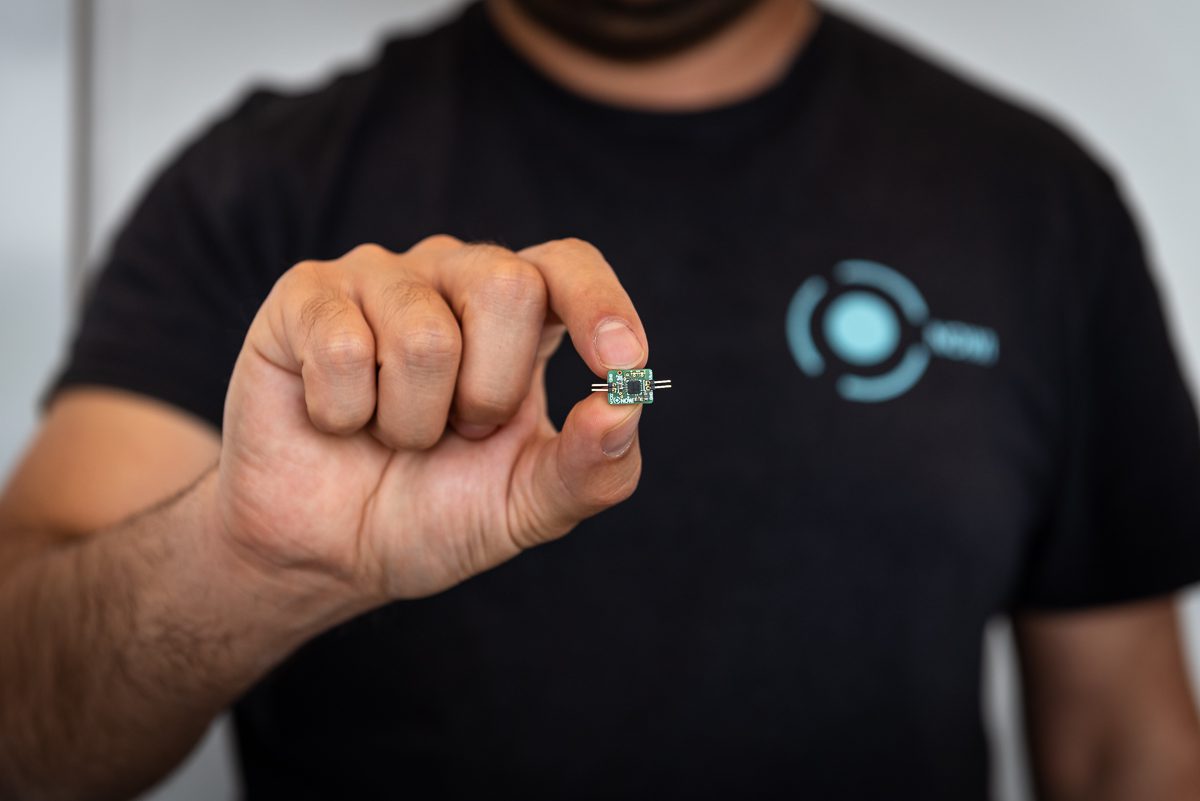
Last week, Amsterdam-based Nowi, a specialist in energy harvesting tech for integrated circuit (IC) microchips, announced work with narrowband IoT connectivity provider Sigfox to produce IoT modules that extract power from ambient energy sources, instead of from conventional single-use or rechargeable batteries. It has similar arrangements, it says (see below), with producers of LoRaWAN and cellular IoT (NB-IoT and LTE-M) products.
Together, these low-power wide-area (LPWA) technologies – plus a few others, plus local-area low-power equivalents BLE and Zigbee, plus everyday in-between technologies like WI-Fi – will drive the so-called ‘massive IoT’ market, comprising billions of sensor ‘things’ connecting millions of monitoring applications. This is the real IoT market, nominally defined as massive machine-type comms (mMTC), which will drive societal change.
So the story goes. By contrast, the brighter IoT pyrotechnics (loosely, ultra-reliable low-latency comms; URLLC) on private (someday-sliced) 5G networks, in Industry 4.0 and other digital-change sectors, are a sideshow – highly-engineered and powerful, but also rather niche. Everything else in the new connectivity game is about flexing (enhanced mobile) broadband (eMBB) for the old internet-of-people.

van der Jagt – on energy harvesting in IoT (see interview below)
This is an interpretation of the cellular world-view, anyway; it is simplistic, and probably dogmatic, but useful as a prism through which to regard ‘digital transformation’ – this grand sales effort to reimagine industrial economies as smart, profitable, and sustainable. The problem with massive IoT – mMTC; just plain enterprise IoT – is that, even if it is good for business, it looks bad for the environment. Billions of throwaway IoT trackers? What a mess!
Because the barrier for massive IoT, until now, has been price and complexity. But these are being put right, progressively, probably belatedly. IoT costs are coming down – to as low as a couple of dollars, and ever-closer to the magic dollar mark, for hardware and to about a dollar-per-year for airtime. There are other fees, too, but these are being hammered out and hammered down in clearer total-cost-of-ownership (TCO) calculations.
Meanwhile, complexity is being abstracted all the time; the design-once (deploy anywhere) mantra is starting to work for airtime, through flat-rate pricing, international roaming and integrated SIM (iSIM) rollout, and also for software development, as the low-code/no-code movement (and tiny ML trend) makes machine learning (ML) accessible (and portable to the device-edge), and open app interfaces (APIs) untangle the mad web of IoT airtime standards.
But alarm bells are ringing as IoT gets cheaper and easier, and the IoT industry looks to make good on its promise of however-many billion trackers and monitors. Because at a dollar-a-pop, where the initial ROI becomes irrefutable, there is surely no wriggle-room to replace or recharge batteries on huge fleets of IoT sensors, every five or 10 years. So realistically, where will they go, really, if they are not to litter the planet?
There is talk about using alkaline batteries, instead of lithium batteries, which are “dissolvable”; the same for the other printed components, bar the chip, which can be retrieved, the industry thinks. There is also talk about using biodegradable plastics made from fish scales for the substrate (wafer) in the chips. Such innovations are hopeful, but they all tend to look at the problem for massive IoT – and electronics, in general – from the old viewpoint.
Nowi, now we get back to it, looks at it differently; it wants to get rid of the battery altogether. In the end, massive IoT is not being held back just by cost and complexity, says Simon van der Jagt, the company’s chief executive, but by the existential issue of its environmental impact. If the IoT industry cannot answer the green question, it cannot move forward, he suggests. And the only way to do that, he argues, is by jettisoning the battery to harness natural power sources.
Which is the basis of its work with all the LPWA brigade, including teams Sigfox, LoRaWAN, and NB-IoT/LTE-M. The company’s power-management IC (PMIC) extracts power from ambient energy sources like light and vibration to charge a variety of energy storage elements such as a rechargeable battery (!) or a capacitor. In conversation with Enterprise IoT Insights, van der Jagt says there is no other way for IoT than with energy harvesting.
The full transcript is below, and makes for important reading; all the responses are from van der Jagt. A new editorial report by RCR Wireless and Enterprise Iot Insights on the green credentials of 5G and IoT, including with input from van der Jagt at Nowi, will be available next month; check back for its release.
…
Can massive IoT – millions and billions of dirt-cheap, possibly disposable, trackers – also be green IoT?
“I think the question is more the opposite. Can massive IoT exist without being green? Green in this context effectively means a low-cost-of-ownership as it eliminates the need for battery changes. Currently IoT solutions are often either limited in functionality or in operational costs due to their power constraints. Vendors can choose to limit functionality – such as the number of transmissions per day – in order to prolong battery life, or [else] try to incorporate the costs of battery changes into their business models. In practice, both [options] are… prohibitive for mass deployments. Many high-volume applications will require energy harvesting in order to be economically viable. As such, it is not a nice-to-have, but a need-to-have.”
How can the environmental impact of massive IoT be mitigated by the industry?
“By thinking about the total product life cycle and how batteries play a central role in this. We often think about production cost in relation to sales price when launching a new product. This is important, clearly. But with IoT, the purchase price is often a fraction of the total lifetime cost of operating a sensor. Having to change a single battery during the lifetime of a sensor changes the business case entirely – not so much because of the battery cost itself, but mostly because of the labour and logistics involved in doing this maintenance. Discarding large amounts of batteries is harming the environment, but it is also detrimental to the viability of massive IoT business cases.”
So, batteries not included – batteries cannot and should not be replaceable or recyclable in dirt-cheap dollar trackers?
“The solution to make IoT greener will not be to make batteries slightly-less polluting; it will be to make them redundant altogether. Fundamentally, the problem is how to get energy to a product. As users, we are used to bringing energy to our devices – with a cable or a battery. But with massive IoT this starts to become unfeasible. It is unpleasant as a consumer, and expensive as a business. It often requires someone to drive around and climb a ladder, literally, just to swap a single battery – and repeat 100,000 times over a large area. Few business cases can survive additional operational costs of this magnitude, let alone for IoT trackers that should be inexpensive. The end-user should no longer be made responsible for bringing energy to devices; instead, the responsibility for powering the device should fall to the product engineers – to develop products that are self-powered by design.”

PMIC – the Nowi NH2 on Nordic Semiconductor’s Thingy91 development platform
What are the near-term prospects for energy harvesting? How soon?
“We have seen demand skyrocket recently as more and more IoT projects have failed to scale after initial pilots. Energy harvesting is no longer an interesting technology for making IoT deployments greener; it is now often required in order to make the business case for a deployment work in the first place. Nowi’s PMIC (power-management integrated-circuit) design has simplified and lowered the cost of having high-performing energy harvesting in a product. With multiple partner programs and reference designs with LoRa, Sigfox and NB-IoT vendors, [energy harvesting] is made even easier as all the tools are readily available to implement this into a product.”
What are the most viable energy harvesting techniques for low-power IoT?
“Each application is unique, however they often share similarities. Because of this reason we have made platforms and reference designs available with IoT connectivity vendors that help users get to around 80 percent of their design. That last 20 percent will be different for each user. These platforms have been based on indoor and outdoor light harvesting, as we have seen the largest demand here. Light is reliable, has a high-power density per area, and is low-cost to implement. As such it has become very popular. At the same time there are applications in which movements, vibrations or temperature gradients can be used to power the device.”
Is the functionality and application of IoT devices limited with energy harvesting?
“More often than not it is enhanced as energy harvesting enables a larger daily energy budget and thus more daily functionality. This is of course application dependent as some applications might be used in a way that makes energy harvesting difficult to implement. Nowi’s application engineering team helps companies in deciding what type of harvesting and implementation will work best in their application.”

