
Industrial-grade enhancements coming to 5G with 3GPP Releases 16 and 17
Initial 5G network deployments, beginning in 2018 and continuing today, have largely been focused on providing consumers with an enhanced mobile broadband experience. However, as operators continue to invest in network capabilities enabled by 5G and enhanced by the transition to cloud-native cores and the distribution of computing power to the network edge, it’s becoming clear that digital enablement of physical industries will create significant, long-term value.
Based on research produced by IHS Markit, 5G will drive more than $13 trillion in sales activity by 2035, create nearly 23 million jobs in that time period, and support a more than 10% increase in global GDP. Focusing more near-term on 2021 to 2025, Accenture sees 5G having a major impact on global manufacturing, increasing productivity by between 20% and 30%, improving assembly efficiency by 50%, extending asset life by 20%, and pushing defect detection up to 90%. In the global agricultural sector, Accenture sees 5G contributing to up to 25% increased productivity, a 20% reduction in costs, and a 15% increase in crop yields.
To make good on these significant projections, operators are working with industrial end users and other technology partners to build on 5G for eMBB 5G with the addition of support for massive Internet of Things, and enhanced ultra-reliable low latency communications (eURLLC). Given a number of converging trends around spectrum access liberalization, the unique and highly-variable needs of industrial end users, and technology consumption preferences of distributed global firms, private networks are poised to deliver the 5G capabilities industries need in a manner that aligns with their technological and business strategies.
“5G private networks can serve the connectivity needs of a broad array of enterprise and industry verticals with high network availability, reliability, and data security for business assurance,” said Xiaoxia Zhang, Senior Director, technology, Qualcomm Technologies, Inc.
“With the increased importance of wireless connectivity for business-critical applications in large and complex industrial spaces, 5G private networks offer stringent end-to-end synchronization for time-deterministic packet delivery, precise positioning, and seamless mobility for the most diverse set of use-cases with a single global wireless standard, which makes 5G the foundation for industry 4.0.”
In addition to conducting its own research and development and driving standardization through the 3GPP, Qualcomm Technologies, Inc., is also actively testing and demoing key industrial use cases that can benefit from private 5G networks. As manufacturers look to increase productivity and process efficiency, the use of automated guided vehicles (AGVs) and linking video analytics to precision robotics are foundational use cases that can be iterated upon for a variety of business specific applications. Qualcomm Technologies explored both of these 5G-enabled manufacturing use cases during the recent virtual installment of the Hannover Messe industrial trade fair; a commonality is the need for time-sensitive networking (TSN), coordinated multipoint (CoMP) technology, and precise positioning.
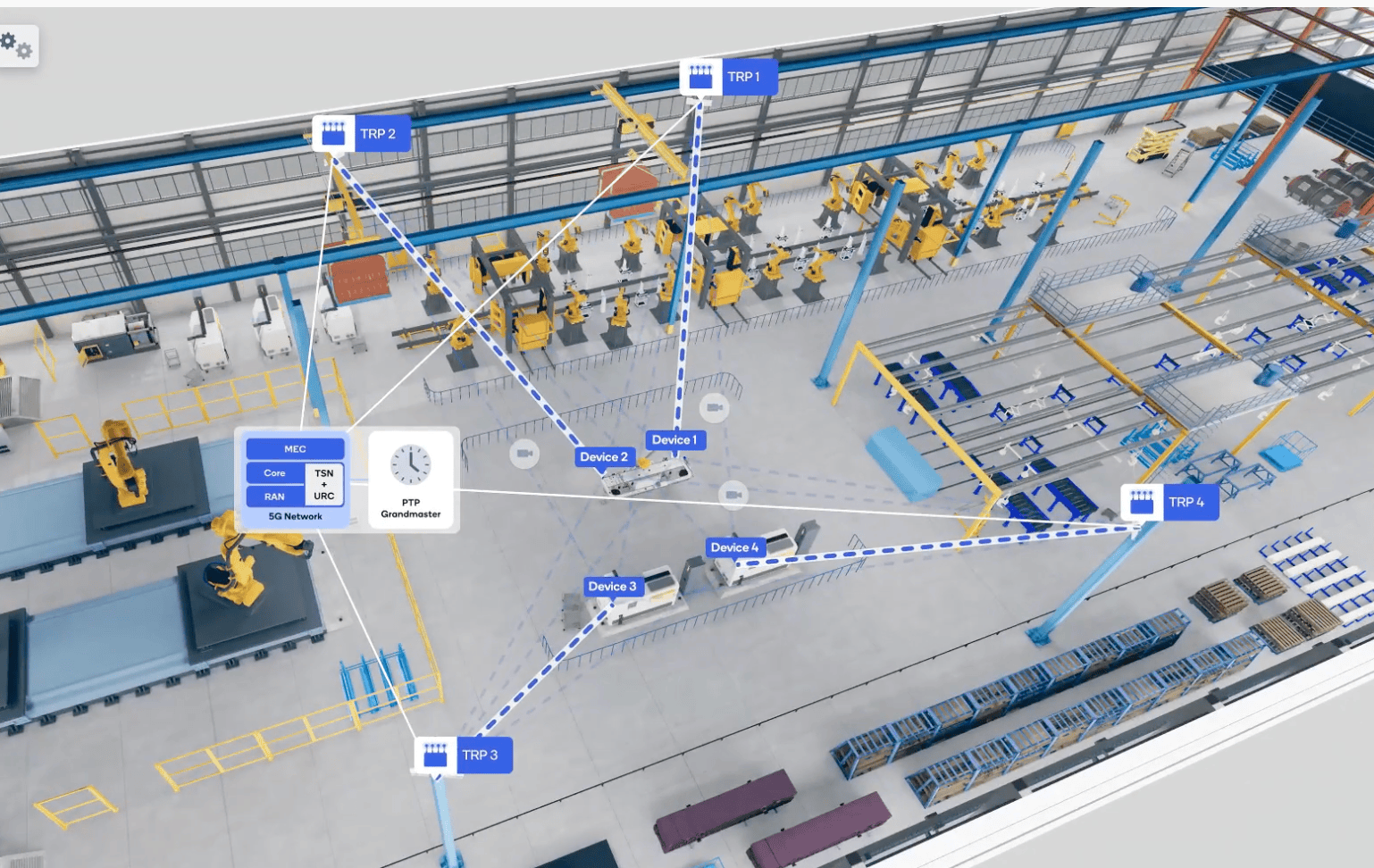
Qualcomm Technologies’ Zhang led an over the air demonstration of precise indoor positioning for AGVs using a 5G network deployed in a 400 megahertz channel of unlicensed 6.225 GHz spectrum and five transmission and reception points (TRPs) equipped with 4×4 MIMO-capable directional antennas. The network supports a UE equipped with an omni-directional antenna and moving on a three-axis gantry system. Each TRP sends positioning signals which run through a positioning algorithm that dynamically measures the observed time of difference between the positioning signal and the ground truth position of the test device. Applying this technology set in a manufacturing or logistics facility would equate to AGVs being able to autonomously, accurately and reliably move objects around the environment, and saving time and money while freeing up skilled workers to concentrate on higher-value tasks.
Zhang noted there was no error beyond a target threshold of 23 centimeters and that the positioning algorithm was able to keep pace with changes in speed and sharp, angular movements. “Our target accuracy is much better than the requirement,” she said. “The precise positioning will be part of Rel. 17 study. We will be using our OTA demo to support our research and standards activity in the Rel. 17 studies.”
Additional demonstrations show the importance of TSN and CoMP to industrial-grade requirements in a system linking smart cameras using onboard artificial intelligence for object classification to a programmable logic controller (PLC) operating a robotic arm. In a real world setting, a manufacturing firm could use this setup to correctly sort items moving along a conveyor belt for quality assurance, defect detection and other important applications.
Zhang showed that when TSN was enabled, the robotic arm correctly sorted objects with no errors while with TSN disabled, the error rate went up to more than 30%. TSN ensures “all the devices can be synchronized up to a tight synchronization requirement,” she said. “The robotic arm doesn’t miss any objects.” CoMP technology, especially crucial in a complex RF environment where moving objects are passing between TRPs, is applied to downlink and uplink cellular traffic to ensure robust, stable connections—it’s key to maintaining the high system throughput and ultra low latency required in a manufacturing environment and “can ensure the successful delivery of the packet,” Zhang said.
Another important industrial IoT technology is 5G sidelink which allows devices to talk directly with one another rather than by sending information back through a gNodeB. In scenarios where milliseconds matter, this is an important development given the capacity and latency improvements associated with the move from two-hop communication through the gNodeB to one-hop, device-to-device comms. Sidelink has also been successfully applied to cellular vehicle-to-everything communications, allowing smart vehicles to talk directly to one another thus improving responsiveness and safety.
The evolution of sidelink from earlier generations of cellular to C-V2X and 5G private networking is indicative of Qualcomm’s broader trajectory of taking the expertise gained in developing smartphone technologies and applying it in new ways. As company President and CEO-elect Cristiano Amon said in a recent Reddit AMA session, “Qualcomm will continue to define the pace of innovation in wireless connectivity and high performance computing for power efficient devices. 5G is taking Qualcomm everywhere. Beyond mobile, we are growing in automotive…as well as computing, XR, AI, wearables, networking, industrial solutions and many more. I am super excited about the 5G we’re seeing today…We are just at the beginning of the 5G transition. Not only am I excited about what 5G is bringing to smartphones, but its upcoming potential to transform every industry.”