

RCR Wireless
  • News
  • Channels
    • 5G
    • 6G
    • BSS OSS
    • Carriers
    • IoT
    • Network Infrastructure
    • Open RAN
    • Private 5G
    • Telco AI
    • Telco Cloud
    • Test & Measurement
  • Resources
    • Reports
    • Webinars
    • White papers
    • AI Fundamentals
    • Analyst Angle
    • Editorial Calendar
    • Fundamentals
      • 5G NR Release 17
      • AI
        • Telco AI in 2025
    • Podcasts
      • Let’s Get Digital with Carrie Charles
      • Wireless Connectivity to Enable Industry 4.0 for the Middleprise
      • Well Technically…
      • Will 5G Change the World
      • Accelerating Industry 4.0 Digitalization
  • AI Infrastructure
  • Programs
  • Events
  • RCRtv
  • Advertise
  • Subscribe
Friday, July 31, 2026
RCR Wireless
  • News
  • Channels
    • 5G
    • 6G
    • BSS OSS
    • Carriers
    • IoT
    • Network Infrastructure
    • Open RAN
    • Private 5G
    • Telco AI
    • Telco Cloud
    • Test & Measurement
  • Resources
    • Reports
    • Webinars
    • White papers
    • AI Fundamentals
    • Analyst Angle
    • Editorial Calendar
    • Fundamentals
      • 5G NR Release 17
      • AI
        • Telco AI in 2025
    • Podcasts
      • Let’s Get Digital with Carrie Charles
      • Wireless Connectivity to Enable Industry 4.0 for the Middleprise
      • Well Technically…
      • Will 5G Change the World
      • Accelerating Industry 4.0 Digitalization
  • AI Infrastructure
  • Programs
  • Events
  • RCRtv
  • Advertise
  • Subscribe
Add RCR Wireless as a preferred source on Google
  • Qualcomm 6G Insights
  • Huawei Content Hub
  • Qualcomm – 6G Vision
  • OSS/BSS Channel
  • RCRTech Roundtable: AI Infrastructure
RCR Wireless
RCR Wireless
  • Advanced Mimo
  • Mobile mmWave
  • 5G Positioning
  • Green Networks
  • Metaverse
  • Automotive
  • Industrial and Wide-area IoT
Copyright 2021 - All Right Reserved
Home - Private 5G for industrial IoT in smart ports – payback in two years, says Ericsson
5GConnected CarsEnterpriseInternet of Things (IoT)News & Event CoverageSensorsSmart CitiesSmart FactoryTransportation: Airports, Rail, PortsWired Networks, Fiber

Private 5G for industrial IoT in smart ports – payback in two years, says Ericsson

by James Blackman February 25, 2021
written by James Blackman February 25, 2021 Share
LinkedinEmail
Share 0LinkedinEmail
188

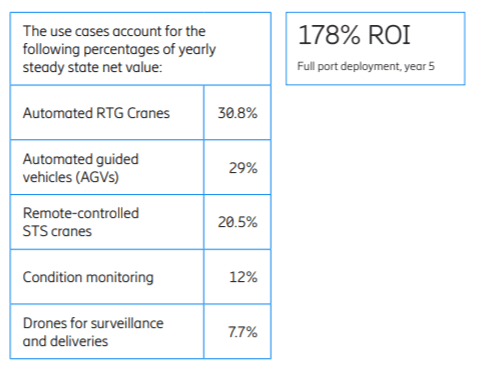
Shipping ports can make money back on key private 5G-based automation systems in less than two years, reckons Ericsson, and make valuable gains (178-percent returns) within five.

The Swedish vendor has worked with Germany-based industrial IoT provider ifm electronic, along with commission management consultancy Arthur D. Little, to investigate the combined impact of five essential Industry 4.0 use cases on a standard (“baseline”) container terminal, running approximately four million TEUs (twenty-foot equivalent units) per year. 

The report makes implicit that the initial investment covers deployment of a private 5G network, as well. The five use cases – two for crane automation, one for automated guided vehicles, one for condition monitoring, and one for drone deliveries – will not work with “costly and inflexible legacy technologies”, says Ericsson; private 5G is the only way, the marketing goes.

“Port operators can no longer bridge the gap with… Wi-Fi, Bluetooth, or physical cables… 5G is the key tool to create a smart port and lay the foundation for IoT in industrial automation. Cellular enables mission-critical comms like voice and data capabilities. These help to prevent injury to workers by keeping them physically distant from potential hazards,” it says. 

“5G is well optimized for IoT, ensuring low energy usage, increased data security, and the ability to support high connection density. In contrast to legacy networks, 5G provides a complete connectivity solution for licensed and unlicensed spectra, as well as seamless cellular vehicle-to-everything (C-V2X) communication.” 
Smart Ports 1

Ericsson’s baseline port, for which the proposed ROI is calculated, generates roughly $400 million in revenue with an operating margin of around 30 percent – enough for it to rank, on paper, among the top 100 container ports in the world (at number 50, in fact). But it has the same issues as all the rest of them, the reports goes on: mainly, higher cargo volumes and a shortage of yard space.

The report quotes data from Finnish cargo-handling machinery maker Cargotec, that compound growth for global container volumes is rising at 3.6 percent per annum, and maritime trade publication Port Technology, that 76 percent of port operators cite operational efficiencies as their primary concern.

All the human and environmental risks that go with this industrial congestion are noted, too. 2018 data from the European Maritime Safety Agency (EMSA) said almost 42 percent of marine casualties or incidents take place in (increasingly busy and congested ) port areas. And, as with every sector knocking at the Industry 4.0 door, you just can’t find the staff.

The shortage of port pilots, generally, means longer waiting times for boats to be unloaded (36 hours at the dock, typically), with their engines idling; McKinsey & Company says 75 percent of operators reckon the skills gap is an issue when it comes to automating port systems. Enter private 5G (duh-duh), and the five automation cases it sets to work.

Ericsson says: “A port can use the same cellular network for all these use cases, plus other tech like sensors, cameras, human-to-human communication, and container tracking… A smart port’s network has to handle large amounts of data generated by cranes, vehicles, equipment, workers… [5G] allows… one backhaul for all services instead of several pieces of network equipment.”

The application / ROI breakdown goes something like this. The financial benefit of remote-controlled ship-to-shore (STS) cranes, for loading and unloading container ships, is equivalent to about 4.9 percent of port revenue (as yearly steady-state net value), and provides payback in two years on the the private 5G deployment – and a 156-percent ROI by year five.

Which sounds almost like the headline saving: payback in less than two years; a 178-percent return within five years. The thing is, says Ericsson, STS automation has to be daisy-chained with a couple of other use cases to work. These are to automate rubber tired gantry (RTG) cranes, stacking containers on the dock, and guided vehicles (AGVs), for the donkey work in between.
Smart Ports 2

In each case, the private 5G network replaces “an unreliable combination of Wi-Fi and fibre”, to enable IoT sensors and positioning devices. The benefit cascades down into reduced maintenance (by 20 percent), requiring fewer spare parts, oils, and other resources – including workers. AGVs, meanwhile, reduce energy costs by 10 percent due to optimized routes.

The financial benefit for automated RTG cranes is about 7.5 percent, as yearly steady-state net value, and 7.1 percent for AGVs. Payback is in less than three years and around two years, respectively; the five-year ROI is put at 98 percent and 149 percent. 

The other cases – for condition monitoring and drone deliveries – give a benefit of 2.7 percent and 1.6 percent of the revenue, and break-even in two years in both cases; five-year returns are pegged at 126 percent and 154 percent. The report is available here; a Smart Ports Value Calculator has been published alongside to figure out the ROI for different use cases.

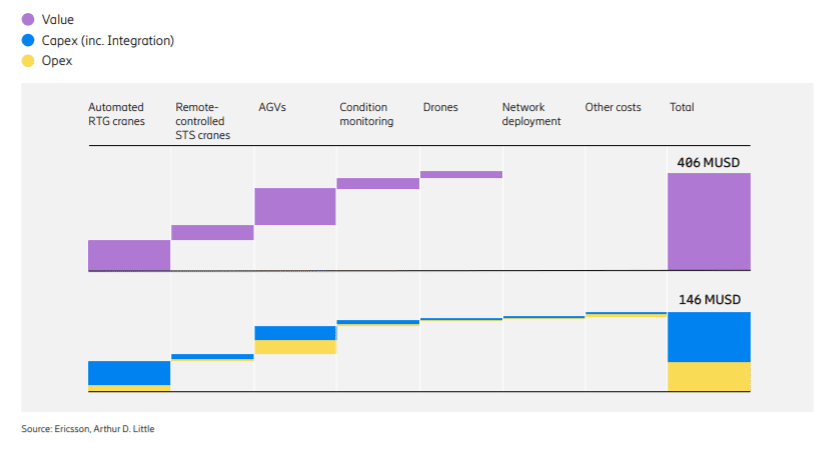
The report explains the maths: “The smart money is on smart ports. Out of all our use cases, the highest value comes from automated RTG cranes, followed by cellular connected AGVs, and then remote-controlled STS cranes. In our baseline port, with all five use cases working together, we reached a payback time of less than two years. The annual steady state net value by year five reaches $101 million, which is 25 percent of the baseline port’s revenue. 

“The accumulated net value reaches $260 million in year five – 68 percent of the baseline port’s revenue. This figure includes the full network deployment and the cost and benefits from the five use cases. By year five, the use cases contribute to an accumulated gross value of $406 million. The total, accumulated costs for deploying all use cases is around $146 million by year five, driving a return on investment of 178 percent.”


You Might Also Like
  • Ensuring colocation success by eliminating network observability blind spots (Reader Forum)
  • AI-RAN takes shape as Open RAN, Cloud RAN and AI converge
  • Japan’s private 5G market is finally moving beyond demo experiments (Analyst Angle)
  • Wednesday (telco diary) | Orange leads Euro telco revival
  • Private 5G – hype, hope, and (some) hard maths 
  • Hollow-core fiber won’t hit cost parity for a decade – regarding HKT’s 3.2Tbps DCI ‘superhighway’
Share 0 LinkedinEmail
James Blackman
James Blackman

James Blackman has been writing about the technology and telecoms sectors for over a decade. He has edited and contributed to a number of European news outlets and trade titles. He has also worked at telecoms company Huawei, leading media activity for its devices business in Western Europe. He is based in London.

previous post
ZTE to construct 5G ATG networks in China in 2021
next post
Zome Energy Networks targets the Austin energy market with new projects

White Papers

  • Norton eBook: The 2026 Telco Playbook

  • Enea White Paper: Why Intelligent AAA is the Swiss Army Knife of Telecom

  • CSG White Paper: Telco AI Enabler: Mediation’s Defining Role

  • Enea White Paper: Scalable Database Design for 5G and Beyond

  • Supermicro and NVIDIA Whitepaper: Powering sovereign AI at scale

Editorial Reports

  • Market Pulse Report: Telco AI in 2026 – Trends, Challenges and Opportunities

  • Nvidia Report: The State of AI in Telecommunications: 2026 Trends

  • Report: Scaling Optical Networks For The Hyperscale And AI Era

Webinars

  • Webinar: Building 6G — aligning technology, policy and purpose

  • SIMCom Webinar: Scaling your next deployment – from plastic to provisioning

  • Webinar: Rethinking the RAN as AI, cloud and openness converge

  • Webinar: Scale-Up, Scale-Out, Scale-Across – Building AI-Era Network Fabrics

  • Webinar: NTN in motion – evolving standards, expanding services

Since 1982, RCR Wireless News has been providing wireless and mobile industry news, insights, and analysis to mobile and wireless industry professionals, decision makers, policy makers, analysts and investors.

Facebook Twitter Youtube Linkedin Envelope Rss

Useful Links

  • Subscribe
  • About RCR Wireless News
  • Contact Us
  • Advertise
  • Editorial Calendar
  • Archive
  • RSS
  • Wireless News Archive
  • Subscribe
  • About RCR Wireless News
  • Contact Us
  • Advertise
  • Editorial Calendar
  • Archive
  • RSS
  • Wireless News Archive

Edtior's Picks

Building the AI backbone, waiting on the AI billions
Ensuring colocation success by eliminating network observability blind spots (Reader Forum)
Thursday (telco diary) | Vodafone resets, AT&T reloads

Latest Articles

Building the AI backbone, waiting on the AI billions
Ensuring colocation success by eliminating network observability blind spots (Reader Forum)
Thursday (telco diary) | Vodafone resets, AT&T reloads
SK Telecom’s A.X K2 is South Korea’s biggest bet yet on sovereign AI

© 2026 RCR Wireless News All Right Reserved. Developed by Eight Hats.

Cookie Policy | Privacy Policy

RCR Wireless
  • News
  • Channels
    • 5G
    • 6G
    • BSS OSS
    • Carriers
    • IoT
    • Network Infrastructure
    • Open RAN
    • Private 5G
    • Telco AI
    • Telco Cloud
    • Test & Measurement
  • Resources
    • Reports
    • Webinars
    • White papers
    • AI Fundamentals
    • Analyst Angle
    • Editorial Calendar
    • Fundamentals
      • 5G NR Release 17
      • AI
        • Telco AI in 2025
    • Podcasts
      • Let’s Get Digital with Carrie Charles
      • Wireless Connectivity to Enable Industry 4.0 for the Middleprise
      • Well Technically…
      • Will 5G Change the World
      • Accelerating Industry 4.0 Digitalization
  • AI Infrastructure
  • Programs
  • Events
  • RCRtv
  • Advertise
  • Subscribe
RCR Wireless
  • News
  • Channels
    • 5G
    • 6G
    • BSS OSS
    • Carriers
    • IoT
    • Network Infrastructure
    • Open RAN
    • Private 5G
    • Telco AI
    • Telco Cloud
    • Test & Measurement
  • Resources
    • Reports
    • Webinars
    • White papers
    • AI Fundamentals
    • Analyst Angle
    • Editorial Calendar
    • Fundamentals
      • 5G NR Release 17
      • AI
        • Telco AI in 2025
    • Podcasts
      • Let’s Get Digital with Carrie Charles
      • Wireless Connectivity to Enable Industry 4.0 for the Middleprise
      • Well Technically…
      • Will 5G Change the World
      • Accelerating Industry 4.0 Digitalization
  • AI Infrastructure
  • Programs
  • Events
  • RCRtv
  • Advertise
  • Subscribe
@2020 - All Right Reserved. Designed and Developed by PenciDesign