

Note, this article is taken from a new Enterprise IoT Insights editorial report on the combination of low-power short- and long-range communications technologies in hybrid IoT systems. Go here for the full report, which is free to download. A webinar on the same subject, with panellists from ABI Research, the Bluetooth SIG, Nordic Semiconductor, Sigfox, and The Things Network, is available here.
Interestingly, in the new hybrid IoT love-in, no one ever pitches two from the same low-power wide-area (LPWA) side of the IoT connectivity game, where the most trenchant rivalries exist. The LoRaWAN and Sigfox camps, notably, are never reconciled in hybrid IoT solutions in practical terms. Even the novel MIOTY technology, the newest challenger in the arena, is pitched squarely as a competitor of both of these (see pages 32-33 of report).
This is where the dust-up really is, then; the scopes of these technologies are too similar, perhaps; their rivalries too fierce. Except, the wrangle between LPWA systems – the focus of a major Enterprise IoT Insights report 12 months ago, and the subtext of a new one, out this month – has split, recently, with the emergence of hybrid IoT combining overlapping wide-area systems running in parallel, and complementary networking systems in jigsaw-like IoT architecture.
The clearest example of overlapping wide-area systems is from Sigfox. The French firm has pioneered a ‘0G’ model that positions its narrowband network as a fall-back for cellular. Instead of dovetailing technologies to extend range, it overlaps them to bring redundancy.
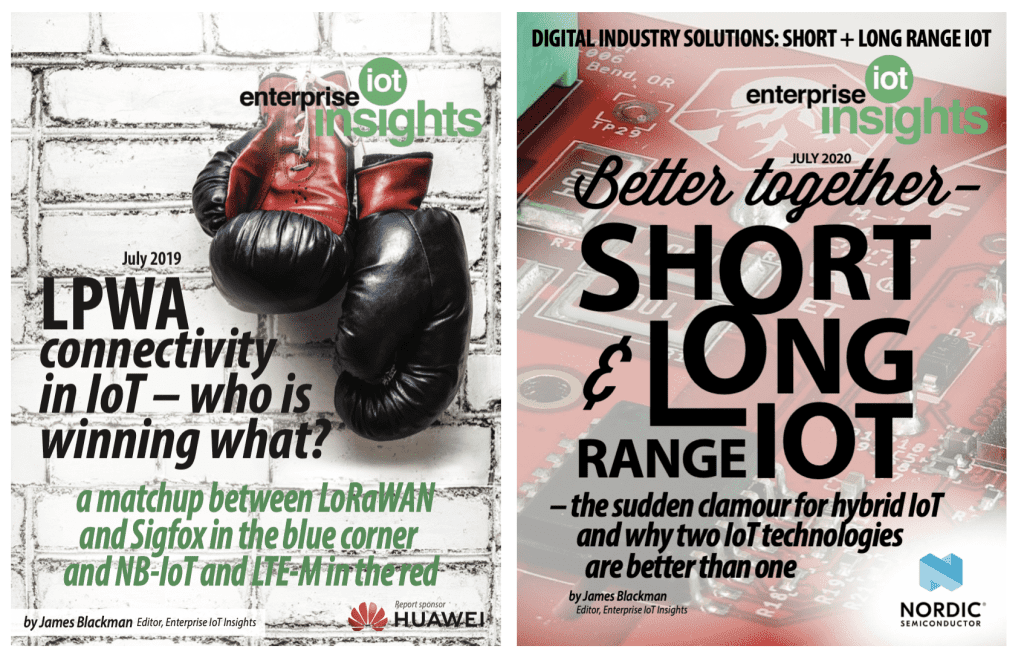
Reports – from July 2019 (left), on rival LPWA tech in IoT, and from July 2020, on the combination with short-range wireless.
A headline deal with Securitas Direct to provide backup for alarm systems, in case their default 3G connections are compromised or fail, makes its logic plain. Sigfox’s whole strategy is based around playing second fiddle; the 0G branding tacitly acknowledges the cellular brigade are calling the tune in terms of mainline connectivity.
The company has linked about three million alarms to its network in the last five years, representing a major chunk of its total base. It has a similar arrangement with French operator Free Mobile, part of the Iliad group, which has Sigfox as a last-gasp pulse in a premium set-top box.
The point is the non-cellular LPWA brigade, even as they are generally hostile towards each other, appear to have fallen in line behind the well-heeled cellular market, now encroaching with NB-IoT and LTE-M. Sigfox complements standard cellular, in its various guises, it insists.
“Sigfox does not constitute a competing tech to NB-IoT and LTE-M, and 3G and 4G and everything else, but a complement in a lot of cases. It is a perfect network for that,” remarks Bertrand Ramé, the company’s senior vice president of international operations.
Sigfox’s old rival LoRaWAN takes the same line; it needs cellular, often, to bring higher-grade backhaul security to its private networking setups, as Wienke Giezeman, chief executive at Netherlands-based LoRaWAN group The Things Network, notes in the main report.
“I don’t believe NB-IoT, LTE-M, and LoRaWAN are any competition at all. I just don’t see it in the field,” he says. Giezeman is disarming, actually, because his start-point is that the IoT market is multi-faceted, and its busy innovation is a response to its inherent fragmentation, and not just a cause of it.
Even in this hybrid IoT love-fest, the LPWA sector remains divided; and yet, Giezeman breaks with tradition. The question comes, inevitably: is there room for everyone in the IoT market? What about Sigfox, most often the whipping boy in the LPWA space?
Giezeman issues a disclaimer about his loyalty to the LoRaWAN camp before bowling forward with a wide-view appraisal. “Sigfox is awesome; if you look at its latest numbers, it is doing great,” he says. “If you look at how it is pushing the concept of LPWA networks, it’s awesome as well. But it has a closed business model, from a technology perspective, and it is not very flexible on a workbench.”
The workbench concept, about fashioning bespoke solutions for a wide range of narrow concerns, is discussed in the main article; we are focused, here, on the fratricide in the LPWA space. And while LoRaWAN and Sigfox appear to have thrown-in with the cellular market, the feeling is not always reciprocated – or, at least, not articulated with any duty or emotion.
In some cases, it is portrayed as a mismatch, which will not last. Svein-Egil Nielsen, chief technology officer at Nordic Semiconductor, puts it starkly; non-cellular LPWA technologies, generally, are under-cooked and bound-to-fail, he suggests. He calls his first witness: remote provisioning.
“If you can’t upgrade your firmware over-the-air, then you are being reckless. Any technology that does not allow for software to be upgraded in the field is not doing its job. That is a baseline for all technologies.”
He says worse about Sigfox, actually, and under-cuts Giezeman’s criticism of Sigfox as a closed system by declaring LoRaWAN a Semtech-sponsored affair. “We prefer to deal with open standards, and not closed ecosystems. We have chosen cellular because we think it is more scalable in the longer term.”
These claims go unchallenged, here, except to note Sigfox would argue its intelligence is in the cloud, and LoRaWAN would make a defence about enabling remote upgrades in its latest specification.
But neither the prosecution nor defence is so important, actually; the story is the cellular community at large does not care very much about outsiders, and feels momentum is firmly with it. “A lot of the things the industry has been struggling with – carrier readiness, subscription models, certifications and approvals – have been greatly resolved in the last 12-18 months,” says Nielsen.
There are exceptions (Orange and KPN, for example), but most mobile operators have a blind spot when it comes to non-cellular LPWA networks. Telefónica recommends only Wi-Fi as a companion technology for cellular, and a preference for cellular on its own (see page 15 of report).
Vodafone, in this narrative anyway, presents a more thorough viewpoint. “A bigger issue is in the operation of the network,” says Phil Skipper, global head of IoT business development for Vodafone’s global enterprise division.
“These low-power networks typically offer low-cost connectivity. Operators have to build, support, extend, and more importantly secure the network at all times. This is a large undertaking and one that has ongoing cost. Licensed technologies, on the other hand, are provided by licensed parties; they run on the same infrastructure as consumer and enterprise services.
“This offers benefits in terms of network build and extension and provides synergies in terms of support and security. This is probably the largest difference between these technologies, and makes a big difference when considering wide-area deployments in a hybrid network.”
There will be room for both, he suggests; it is just that sundry cellular-based protocols in an all-consuming 5G ecosystem will make the running. “These unlicensed technologies will be supported in a different way, for instance in a factory by the existing maintenance teams, allowing the benefits of both to be realised,” says Skipper.
Can he be more explicit? Which of these technologies will fail, ultimately? There is no telling, he says, but standardisation is a good basis for scale and longevity. Again, Sigfox appears like an easy target, even as it carves its own niche, and gathers its own ecosystem behind.
Skipper comments: “The winners will be those with the largest footprint, the best cost position, and the capability to enhance and secure the network. It’s interesting to note the difference between a technology ‘standard’ like Bluetooth and an operating network like Sigfox, as the demands in adoption cost, availability, and support are very different.”
But individually, the non-cellular LPWA industry, casting glances at cellular, has gained good experience by propping up parts of the IoT market so far. It should not be so easily dismissed, says John Gole, research director at IDC. “LoRaWAN and Sigfox have been developing their ecosystems for longer than NB-IoT and LTE-M, so they have some advantages on that front.”
Mobile operators have been side-tracked by 5G, he says. “NB-IoT and LTE-M have been slower off the mark. The cellular industry put attention on 5G, due to its higher revenue potential. But now the 5G hype has passed, it will buckle down. But, LoRaWAN and Sigfox have established unique positions and gained momentum that make it unlikely either will fall by the wayside.”

Reports – looking at enterprise IoT in depth; go to enterpriseiotinsights.com/reports for every report from the last 18-24 months

