

RCR Wireless
  • News
  • Channels
    • 5G
    • 6G
    • BSS OSS
    • Carriers
    • IoT
    • Network Infrastructure
    • Open RAN
    • Private 5G
    • Telco AI
    • Telco Cloud
    • Test & Measurement
  • Resources
    • Reports
    • Webinars
    • White papers
    • AI Fundamentals
    • Analyst Angle
    • Editorial Calendar
    • Fundamentals
      • 5G NR Release 17
      • AI
        • Telco AI in 2025
    • Podcasts
      • Let’s Get Digital with Carrie Charles
      • Wireless Connectivity to Enable Industry 4.0 for the Middleprise
      • Well Technically…
      • Will 5G Change the World
      • Accelerating Industry 4.0 Digitalization
  • AI Infrastructure
  • Programs
  • Events
  • RCRtv
  • Advertise
  • Subscribe
Sunday, August 2, 2026
RCR Wireless
  • News
  • Channels
    • 5G
    • 6G
    • BSS OSS
    • Carriers
    • IoT
    • Network Infrastructure
    • Open RAN
    • Private 5G
    • Telco AI
    • Telco Cloud
    • Test & Measurement
  • Resources
    • Reports
    • Webinars
    • White papers
    • AI Fundamentals
    • Analyst Angle
    • Editorial Calendar
    • Fundamentals
      • 5G NR Release 17
      • AI
        • Telco AI in 2025
    • Podcasts
      • Let’s Get Digital with Carrie Charles
      • Wireless Connectivity to Enable Industry 4.0 for the Middleprise
      • Well Technically…
      • Will 5G Change the World
      • Accelerating Industry 4.0 Digitalization
  • AI Infrastructure
  • Programs
  • Events
  • RCRtv
  • Advertise
  • Subscribe
Add RCR Wireless as a preferred source on Google
  • Qualcomm 6G Insights
  • Huawei Content Hub
  • Qualcomm – 6G Vision
  • OSS/BSS Channel
  • RCRTech Roundtable: AI Infrastructure
RCR Wireless
RCR Wireless
  • Advanced Mimo
  • Mobile mmWave
  • 5G Positioning
  • Green Networks
  • Metaverse
  • Automotive
  • Industrial and Wide-area IoT
Copyright 2021 - All Right Reserved
Home - Why short-range and wide-area IoT make a marriage of perfect convenience
CarriersEnterpriseFundamentalsInfrastructureInternet of Things (IoT)NB-IoTNews & Event CoverageSensorsSmart CitiesSmart FactoryWired Networks, Fiber

Why short-range and wide-area IoT make a marriage of perfect convenience

by James Blackman June 18, 2020
written by James Blackman June 18, 2020 Share
LinkedinEmail
Share 0LinkedinEmail
94

Short-range wireless technologies such as Bluetooth Low Energy (BLE), notably, are suited for widespread sensor networks for monitoring all sorts of processes. The chips are cheap and robust, their battery life is excellent, and it is easy to link them together into networks.

Plus, the throughput of short-range technologies like BLE is ideal for transmitting data from wireless sensors, and the system-on-chips (SoCs) that house short-range radios feature processors capable of some edge processing. Even better, Bluetooth is already a default technology in smartphones, meaning BLE sensors can be configured and interrogated with most handheld devices.

But BLE, as a short-range technology, has restricted range – up to several hundred meters even in the best conditions. It is also incompatible with the key IPv4 and IPv6 internet protocols. It is therefore difficult to link directly to the internet using BLE, not discounting workarounds such as IPv6 over BLE.

BLE-based SoCs also feature restricted processing and memory resources, which puts a limit on what they can handle. Combined together, these factors make BLE, for example, both inherently valuable and somewhat limited in IoT use cases; BLE could do with a partner technology to pick it up where it falls down.

Enter the low-power wide-area (LPWA) technology set, which has animated much of the industrial IoT space so far as a kind of work-horse technology to connect cheap, far-away, fit-and-forget sensors. Like with short-range (BLE, plus sundry IEEE 802.15.4 protocols) and ultra short-range technologies (RFID, UWB, for example), LPWA comes in a variety flavours.

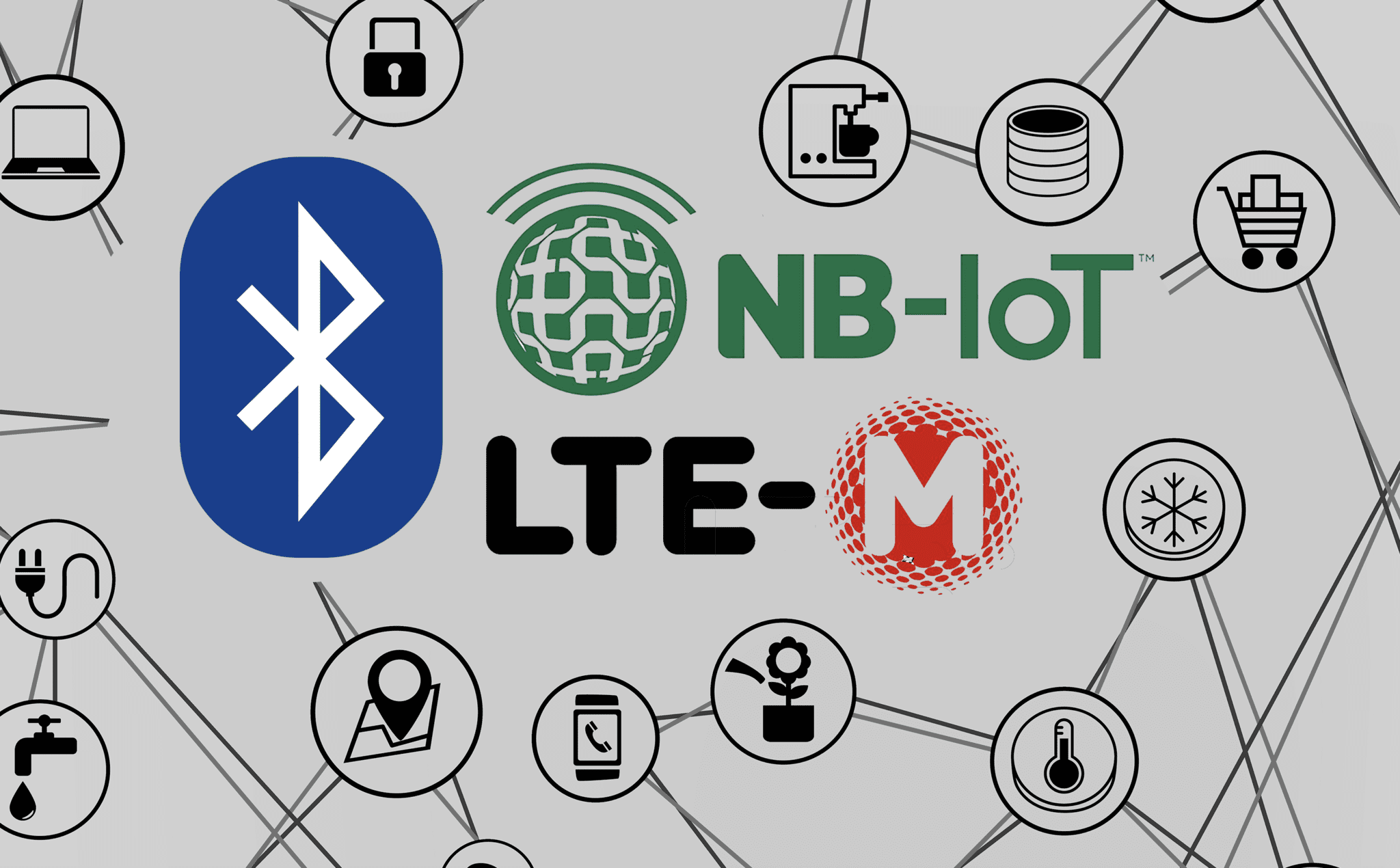
These include both cellular (NB-IoT, LTE-M) and non-cellular (LoRaWAN, Sigfox et al) variants. We will deal here with cellular-based IoT, to make the case specific for pairing IoT technologies (BLE and dual-mode NB-IoT / LTE-M) in hybrid solutions. Low-power cellular IoT is compatible with the cellular network, by definition, and hence the internet; it also offers tens-of-kilometres of range.

Moreover, cellular-based IoT modules tend to feature more capable processors and more memory, compared with short-range SoCs. They can support higher-functioning analytics at the edge, on the devices themselves – useful to jettison data that is only relevant for local decision-making before burdening the network at some cost to the business with a bloated round-trip to the cloud.

But cellular IoT chips are large, expensive, and power hungry, by comparison with BLE-based SoCs. They are also difficult to network. It might be considered wrongheaded, arguably, to fit cellular IoT devices directly to wireless sensors in the field, and build a highly populated IoT network using just them.

In the end, the solution is clear, and gathering popularity among IoT fitters: to dovetail short-range and wide-area technologies in hybrid IoT setups, where they compensate each others’ limitations and accentuate their strengths. The standard model is short-range mesh-based sensor networks are backhauled over carefully-deployed wide-area base stations.

The scenarios are familiar: vibration data from factory machines is channeled locally over a cellular connection to a cloud-based server for storage and analysis; moisture sensors in a field communicate together with a gateway that opens a single channel back to the cloud from the middle of nowhere.

In both cases, a local breakout route might be configured for real-time decision-making using edge-based compute. In the agricultural use case, there is really no other option for the long hop home; in the industrial case, the option of cellular means local-area Wi-Fi, considered high-maintenance ands flaky, does not have to be engaged.

But BLE and cellular IoT do not talk to each other directly because they use different protocols. Instead, designers are required to build gateways with twin radios, which are hard-wired together: a BLE chip linked into the short range mesh network, and a cellular-based system-in-package to communicate with the cloud.

It is a marriage made physical in hardware, intelligent in software, and productive in data, which sparks bountiful gains in terms of business operations.


You Might Also Like
  • Ensuring colocation success by eliminating network observability blind spots (Reader Forum)
  • Thursday (telco diary) | Vodafone resets, AT&T reloads
  • The Agentic Network — Boost Mobile on the right data for AI
  • Japan’s private 5G market is finally moving beyond demo experiments (Analyst Angle)
  • Wednesday (telco diary) | Orange leads Euro telco revival
  • The 6G AI uplink panic (Analyst Angle)
Share 0 LinkedinEmail
James Blackman
James Blackman

James Blackman has been writing about the technology and telecoms sectors for over a decade. He has edited and contributed to a number of European news outlets and trade titles. He has also worked at telecoms company Huawei, leading media activity for its devices business in Western Europe. He is based in London.

previous post
Potentially billions of IoT devices at risk from Ripple20 attacks – major brands are flagged
next post
Unlocking the promise of IoT with standards (Reader Forum)

White Papers

  • Norton eBook: The 2026 Telco Playbook

  • Enea White Paper: Why Intelligent AAA is the Swiss Army Knife of Telecom

  • CSG White Paper: Telco AI Enabler: Mediation’s Defining Role

  • Enea White Paper: Scalable Database Design for 5G and Beyond

  • Supermicro and NVIDIA Whitepaper: Powering sovereign AI at scale

Editorial Reports

  • Market Pulse Report: Telco AI in 2026 – Trends, Challenges and Opportunities

  • Nvidia Report: The State of AI in Telecommunications: 2026 Trends

  • Report: Scaling Optical Networks For The Hyperscale And AI Era

Webinars

  • Webinar: Building 6G — aligning technology, policy and purpose

  • SIMCom Webinar: Scaling your next deployment – from plastic to provisioning

  • Webinar: Rethinking the RAN as AI, cloud and openness converge

  • Webinar: Scale-Up, Scale-Out, Scale-Across – Building AI-Era Network Fabrics

  • Webinar: NTN in motion – evolving standards, expanding services

Since 1982, RCR Wireless News has been providing wireless and mobile industry news, insights, and analysis to mobile and wireless industry professionals, decision makers, policy makers, analysts and investors.

Facebook Twitter Youtube Linkedin Envelope Rss

Useful Links

  • Subscribe
  • About RCR Wireless News
  • Contact Us
  • Advertise
  • Editorial Calendar
  • Archive
  • RSS
  • Wireless News Archive
  • Subscribe
  • About RCR Wireless News
  • Contact Us
  • Advertise
  • Editorial Calendar
  • Archive
  • RSS
  • Wireless News Archive

Edtior's Picks

Building the AI backbone, waiting on the AI billions
Ensuring colocation success by eliminating network observability blind spots (Reader Forum)
Thursday (telco diary) | Vodafone resets, AT&T reloads

Latest Articles

Building the AI backbone, waiting on the AI billions
Ensuring colocation success by eliminating network observability blind spots (Reader Forum)
Thursday (telco diary) | Vodafone resets, AT&T reloads
SK Telecom’s A.X K2 is South Korea’s biggest bet yet on sovereign AI

© 2026 RCR Wireless News All Right Reserved. Developed by Eight Hats.

Cookie Policy | Privacy Policy

RCR Wireless
  • News
  • Channels
    • 5G
    • 6G
    • BSS OSS
    • Carriers
    • IoT
    • Network Infrastructure
    • Open RAN
    • Private 5G
    • Telco AI
    • Telco Cloud
    • Test & Measurement
  • Resources
    • Reports
    • Webinars
    • White papers
    • AI Fundamentals
    • Analyst Angle
    • Editorial Calendar
    • Fundamentals
      • 5G NR Release 17
      • AI
        • Telco AI in 2025
    • Podcasts
      • Let’s Get Digital with Carrie Charles
      • Wireless Connectivity to Enable Industry 4.0 for the Middleprise
      • Well Technically…
      • Will 5G Change the World
      • Accelerating Industry 4.0 Digitalization
  • AI Infrastructure
  • Programs
  • Events
  • RCRtv
  • Advertise
  • Subscribe
RCR Wireless
  • News
  • Channels
    • 5G
    • 6G
    • BSS OSS
    • Carriers
    • IoT
    • Network Infrastructure
    • Open RAN
    • Private 5G
    • Telco AI
    • Telco Cloud
    • Test & Measurement
  • Resources
    • Reports
    • Webinars
    • White papers
    • AI Fundamentals
    • Analyst Angle
    • Editorial Calendar
    • Fundamentals
      • 5G NR Release 17
      • AI
        • Telco AI in 2025
    • Podcasts
      • Let’s Get Digital with Carrie Charles
      • Wireless Connectivity to Enable Industry 4.0 for the Middleprise
      • Well Technically…
      • Will 5G Change the World
      • Accelerating Industry 4.0 Digitalization
  • AI Infrastructure
  • Programs
  • Events
  • RCRtv
  • Advertise
  • Subscribe
@2020 - All Right Reserved. Designed and Developed by PenciDesign