
RCR Wireless
  • News
  • Channels
    • 5G
    • 6G
    • BSS OSS
    • Carriers
    • IoT
    • Network Infrastructure
    • Open RAN
    • Private 5G
    • Telco AI
    • Telco Cloud
    • Test & Measurement
  • Resources
    • Reports
    • Webinars
    • White papers
    • AI Fundamentals
    • Analyst Angle
    • Editorial Calendar
    • Fundamentals
      • 5G NR Release 17
      • AI
        • Telco AI in 2025
    • Podcasts
      • Let’s Get Digital with Carrie Charles
      • Wireless Connectivity to Enable Industry 4.0 for the Middleprise
      • Well Technically…
      • Will 5G Change the World
      • Accelerating Industry 4.0 Digitalization
  • AI Infrastructure
  • Programs
  • Events
  • RCRtv
  • Advertise
  • Subscribe
Sunday, August 9, 2026
RCR Wireless
  • News
  • Channels
    • 5G
    • 6G
    • BSS OSS
    • Carriers
    • IoT
    • Network Infrastructure
    • Open RAN
    • Private 5G
    • Telco AI
    • Telco Cloud
    • Test & Measurement
  • Resources
    • Reports
    • Webinars
    • White papers
    • AI Fundamentals
    • Analyst Angle
    • Editorial Calendar
    • Fundamentals
      • 5G NR Release 17
      • AI
        • Telco AI in 2025
    • Podcasts
      • Let’s Get Digital with Carrie Charles
      • Wireless Connectivity to Enable Industry 4.0 for the Middleprise
      • Well Technically…
      • Will 5G Change the World
      • Accelerating Industry 4.0 Digitalization
  • AI Infrastructure
  • Programs
  • Events
  • RCRtv
  • Advertise
  • Subscribe
Add RCR Wireless as a preferred source on Google
  • Qualcomm 6G Insights
  • Huawei Content Hub
  • Qualcomm – 6G Vision
  • OSS/BSS Channel
  • RCRTech Roundtable: AI Infrastructure
RCR Wireless
RCR Wireless
  • Advanced Mimo
  • Mobile mmWave
  • 5G Positioning
  • Green Networks
  • Metaverse
  • Automotive
  • Industrial and Wide-area IoT
Copyright 2021 - All Right Reserved
Home - SMEs can ‘punch above their weight’ with carrier-IoT as-a-service, says Vodafone
5GCarriersEnterpriseInternet of Things (IoT)LTENews & Event CoverageSensorsSmart CitiesSmart Factory

SMEs can ‘punch above their weight’ with carrier-IoT as-a-service, says Vodafone

by James Blackman November 6, 2019
written by James Blackman November 6, 2019 Share
LinkedinEmail
Share 0LinkedinEmail
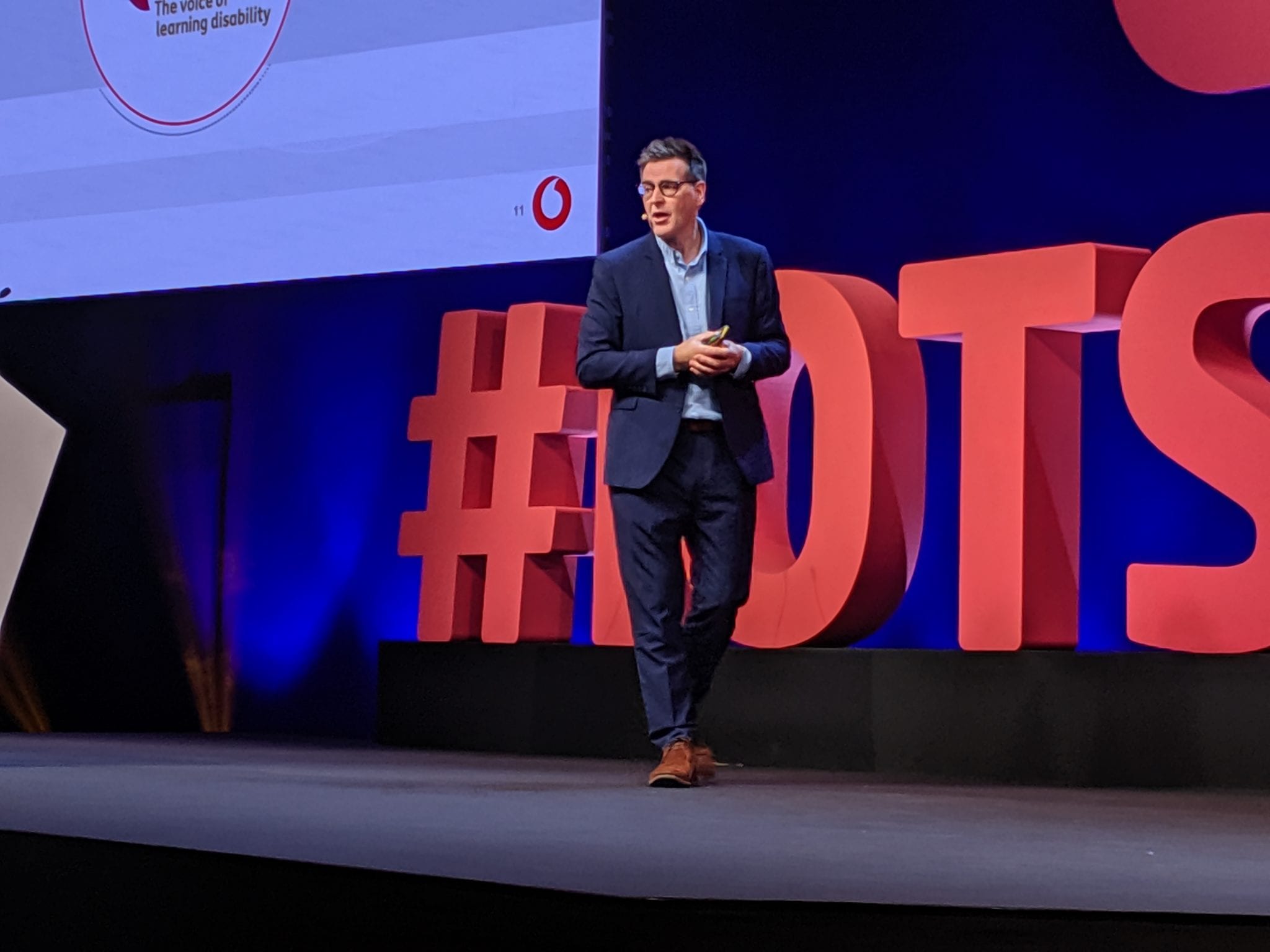
Skipper – Vodafone's IoT development chief, speaking at IoT Solutions World Congress in Barcelona
109

Small and medium sized enterprises can “punch above their weight” in global markets by taking IoT as-a-service from mobile operators. Where large organisations will go it alone, and develop their own IoT platforms internally, smaller companies must seek specialist partners.

At the same time, mobile operators must change, too, and go from sales operations, pushing SIM cards and airtime subscriptions, to after-sales operations, providing digital change and support on subscription. This was the message from Vodafone at IoT Solutions World Congress in Barcelona last week.

“Even though the risk of digitalization around IoT might seem disproportionately high for small or mid-sized companies, the benefits are also disproptionately high,” said Phil Skipper, head of IoT business development at the UK carrier.

He suggested large corporations have been incubating IoT-based change programmes for a period, already, and have a headstart on small and medium enterprises (SMEs), which have neither the ability or desire to put their operations at the mercy of experimental technology.

“Large multinationals have seen this coming. They have been early adopters of IoT, and responded in simple ways – to look at digitalization as an opportunity to open new revenue streams,” said Skipper.

“Most big organisations are almost as expert as we are in the way they use connectivity. Smaller organisations realise they can punch above their weight in global markets, but it is a different ask.”

Just 20 per cent of in-house IoT projects succeed, he said, compared with 60 per cent of third-party collaborations, developed in a process of ‘co-creation’ between technology buyers and sellers. (Whether the statistic was a SME-only figure, or counted-in results from large corporates was unclear.)

But he continued: “There is a disproportionate risk of failure [for SMEs]. They can’t have two gos at it; they need to get it right first time, whereas big organisations can afford to have multiple bites at the cherry.”

The counter narrative, of course, is about the role traditional telecoms operators will play in the the digital transformation of industry, and how or if they will change their own businesses to go beyond straight connectivity-selling. Vodafone is on the road, already, said Skipper.

“We are seeing interesting growth in the mid-market. These companies are coming to us, asking how to de-risk digitalization with IoT. We make it very simple. Because these organisations don’t want to be experts in IoT. They have bigger and better things to do. They want to buy [IoT solutions] as-a-service. The market is moving from what telcos want to sell to what enterprises want to buy.”

Vodafone pushed its new Invent platform, which seeks to enable enterprises to make their own IoT solutions, based on a take-away menu of IoT capabilities, with a localised discussion around the final garnish to make the solution properly bespoke. Skipper said the IoT solutions market can be simplified, at root level, as two ‘use classes’, plus a third that will come available with 5G.

“Forget all the 100s of use cases you see; forget all you know: there are only actually two use classes for IoT. The first one is remote monitoring; the second is mobile asset tracking. You can do every application out there with one or other, or both of these use classes,” he said.

“Interestingly, 5G opens up a third, which is about control – so when we have 5G for controlling turntables and AGVs, and the rest of it, you can start to use IoT as a control network. So over the forseeable future, there will be these three main use classes. You can put all of those together in a set of components, which takes you 80 per cent up the learning curve.”

Which is the basis of the Invent initiative: 80 per cent off-the-shelf technical gubbins, plus 20 per cent back-and-forth to make it a tailored fit, for whatever discipline in whichever sector.

“Companies can go on the platform and develop the remaining 20 per cent. So we are moving away from this idea of ‘co-creation’ towards this world where you have ‘co-configuraion’, so you are adding the 20 per cent you need to make it a connected rat trap, or a connected chiller, or a connected HVAC system, rather than starting froms scratch and having to build everything up.”

It was a polished performance. Skipper described the state of the IoT market, at large, where parallel narratives about industrial challenges and technological solutions are coming together. The kaleidoscope has been shaken, and the chance of change is in grasp.

“Global trends are forcing organisations to change, just as three technologies are reaching maturity – IoT, cloud, and data analytics. There is a fourth, as well, less talked about, which is the availability of low-cost compute power, in the cloud and at the edge. It is an interesting tipping point, where we have this need to change as we have a set of potential technologies coming to maturity.”

Enterprises of every sort must change their wiring to keep pace. The market is jumping to a new rhythm, and the rate of technological advancement has made the tempo-change hyper and disruptive. “It is about businesses changing their metabolic rate – about increaing their heartbeat,” he said.

“I used to send letters to complain, and three months later I’d get a letter back with an apology and a postal order for £5. You could run business on a three month cycle. With email, that cycle became compressed, and with social media it has become almost instantaneous – 20 seconds, and the issue not about the problem any longer, but about the speed of response.”

Digital change is not about technology, but about business practice, said Skipper. The spoils are transformative, potentially. “If we get it right, we take IoT to the next level.” But the spectacle must be seen in the round.

“IoT devices are not a means to predictive maintenance, but a means to generate data [for new opportunitues]. It is not about tyre wear, actually, but about how to run whole fleets [of vehicles]… You have to look at the other side to realize the true benefits. Yes, it is about data, but the question is how to capture value from it.”

The technological question is only about how to serve those business ends, by future-proofing solutions with high-value and low-risk technologies. There is no way back, in the event connectivity and automation fail. “It is a one-way street. Because you have to change from paper to electronic processes, and from manual to automated systems. You become reliant on a third party to deliver your service.”

Which, of course, was the message in the end: that operators like Vodafone, with services like Invent, are uniquely positioned to simplify and support digital change for enterprises that cannot, or will not, solve IoT alone.

“Put those things together and you start to hit the topics: local capability, application as-a-service, with 80 per cent as standard and 20 per cent configurable, and then you have an ecosystem you can rely on,” said Skipper.

You Might Also Like
  • Bell advances AIDC strategy as fiber and enterprise AI drive Q2
  • Thursday (telco diary) | APAC telcos pile into AI infrastructure
  • Chunghwa Telecom expands AI infra with new DC
  • Starlink Mobile – what is Musk actually building, beyond the chatter?
  • SpaceX targets US carriers with small-cell terrestrial rollout and mega demand from physical AI
  • SoftBank lifts AI growth outlook as cloud infrastructure enters monetization phase
Share 0 LinkedinEmail
James Blackman
James Blackman

James Blackman has been writing about the technology and telecoms sectors for over a decade. He has edited and contributed to a number of European news outlets and trade titles. He has also worked at telecoms company Huawei, leading media activity for its devices business in Western Europe. He is based in London.

previous post
Cradlepoint White Paper: A Sensible Approach to Smart City Projects
next post
Orange goes live with 5G in three Romanian cities

White Papers

  • Norton eBook: The 2026 Telco Playbook

  • Enea White Paper: Why Intelligent AAA is the Swiss Army Knife of Telecom

  • CSG White Paper: Telco AI Enabler: Mediation’s Defining Role

  • Enea White Paper: Scalable Database Design for 5G and Beyond

  • Supermicro and NVIDIA Whitepaper: Powering sovereign AI at scale

Editorial Reports

  • Report: NTN in motion — evolving standards, expanding services

  • Market Pulse Report: Telco AI in 2026 – Trends, Challenges and Opportunities

  • Nvidia Report: The State of AI in Telecommunications: 2026 Trends

Webinars

  • Webinar: Building 6G — aligning technology, policy and purpose

  • SIMCom Webinar: Scaling your next deployment – from plastic to provisioning

  • Webinar: Rethinking the RAN as AI, cloud and openness converge

  • Webinar: Scale-Up, Scale-Out, Scale-Across – Building AI-Era Network Fabrics

  • Webinar: NTN in motion – evolving standards, expanding services

Since 1982, RCR Wireless News has been providing wireless and mobile industry news, insights, and analysis to mobile and wireless industry professionals, decision makers, policy makers, analysts and investors.

Facebook Twitter Youtube Linkedin Envelope Rss

Useful Links

  • Subscribe
  • About RCR Wireless News
  • Contact Us
  • Advertise
  • Editorial Calendar
  • Archive
  • RSS
  • Wireless News Archive
  • Subscribe
  • About RCR Wireless News
  • Contact Us
  • Advertise
  • Editorial Calendar
  • Archive
  • RSS
  • Wireless News Archive

Edtior's Picks

The Agentic Network — NVIDIA on the full-stack path to telecom autonomy
Ericsson named sole global tech partner in SK Telecom-led AI-RAN pilot
Bell advances AIDC strategy as fiber and enterprise AI drive Q2

Latest Articles

The Agentic Network — NVIDIA on the full-stack path to telecom autonomy
Ericsson named sole global tech partner in SK Telecom-led AI-RAN pilot
Bell advances AIDC strategy as fiber and enterprise AI drive Q2
Context before control – Blue Planet maps AI architecture for autonomous networks

© 2026 RCR Wireless News All Right Reserved. Developed by Eight Hats.

Cookie Policy | Privacy Policy

RCR Wireless
  • News
  • Channels
    • 5G
    • 6G
    • BSS OSS
    • Carriers
    • IoT
    • Network Infrastructure
    • Open RAN
    • Private 5G
    • Telco AI
    • Telco Cloud
    • Test & Measurement
  • Resources
    • Reports
    • Webinars
    • White papers
    • AI Fundamentals
    • Analyst Angle
    • Editorial Calendar
    • Fundamentals
      • 5G NR Release 17
      • AI
        • Telco AI in 2025
    • Podcasts
      • Let’s Get Digital with Carrie Charles
      • Wireless Connectivity to Enable Industry 4.0 for the Middleprise
      • Well Technically…
      • Will 5G Change the World
      • Accelerating Industry 4.0 Digitalization
  • AI Infrastructure
  • Programs
  • Events
  • RCRtv
  • Advertise
  • Subscribe
RCR Wireless
  • News
  • Channels
    • 5G
    • 6G
    • BSS OSS
    • Carriers
    • IoT
    • Network Infrastructure
    • Open RAN
    • Private 5G
    • Telco AI
    • Telco Cloud
    • Test & Measurement
  • Resources
    • Reports
    • Webinars
    • White papers
    • AI Fundamentals
    • Analyst Angle
    • Editorial Calendar
    • Fundamentals
      • 5G NR Release 17
      • AI
        • Telco AI in 2025
    • Podcasts
      • Let’s Get Digital with Carrie Charles
      • Wireless Connectivity to Enable Industry 4.0 for the Middleprise
      • Well Technically…
      • Will 5G Change the World
      • Accelerating Industry 4.0 Digitalization
  • AI Infrastructure
  • Programs
  • Events
  • RCRtv
  • Advertise
  • Subscribe
@2020 - All Right Reserved. Designed and Developed by PenciDesign