

RCR Wireless
  • News
  • Channels
    • 5G
    • 6G
    • BSS OSS
    • Carriers
    • IoT
    • Network Infrastructure
    • Open RAN
    • Private 5G
    • Telco AI
    • Telco Cloud
    • Test & Measurement
  • Resources
    • Reports
    • Webinars
    • White papers
    • AI Fundamentals
    • Analyst Angle
    • Editorial Calendar
    • Fundamentals
      • 5G NR Release 17
      • AI
        • Telco AI in 2025
    • Podcasts
      • Let’s Get Digital with Carrie Charles
      • Wireless Connectivity to Enable Industry 4.0 for the Middleprise
      • Well Technically…
      • Will 5G Change the World
      • Accelerating Industry 4.0 Digitalization
  • AI Infrastructure
  • Programs
  • Events
  • RCRtv
  • Advertise
  • Subscribe
Friday, July 10, 2026
RCR Wireless
  • News
  • Channels
    • 5G
    • 6G
    • BSS OSS
    • Carriers
    • IoT
    • Network Infrastructure
    • Open RAN
    • Private 5G
    • Telco AI
    • Telco Cloud
    • Test & Measurement
  • Resources
    • Reports
    • Webinars
    • White papers
    • AI Fundamentals
    • Analyst Angle
    • Editorial Calendar
    • Fundamentals
      • 5G NR Release 17
      • AI
        • Telco AI in 2025
    • Podcasts
      • Let’s Get Digital with Carrie Charles
      • Wireless Connectivity to Enable Industry 4.0 for the Middleprise
      • Well Technically…
      • Will 5G Change the World
      • Accelerating Industry 4.0 Digitalization
  • AI Infrastructure
  • Programs
  • Events
  • RCRtv
  • Advertise
  • Subscribe
Add RCR Wireless as a preferred source on Google
  • Qualcomm 6G Insights
  • Huawei Content Hub
  • Qualcomm – 6G Vision
  • OSS/BSS Channel
  • RCRTech Roundtable: AI Infrastructure
RCR Wireless
RCR Wireless
  • Advanced Mimo
  • Mobile mmWave
  • 5G Positioning
  • Green Networks
  • Metaverse
  • Automotive
  • Industrial and Wide-area IoT
Copyright 2021 - All Right Reserved
Home - ‘Made for each other’–Why integrated modem-RF system approach is a must for 5G device supremacy (Analyst Angle)
5GAnalyst AngleDevices

‘Made for each other’–Why integrated modem-RF system approach is a must for 5G device supremacy (Analyst Angle)

by Prakash Sangam September 16, 2019
written by Prakash Sangam September 16, 2019 Share
LinkedinEmail
Share 0LinkedinEmail
modem-rf system qualcomm
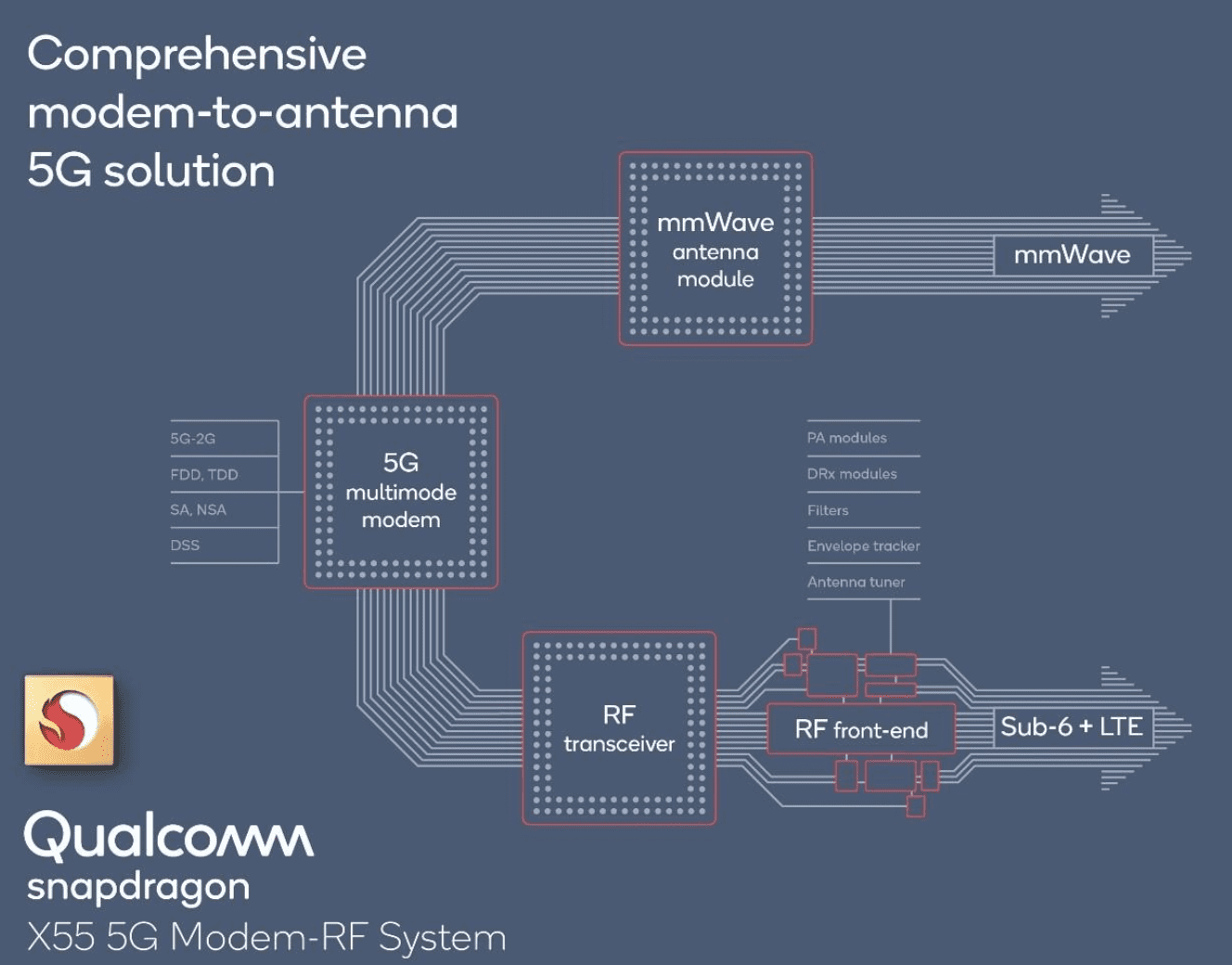
Image courtesy of Qualcomm Technologies, Inc.
328

Qualcomm made two announcements in the last couple of weeks that underpins much of their superiority in 5G technology, especially the millimeter wave (mmWave). First, they gave a name to the “made-for-each-other” duo of Modem and RF (Radio Frequency) system— Qualcomm® Snapdragon™ 5G Modem-RF System. It’s a mouthful, but captures its essence—an end-to-end systems approach for maximizing 5G performance. Second, they completed the very fruitful journey they started a couple of years ago—acquiring the remaining portion of the RF360 holdings— a JV with TDK, which got them started with building complex RF components. Since this is such a slam dunk of a decision, I will focus my discussion on the first part and its significance for 5G. 

The Modem-RF system consists of market-leading Snapdragon modems, Radio Frequency Front End (RFFE) and sometimes even the antennas. These work together as a single fine-tuned (pun intended) system to make 5G smartphones thin and slick while providing excellent coverage, longer battery life, and faster speeds. 

RFFE (aka RF FEM) is a suite of components including amplifiers, filters, switches, duplexers, and specialty components such as Antenna Tuners and Envelope trackers. RFFE converts the digital signals coming from the modem into analog signals, which are further converted into RF waves by the antenna. Traditionally, RFFE was considered a separate block from the modem, transceiver, and antennas. So much so that many OEMs use third-party RFFE solutions from providers such as Qorvo, Skyworks, Broadcom, and others to pair with the modem. However, 5G, especially millimeter wave (mmW) bands, turned that concept upside down. With features, such as beamforming and beamsteering in mmW, Massive MIMO in sub-6GHz, integrated modem – RF system approach is an absolute necessity. Qualcomm calls it the “Modem-to-antenna” solution. 

It will take several pages to explain all the RFFE components and their functions (might do a series of articles on that soon. So, be on the lookout). However, here, I will focus only on a few of the important aspects and explain how and why the systems approach matters. You might think some of these components and features are already supported in 4G. And that is true, but for 5G, because of its varying bands and wider bandwidths, RF is far more complex and difficult. 

Modem – RF system integration is a must for mmWave

The mmW bands are nothing like traditional cellular frequencies. Read my previous article to understand the difference and considerations. Devices with mmW support need up to three mmW antenna arrays, and each array typically consists of 2-4 elements. These elements are used to create very narrow beams (beamforming) targeted towards each user. The beams dynamically follow the users they move (beamsteering). All of that is achieved by rapidly changing the amplitude and phase of the signals going to the elements. With the immediacy and complexities involved in this closed-loop system, integration between modem and RFFE and antennas is an absolute necessity to make mmW work. That is probably one of the main reasons why so far only Qualcomm has been able to make commercial devices supporting mmW. Other 5G players are yet to demonstrate a working 5G mmW phone!

Antenna Tuner (AT) to efficiently select bands, antennas, and technologies

5G smartphone is a royal mix of extreme variations. For example, there are multiple mmW antenna modules, multiple sub-6GHz antennas, a variety of combinations of Sub-6 GHz bands and carrier aggregation (CA) options between them, simultaneous connectivity on both 4G and 5G, cellular, Wi-Fi and GPS technologies and more. A good AT, e.g. the one that is part of Qualcomm’s Modem and RF system, manages all of these complexities and switches between the configurations efficiently and without the user ever noticing it. With a good AT, OEMs can develop fewer global SKUs eliminating the need for separate SKUs for different regions, operators, etc. That means major cost-savings across the board, including R&D, customer support, logistics, inventory management, end of life support and more. There are already many 5G smartphones and a score of 4G LTE phones in the market using Qualcomm’s AT solution.

Envelope Tracker (ET) for higher power-efficiency (longer battery life)

This technology very tightly manages the transmit power of the device so that it only transmits exactly what is needed—not more, not less. ET will work only if there is a close coupling between the modem and the transmitter/power amplifier. The 4G ET has been available for a couple of years now. But the challenge with 5G was its extremely wide bandwidths (up to 100 MHz compared to 20 MHz of LTE). Qualcomm claims that it’s 5G ET can double the power efficiency, which means longer battery life, lower interference, which in turn means better coverage. ET is supported in many 5G devices available in the market today.

Power save (PS) and Smart Transmit (ST) for longer battery life and better coverage

Power Save uses a feature called Connected-Mode Discontinuous Transmission (C-DRX) which allows the phone receiver to go to sleep when it has no activity even when in the connected mode. Making the receiver and its associated RF components (e.g., amplifiers) sleep longer results in less power consumption and longer battery life. 

Smart Transmit, as the name suggests, manages the device transmit duty cycle in such a way that the device can transmit at higher power-level while being within the max power allowed by regulations. This increases uplink coverage and speeds. 

Currently, there are many 5G devices in the market today supporting Qualcomm’s 5G PS and ST features. 

Many such features make a comprehensive approach that Qualcomm calls “Modem-to-antenna” almost a necessity for high-performance 5G smartphones. The difference between devices with such a system and the ones without it will be apparent if a detailed performance benchmarking is performed. The difference will be even more visible with smartphones that support mmW — anybody up for benchmarking?

You Might Also Like
  • Fifteen years on, how did that 1,000x mobile broadband forecast fare? (Analyst Angle)
  • Mimosa Networks and Viaero Wireless demonstrate scalable 5 GHz and 6 GHz fixed wireless broadband with AFC
  • What defines network performance in 5G and beyond? A CTO Perspective
  • Elisa says AI automation has cut network incidents by over 80%
  • Huawei outlines AI-centric network roadmap for telecom monetization
  • Why consolidation will reshape MDU connectivity (part 3/3) – Analyst Angle

Table of Contents

  • Modem – RF system integration is a must for mmWave
  • Antenna Tuner (AT) to efficiently select bands, antennas, and technologies
  • Envelope Tracker (ET) for higher power-efficiency (longer battery life)
  • Power save (PS) and Smart Transmit (ST) for longer battery life and better coverage
Share 0 LinkedinEmail
Avatar of Prakash Sangam
Prakash Sangam

Prakash Sangam is the founder and principal at Tantra Analyst, a leading research and consultancy firm covering IP strategy, 5G, IoT, AI, as well as client and cloud computing. He has more than 20 years of wireless industry experience working for Qualcomm, Ericsson, and AT&T. A prolific writer, blogger, and speaker, Prakash enjoys analyzing technical and business challenges and transforming them into impactful strategies and persuasive messaging. He is a regular contributor to Forbes, EETimes, RCR Wireless, Medium, and other leading publications and has been on the speaking circuit for leading industry events, including Mobile World Congress, and CTIA. Prakash holds a Bachelor’s of Engineering in electronics and communications from Karnatak University in India, and a Masters of Business Administration from San Diego State University. He can be reached on twitter @MyTechMusings

previous post
The Sunday Brief: Dominate, divest, dedicate, deliver –The Elliott memo appendix
next post
Certification of Wi-Fi 6 marks an ‘inflection point’

White Papers

  • Enea White Paper: Why Intelligent AAA is the Swiss Army Knife of Telecom

  • CSG White Paper: Telco AI Enabler: Mediation’s Defining Role

  • Enea White Paper: Scalable Database Design for 5G and Beyond

  • Supermicro and NVIDIA Whitepaper: Powering sovereign AI at scale

  • VIAVI Whitepaper: RAN scenario generators and their critical role for future-proofing AI-native RAN in Advanced 5G and 6G networks

Editorial Reports

  • Report: Scaling Optical Networks For The Hyperscale And AI Era

  • Test And Measurement Market Pulse Report

  • Editorial Report: Securing telecom infrastructure for the quantum era

Webinars

  • SIMCom Webinar: Scaling your next deployment – from plastic to provisioning

  • Webinar: Rethinking the RAN as AI, cloud and openness converge

  • Webinar: Scale-Up, Scale-Out, Scale-Across – Building AI-Era Network Fabrics

  • Webinar: NTN in motion – evolving standards, expanding services

  • Webinar: Noise-Figure Measurements with RFmx and PXI VSTs

Since 1982, RCR Wireless News has been providing wireless and mobile industry news, insights, and analysis to mobile and wireless industry professionals, decision makers, policy makers, analysts and investors.

Facebook Twitter Youtube Linkedin Envelope Rss

Useful Links

  • Subscribe
  • About RCR Wireless News
  • Contact Us
  • Advertise
  • Editorial Calendar
  • Archive
  • RSS
  • Wireless News Archive
  • Subscribe
  • About RCR Wireless News
  • Contact Us
  • Advertise
  • Editorial Calendar
  • Archive
  • RSS
  • Wireless News Archive

Edtior's Picks

NestAI and Nokia debut AI defense tech for denied battlefields
OCUDU aims to resolve the ‘last bottlenecks of proprietary software’
Optical advances won’t eliminate need for new fiber, says Dell’Oro

Latest Articles

NestAI and Nokia debut AI defense tech for denied battlefields
OCUDU aims to resolve the ‘last bottlenecks of proprietary software’
Optical advances won’t eliminate need for new fiber, says Dell’Oro
SIMCom Webinar: Scaling your next deployment – from plastic to provisioning

© 2026 RCR Wireless News All Right Reserved. Developed by Eight Hats.

Cookie Policy | Privacy Policy

RCR Wireless
  • News
  • Channels
    • 5G
    • 6G
    • BSS OSS
    • Carriers
    • IoT
    • Network Infrastructure
    • Open RAN
    • Private 5G
    • Telco AI
    • Telco Cloud
    • Test & Measurement
  • Resources
    • Reports
    • Webinars
    • White papers
    • AI Fundamentals
    • Analyst Angle
    • Editorial Calendar
    • Fundamentals
      • 5G NR Release 17
      • AI
        • Telco AI in 2025
    • Podcasts
      • Let’s Get Digital with Carrie Charles
      • Wireless Connectivity to Enable Industry 4.0 for the Middleprise
      • Well Technically…
      • Will 5G Change the World
      • Accelerating Industry 4.0 Digitalization
  • AI Infrastructure
  • Programs
  • Events
  • RCRtv
  • Advertise
  • Subscribe
RCR Wireless
  • News
  • Channels
    • 5G
    • 6G
    • BSS OSS
    • Carriers
    • IoT
    • Network Infrastructure
    • Open RAN
    • Private 5G
    • Telco AI
    • Telco Cloud
    • Test & Measurement
  • Resources
    • Reports
    • Webinars
    • White papers
    • AI Fundamentals
    • Analyst Angle
    • Editorial Calendar
    • Fundamentals
      • 5G NR Release 17
      • AI
        • Telco AI in 2025
    • Podcasts
      • Let’s Get Digital with Carrie Charles
      • Wireless Connectivity to Enable Industry 4.0 for the Middleprise
      • Well Technically…
      • Will 5G Change the World
      • Accelerating Industry 4.0 Digitalization
  • AI Infrastructure
  • Programs
  • Events
  • RCRtv
  • Advertise
  • Subscribe
@2020 - All Right Reserved. Designed and Developed by PenciDesign
