
Note this is a serialised version of an editorial report, called LPWA connectivity in IoT – who is winning what?’. It is continued from a previous instalment, which can be found here. The full report, including additional content, is available for download here.
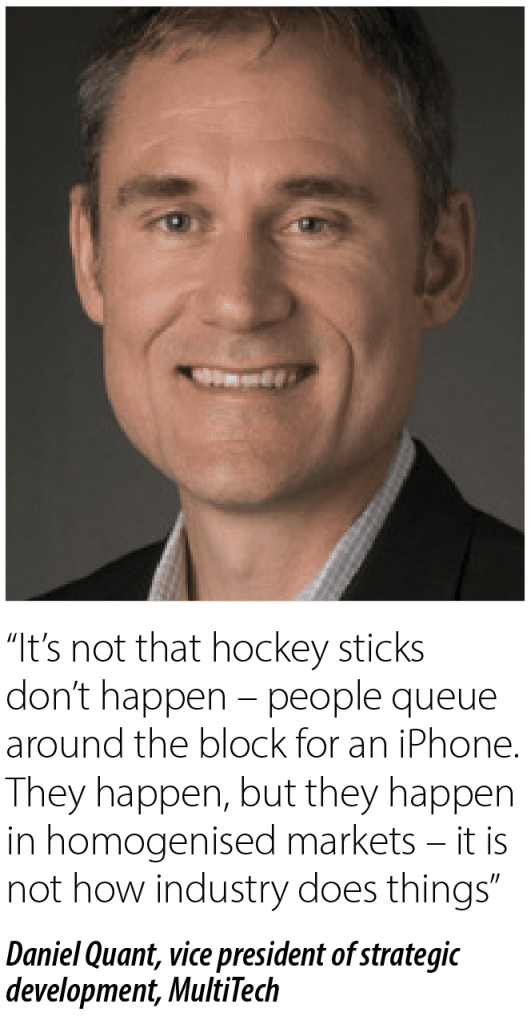
Not everyone buys the hyper-acceleration of cellular LPWA take-up. “I don’t think so – that NB-IoT curve goes up like a hockey stick, and I don’t believe in hockey sticks,” says Daniel Quant, vice president for strategic development at Minnesota-based vendor MultiTech, referencing the ABI forecast, in particular.
“It’s not that hockey sticks don’t happen – people queue around the block for an iPhone. They happen, but they happen in homogenised markets, where everyone uses devices the same way – which is not how industry does things.”
Industrial applications require higher customisation and longer development, he says, echoing Skipper’s note about contract cycles. “Solid compound growth, yes; hockey-stick growth, maybe not.”
MultiTech is a founding member of the LoRa Alliance, the collective in charge of corralling a vibrant community of start-ups and corporations. It has also supplied early-stage LTE-M and NB-IoT gear into AT&T, Deutsche Telekom, Orange, Telefónica, and Vodafone, among others. “Cellular is the larger business but LoRa has enjoyed strongest growth,” says Quant of the MultiTech portfolio, positioning himself as an impartial voice – on these technologies, anyway.
His problem with the NB-IoT forecasts is they are skewed towards the Chinese market, with China taking 62 per cent of NB-IoT share in ABI’s count. “China has short-circuited the open market. All the NB-IoT forecasts are about China – the forecast is weak without it.”
By contrast, he notes the balance in the LoRa numbers, with about 50 per cent of LoRaWAN connections in Asia Pacific, declining in the period, and more than 20 per cent slated in both Europe and North America.
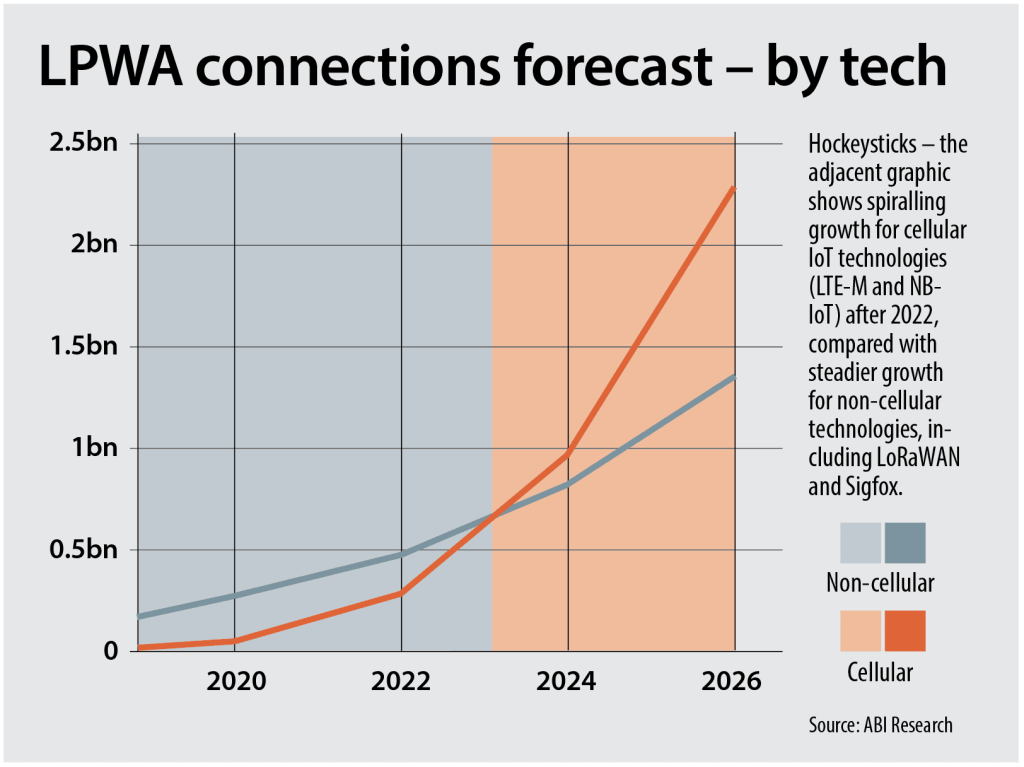
The LoRa community claims an even split between public and private LoRaWAN deployments, it might be noted. “Can China alone create that hockey stick? It feels like high-risk forecasting to me. LoRa has a more equal weighting, which feels much lower risk – everything pulls together, and you get nice compound growth. But that NB-IoT hockey stick story, I’m not sure I buy it.”
The LoRa Alliance claims it is taking share from cellular M2M providers, too. “We’re seeing customers migrating from legacy cellular networks to LoRaWAN,” says Donna Moore, chief executive and chair at the LoRa Alliance. “It is not just about greenfield deployments – the market is switching to LoRaWAN from old-style M2M on 2G and 3G. That’s where we see growth as well.”
The conversation turns, inevitably, to use cases. Quant scratches his head. “Use cases for NB-IoT are few and far between,” he says, taking aim at the idea of NB-IoT as a digital workhorse in the countryside, flagged up by analysts and operators as a use-case scenario. “I mean, they’re positioning agriculture,” he says.
“Agriculture? There’s poor cell phone coverage in the countryside, and you’re expecting to hit sensors in the soil, with vegetation all around? I can tell you from the work we did with LoRaWAN that is not going to fly.”
Such a landscape requires an elevated position, at least, to enable backhaul over a mobile network, whether sensors and gateways in the farm are connected to cellular or non-cellular LPWA. “These people are kidding themselves if they think these markets will deliver high growth for cellular LPWA.”
SYSTEM MONITORS
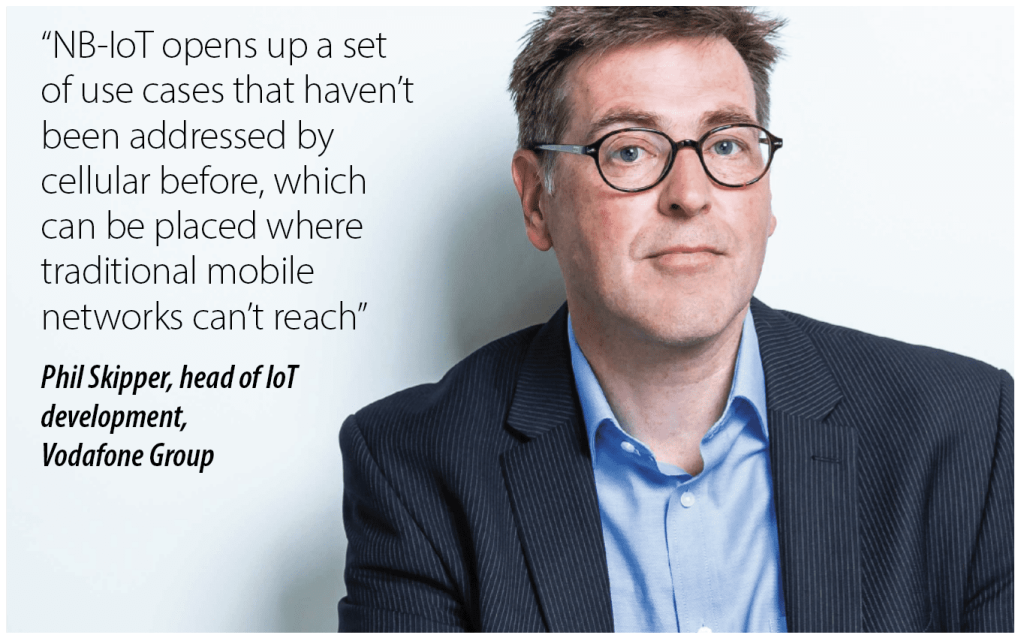
But Skipper does not mention agriculture. Vodafone is putting focus on metering for utilities and sensors for cities, he says, which require long-lasting batteries, narrowband transmissions, and a wide-area extension of national cellular coverage. “NB-IoT opens up a set of use cases that haven’t been addressed by cellular before, which can be placed where traditional mobile networks can’t reach,” he says.
Water and gas meters, making periodic volumetric readings, are prime candidates, says Skipper. (Electricity meters have ready power, varied data requirements, and complex comms protocols, by contrast, and require more bespoke setup). “Static fuels, calor gas, silage – all of those types of things, where it’s basically a full/empty, or in-between type of measure. The same with car parking and bin monitoring.”
Curioiusly, Proximus launched its LoRaWAN and NB-IoT offerings in response to customer demand, which came from an electricity provider in the case of NB-IoT. LoRaWAN is the better technology for water meters, explains Hebbelynck. “They require long-life devices – for 15 years – which is not something we can even imagine with NB-IoT, today.”
By contrast, electricity meters make higher demands of bandwdith, throughput, and coverage, and none at all of power consumption. NB-IoT offers 200kbps on 200 kHz, compared with 50kbps on 125 kHz (see page 16) – and piggybacks on existing LTE infrastructure for wider reach.
“It was a combination of high bandwdith and indoor coverage. The bandwidth aspect was a killer for NB-IoT, and it offers deeper indoor penetration because we are reusing our dense 4G network. And the fact there was no constraint on batteries – because LoRaWAN is really ahead in terms of power consumption.”
But Quant is unconvinced. “With NB-IoT, its still unclear what the high-running applications outside of smart city and metering are going to be,” he responds. Emotive stuff, especially for one hawking NB-IoT kit.
The Sigfox collective, by contrast, appears to take a milder view. “This isn’t a VHS-versus-Betamax contest,” says Tim Harris, chief executive of Sigfox operator WND UK. “The IoT space will be enormous – there’s business for everyone, and different use cases for each. Cellular will go to the top of the pyramid. If you want to stream video, great – go with cellular. We’re useless for that. But the bulk of data and revenue is in that bottom of the pyramid, with LPWA networks.”
VALUE PYRAMID
Of course, Harris’ pyramid describes the whole space, including IoT applications based on broadband cellular, through to industrial deployments of LTE and 5G. But he makes the bun-fight at the bottom one between the non-cellular LPWA pairing of LoRa and Sigfox.
“The choice at the bottom of the pyramid comes down to two things: whether you want to run your own network, and how far you want it to reach,” he says.
The LoRaWAN community, offering public and private deployments, will box-back this double-jab, shortly. But WND’s point about volume and value, even in the LPWA part of the pyramid, chimes. What does ABI think? Will operators make their muscle count, in the end? Will the two factions come at this from above and below, until there is crossover in the middle, but a victor at the bell?
“Absolutely,” says Krishnan. “There are a lot of challenges, still, and LoRaWAN and Sigfox are more mature, but this global supply chain is fantastically well-oiled, and end customers have high confidence in cellular.”
DHL and FedEx are using cellular to track certain assets, notably higher-value items, he says. “Transporting an organ, say, under temperature conditions – that’s already being done with cellular. And even low-value assets, like reusable pallets, are being tracked with cellular.”
AT&T, it might be noted, has a track-and-trace deal with UK firm RM2 to provide LTE-M to reusable pallets, promising 20 per cent savings compared with wooden pallets – provided they can be recovered.
Skipper says the same. LoRaWAN will work as a metering technology in well-covered urban locales, but cannot be relied upon for national and international coverage. “Yes, it might work in the centre of the city, but there are a load of meters outside that aren’t covered,” he says.
The point is cellular LPWA technologies extend mobile cellular coverage – which outruns newer LoRaWAN and Sigfox networks, anyway – without needing new infrastructure. They also work globally.
“With NB-IoT, it doesn’t really matter where the device is. And many of the clients we deal with operate globally. If you’re going to make an electricity meter, it has to work in many different countries, and some countries may not go with LoRaWAN. But if there is a mobile operator there, they’re likely to be offering LTE-M or NB-IoT.”
This article is continued here. A full version of the editorial report, including additional content, is available for download here.