
RCR Wireless
  • News
  • Channels
    • 5G
    • 6G
    • BSS OSS
    • Carriers
    • IoT
    • Network Infrastructure
    • Open RAN
    • Private 5G
    • Telco AI
    • Telco Cloud
    • Test & Measurement
  • Resources
    • Reports
    • Webinars
    • White papers
    • AI Fundamentals
    • Analyst Angle
    • Editorial Calendar
    • Fundamentals
      • 5G NR Release 17
      • AI
        • Telco AI in 2025
    • Podcasts
      • Let’s Get Digital with Carrie Charles
      • Wireless Connectivity to Enable Industry 4.0 for the Middleprise
      • Well Technically…
      • Will 5G Change the World
      • Accelerating Industry 4.0 Digitalization
  • AI Infrastructure
  • Programs
  • Events
  • RCRtv
  • Advertise
  • Subscribe
Friday, August 7, 2026
RCR Wireless
  • News
  • Channels
    • 5G
    • 6G
    • BSS OSS
    • Carriers
    • IoT
    • Network Infrastructure
    • Open RAN
    • Private 5G
    • Telco AI
    • Telco Cloud
    • Test & Measurement
  • Resources
    • Reports
    • Webinars
    • White papers
    • AI Fundamentals
    • Analyst Angle
    • Editorial Calendar
    • Fundamentals
      • 5G NR Release 17
      • AI
        • Telco AI in 2025
    • Podcasts
      • Let’s Get Digital with Carrie Charles
      • Wireless Connectivity to Enable Industry 4.0 for the Middleprise
      • Well Technically…
      • Will 5G Change the World
      • Accelerating Industry 4.0 Digitalization
  • AI Infrastructure
  • Programs
  • Events
  • RCRtv
  • Advertise
  • Subscribe
Add RCR Wireless as a preferred source on Google
  • Qualcomm 6G Insights
  • Huawei Content Hub
  • Qualcomm – 6G Vision
  • OSS/BSS Channel
  • RCRTech Roundtable: AI Infrastructure
RCR Wireless
RCR Wireless
  • Advanced Mimo
  • Mobile mmWave
  • 5G Positioning
  • Green Networks
  • Metaverse
  • Automotive
  • Industrial and Wide-area IoT
Copyright 2021 - All Right Reserved
Home - The $17tn 5G opportunity will explode in cities first – but industrial 5G revenues will drag for a decade
5GCarriersInternet of Things (IoT)News & Event CoverageSmart CitiesWired Networks, Fiber

The $17tn 5G opportunity will explode in cities first – but industrial 5G revenues will drag for a decade

by James Blackman June 10, 2019
written by James Blackman June 10, 2019 Share
LinkedinEmail
Share 0LinkedinEmail
139

New 5G technologies will generate $17 trillion in economic growth in the period to 2035, with the initial stimulus coming from smart-city applications piggybacking on urban 5G rollouts. But operators’ revenues from industrial 5G, hyped as the will not outpace revenues from consumer 5G for more than a decade.

These are the conclusions of a new report, into urban 5G deployments, by ABI Research, which says cities will be at the heart of the 5G story, and the incubation sector for new services and models to spring off next-generation mobile networks.

The rollout of 5G services in urban centres, where user densities are highest, will boost the smart city ecosystem, says ABI, and establish a new connectivity platform for consumer services and industrial actors in urban environments.

Dimitris Mavrakis from ABI Research commented: “The creation of new types of services, especially in cities and smart cities, will likely come faster when 5G becomes a consistent connectivity and processing platform. This will create a new wave of use case innovation and will allow B2B application developers to create many new applications that we cannot yet imagine.”

Operators’ revenues from industrial 5G services, spurred by urban 5G deployments in the first place, will start to outstrip revenue from consumer 5G services from around 2032 (see below), and hardly register until 2025.
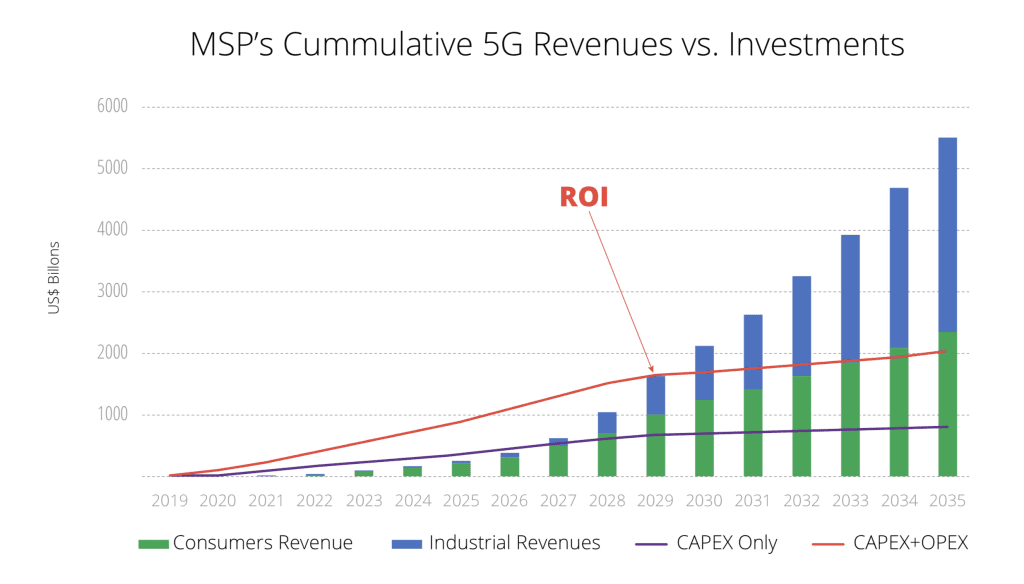
Screenshot 2019 06 10 at 12.39.26

5G is starting to be deployed in the United States, China, Japan, South Korea, and the United Kingdom. Initial 5G use cases are being fuelled by enhanced mobile broadband (eMBB). Technologies like private cellular, millimeter wave (mmWave), small cells, fixed wireless access, and telco cloud/edge are also contributing, noted ABI.

More advanced 5G features such as ultra-reliable low-latency communications (URLLC) and massive machine type communications (MMTC), contained in the 3GPP Release 15 specifications, will start to appear from 2020.

Mavrakis said: “5G will be what 4G was for consumer services: a platform for the creation of new applications and new types of experiences. 5G is currently being deployed for eMBB in cities, which will enhance the consumer experience and allow operators to deploy faster and more efficient radio networks. However, the true revolution will come with Release 16, when URLLC is enabled, allowing deterministic and reliable networking for many different verticals. It is this phase that will create an explosion in enterprise applications and holds the potential to transform many different verticals.”

ABI highlights increased revenue opportunities in the next decade in both direct and indirect contributions, as well as in productivity gains. In the period through 2028, it calculates direct contributions from 5G deployments will amount to $2.4 trillion, mostly driven by end-user subscriptions for connectivity services, as 5G is rolled out in cities first. This compares with $1.1 trillion with 4G.

Besides, $866 billion will come from indirect contributions, including increases in the supply chain from devices, infrastructure, applications, advertising and other products or services. This compares with $500 billion in 2018 from indirect contributions via 4G networks.

In terms of productivity gains, ABI reckons 5G connectivity in urban centres will see $3.2 trillion economic growth.

The report, called ‘5G urban deployment: debunking the capex myth and unlocking new growth’, was commissioned by InterDigital.

Henry Tirri, chief technology offier at InterDigital, said: “We expect 5G deployment to begin to place huge pressures on mobile operators over the next couple of years as they look to compete to capitalise on its revenue potential. Many are trying to understand how they will monetise this next generation of wireless technology, and most importantly, how they’ll deliver ROI from it.

“But while there may still be several questions and doubts surrounding 5G monetisation, these findings clearly demonstrate the growth opportunities that 5G is set to bring about. While CAPEX and OPEX investments will be high, it is evident that 5G technology will radically change our ability to deliver new and innovative consumer and enterprise services, and help dictate the trajectory of our future global economy.”

The city-first strategy for network deployment is plain, based on the ROI brought by the density of users in urban locales. “This common strategy has created tremendous productivity gains for previous network generations, especially for 4G,” said Mavrakis. “The same will happen with 5G: it will be rolled out in dense urban environments in 2019 and 2020 and it will later be expanded to other areas.”

He said: “We have reached a critical point today where our global economy is heavily reliant on our ability to deliver new technological services. 5G has the potential to completely change our every day lives, but only if mobile service providers can roll out 5G in a way that makes economical and logical sense – that is, to start with mobile broadband connectivity deployments in urban areas to create the right use cases that will justify investments in CAPEX and OPEX.”

He continued: “These first years will be vital for 5G to show consumers and business what can be achieved and to lay the foundation for the more advanced, service-based improvements that will be introduced after 2022, including edge computing and network slicing. These will unleash the true power of 5G and will likely enhance several enterprise verticals well beyond the current reach of telco networks, which focus on connectivity.

“Regulators should position spectrum auctions to stimulate the deployment of 5G, especially in dense urban areas. The new generation could be positioned as a catalyst for many new advancements in cities, leading to the evolution of a smart city. Mobile operators should also take bold steps to deploy 5G more aggressively in cities, to make consumers familiar with the new technology and lay the foundation for new applications.

“Infrastructure vendors should make their equipment as interoperable and open as possible, while aiming to migrate to cloud- and edge-based architectures as soon as possible, in order to ease the transition to distributed and intelligent networks that 5G requires.”

You Might Also Like
  • Bell advances AIDC strategy as fiber and enterprise AI drive Q2
  • Thursday (telco diary) | APAC telcos pile into AI infrastructure
  • Chunghwa Telecom expands AI infra with new DC
  • Starlink Mobile – what is Musk actually building, beyond the chatter?
  • SpaceX targets US carriers with small-cell terrestrial rollout and mega demand from physical AI
  • SoftBank lifts AI growth outlook as cloud infrastructure enters monetization phase
Share 0 LinkedinEmail
James Blackman
James Blackman

James Blackman has been writing about the technology and telecoms sectors for over a decade. He has edited and contributed to a number of European news outlets and trade titles. He has also worked at telecoms company Huawei, leading media activity for its devices business in Western Europe. He is based in London.

previous post
‘There needs to be an IT DNA’: The view from VMware (Part 2)
next post
One third of industrial companies, half of large firms, will apply for 5G licenses

White Papers

  • Norton eBook: The 2026 Telco Playbook

  • Enea White Paper: Why Intelligent AAA is the Swiss Army Knife of Telecom

  • CSG White Paper: Telco AI Enabler: Mediation’s Defining Role

  • Enea White Paper: Scalable Database Design for 5G and Beyond

  • Supermicro and NVIDIA Whitepaper: Powering sovereign AI at scale

Editorial Reports

  • Report: NTN in motion — evolving standards, expanding services

  • Market Pulse Report: Telco AI in 2026 – Trends, Challenges and Opportunities

  • Nvidia Report: The State of AI in Telecommunications: 2026 Trends

Webinars

  • Webinar: Building 6G — aligning technology, policy and purpose

  • SIMCom Webinar: Scaling your next deployment – from plastic to provisioning

  • Webinar: Rethinking the RAN as AI, cloud and openness converge

  • Webinar: Scale-Up, Scale-Out, Scale-Across – Building AI-Era Network Fabrics

  • Webinar: NTN in motion – evolving standards, expanding services

Since 1982, RCR Wireless News has been providing wireless and mobile industry news, insights, and analysis to mobile and wireless industry professionals, decision makers, policy makers, analysts and investors.

Facebook Twitter Youtube Linkedin Envelope Rss

Useful Links

  • Subscribe
  • About RCR Wireless News
  • Contact Us
  • Advertise
  • Editorial Calendar
  • Archive
  • RSS
  • Wireless News Archive
  • Subscribe
  • About RCR Wireless News
  • Contact Us
  • Advertise
  • Editorial Calendar
  • Archive
  • RSS
  • Wireless News Archive

Edtior's Picks

The Agentic Network — NVIDIA on the full-stack path to telecom autonomy
Ericsson named sole global tech partner in SK Telecom-led AI-RAN pilot
Bell advances AIDC strategy as fiber and enterprise AI drive Q2

Latest Articles

The Agentic Network — NVIDIA on the full-stack path to telecom autonomy
Ericsson named sole global tech partner in SK Telecom-led AI-RAN pilot
Bell advances AIDC strategy as fiber and enterprise AI drive Q2
Context before control – Blue Planet maps AI architecture for autonomous networks

© 2026 RCR Wireless News All Right Reserved. Developed by Eight Hats.

Cookie Policy | Privacy Policy

RCR Wireless
  • News
  • Channels
    • 5G
    • 6G
    • BSS OSS
    • Carriers
    • IoT
    • Network Infrastructure
    • Open RAN
    • Private 5G
    • Telco AI
    • Telco Cloud
    • Test & Measurement
  • Resources
    • Reports
    • Webinars
    • White papers
    • AI Fundamentals
    • Analyst Angle
    • Editorial Calendar
    • Fundamentals
      • 5G NR Release 17
      • AI
        • Telco AI in 2025
    • Podcasts
      • Let’s Get Digital with Carrie Charles
      • Wireless Connectivity to Enable Industry 4.0 for the Middleprise
      • Well Technically…
      • Will 5G Change the World
      • Accelerating Industry 4.0 Digitalization
  • AI Infrastructure
  • Programs
  • Events
  • RCRtv
  • Advertise
  • Subscribe
RCR Wireless
  • News
  • Channels
    • 5G
    • 6G
    • BSS OSS
    • Carriers
    • IoT
    • Network Infrastructure
    • Open RAN
    • Private 5G
    • Telco AI
    • Telco Cloud
    • Test & Measurement
  • Resources
    • Reports
    • Webinars
    • White papers
    • AI Fundamentals
    • Analyst Angle
    • Editorial Calendar
    • Fundamentals
      • 5G NR Release 17
      • AI
        • Telco AI in 2025
    • Podcasts
      • Let’s Get Digital with Carrie Charles
      • Wireless Connectivity to Enable Industry 4.0 for the Middleprise
      • Well Technically…
      • Will 5G Change the World
      • Accelerating Industry 4.0 Digitalization
  • AI Infrastructure
  • Programs
  • Events
  • RCRtv
  • Advertise
  • Subscribe
@2020 - All Right Reserved. Designed and Developed by PenciDesign