

RCR Wireless
  • News
  • Channels
    • 5G
    • 6G
    • BSS OSS
    • Carriers
    • IoT
    • Network Infrastructure
    • Open RAN
    • Private 5G
    • Telco AI
    • Telco Cloud
    • Test & Measurement
  • Resources
    • Reports
    • Webinars
    • White papers
    • AI Fundamentals
    • Analyst Angle
    • Editorial Calendar
    • Fundamentals
      • 5G NR Release 17
      • AI
        • Telco AI in 2025
    • Podcasts
      • Let’s Get Digital with Carrie Charles
      • Wireless Connectivity to Enable Industry 4.0 for the Middleprise
      • Well Technically…
      • Will 5G Change the World
      • Accelerating Industry 4.0 Digitalization
  • AI Infrastructure
  • Programs
  • Events
  • RCRtv
  • Advertise
  • Subscribe
Wednesday, July 22, 2026
RCR Wireless
  • News
  • Channels
    • 5G
    • 6G
    • BSS OSS
    • Carriers
    • IoT
    • Network Infrastructure
    • Open RAN
    • Private 5G
    • Telco AI
    • Telco Cloud
    • Test & Measurement
  • Resources
    • Reports
    • Webinars
    • White papers
    • AI Fundamentals
    • Analyst Angle
    • Editorial Calendar
    • Fundamentals
      • 5G NR Release 17
      • AI
        • Telco AI in 2025
    • Podcasts
      • Let’s Get Digital with Carrie Charles
      • Wireless Connectivity to Enable Industry 4.0 for the Middleprise
      • Well Technically…
      • Will 5G Change the World
      • Accelerating Industry 4.0 Digitalization
  • AI Infrastructure
  • Programs
  • Events
  • RCRtv
  • Advertise
  • Subscribe
Add RCR Wireless as a preferred source on Google
  • Qualcomm 6G Insights
  • Huawei Content Hub
  • Qualcomm – 6G Vision
  • OSS/BSS Channel
  • RCRTech Roundtable: AI Infrastructure
RCR Wireless
RCR Wireless
  • Advanced Mimo
  • Mobile mmWave
  • 5G Positioning
  • Green Networks
  • Metaverse
  • Automotive
  • Industrial and Wide-area IoT
Copyright 2021 - All Right Reserved
Home - CommScope Definitions: What is HFC?
CommScope DefinitionsCommScope FTTx Blogs

CommScope Definitions: What is HFC?

by CommScope October 2, 2016
written by CommScope October 2, 2016 Share
LinkedinEmail
Share 0LinkedinEmail
143

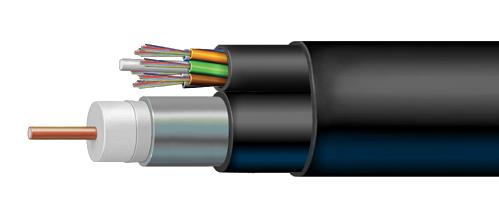
commscope-hfcHybrid fiber coax (HFC) is the term that describes the service delivery architecture used by cable operators and multi-system operators (MSO). The architecture includes a combination of fiber optic cabling and coaxial cabling to distribute video, data and voice content to/from the headend and the subscribers. Typically, the signals are transported from the headend through a hub, to within the last mile via fiber optic cable. As an example, for a service area ranging from 64 homes passed to 1,000* homes, the fiber optic cable ends in an HFC node. At this point, the optical signal is converted into a radio frequency (RF) signal and transmitted over coaxial cable to subscribers’ homes/businesses.

The coaxial cable that enters subscribers’ homes is a flexible, small “drop” cable that will connect directly to the cable modem, the set-top box or other consumer premise equipment. The RF signal on the coaxial cable is strong enough to allow signals to be split in different directions within the home. Sometimes the number of separate devices in the home is so large that amplification may be required. In this instance, a drop amp or house amp is used.  Often, the splitters and amplifier are combined to reduce the number of connections.

The term HFC also implies the way in which signals are transported through the network.  All HFC networks use frequency division multiplexing to pack the content into the spectrum slots of a cable plant. Spectrum in this case is typically referred to as the frequency bands that carry the content – 52MHz to 1004MHz for the forward, (headend to subscriber), and 5-42MHz for the reverse (subscriber to headend) in the US. Across the globe, spectrum allocations and split frequencies vary. Downstream and upstream are terms also used to describe these bands, respectively.

Signals that originate in the headend that must be transported to the subscriber are either analog or modulated with a scheme called quadrature amplitude modulation (QAM). QAM signals are generated by taking a digital representation of the original signal, whether it is an analog voice or video signal, and converting it by sampling and modulating a carrier. The resulting QAM signal is a high-capacity analog signal, which requires care in maintaining a high level of signal-to-noise ratio (SNR). This contrasts with a digital optical signal as used in GEPON or GPON (gigabit passive optical networks), for which SNR equivalent requirements are much simpler.

The standard that governs QAM transport is managed by CableLabs, a non-profit industry funded R&D organization, and is called Data Over Cable Service Interface Specification, or DOCSIS®. Currently, DOCSIS 3.0 is the most widely deployed. The newest version, DOCSIS 3.1, significantly improves the modulation rates and data throughput to subscribers, also expanding the downstream to 1200MHz and beyond, and the upstream to 85MHz and beyond.

So, how do MSOs seamlessly transition HFC to fiber-to-the-home?  Stay tuned for another post on successful strategies.

*A significant consideration as to the size of the service area is the amount of bandwidth a subscriber consumes. As each HFC node has a direct connection back to the headend, smaller service areas get access to more data-per-home-passed delivered from the headend.


You Might Also Like
  • What Is MIMO?
  • What is Wavelength Division Multiplexing (WDM)?
  • How to make a standardized tower top
Share 0 LinkedinEmail
CommScope

previous post
The Connected and Efficient Data Center
next post
Kagan: Smart cities, the next revolution

White Papers

  • Norton eBook: The 2026 Telco Playbook

  • Enea White Paper: Why Intelligent AAA is the Swiss Army Knife of Telecom

  • CSG White Paper: Telco AI Enabler: Mediation’s Defining Role

  • Enea White Paper: Scalable Database Design for 5G and Beyond

  • Supermicro and NVIDIA Whitepaper: Powering sovereign AI at scale

Editorial Reports

  • Nvidia Report: The State of AI in Telecommunications: 2026 Trends

  • Report: Scaling Optical Networks For The Hyperscale And AI Era

  • Test And Measurement Market Pulse Report

Webinars

  • Webinar: Building 6G — aligning technology, policy and purpose

  • SIMCom Webinar: Scaling your next deployment – from plastic to provisioning

  • Webinar: Rethinking the RAN as AI, cloud and openness converge

  • Webinar: Scale-Up, Scale-Out, Scale-Across – Building AI-Era Network Fabrics

  • Webinar: NTN in motion – evolving standards, expanding services

Since 1982, RCR Wireless News has been providing wireless and mobile industry news, insights, and analysis to mobile and wireless industry professionals, decision makers, policy makers, analysts and investors.

Facebook Twitter Youtube Linkedin Envelope Rss

Useful Links

  • Subscribe
  • About RCR Wireless News
  • Contact Us
  • Advertise
  • Editorial Calendar
  • Archive
  • RSS
  • Wireless News Archive
  • Subscribe
  • About RCR Wireless News
  • Contact Us
  • Advertise
  • Editorial Calendar
  • Archive
  • RSS
  • Wireless News Archive

Edtior's Picks

South Korea launches AI-RAN project to advance industrial AI
Tuesday (telco diary) | Telco agents and outcomes
AT&T’s bets on “best tech” (fiber) pay off with record adds, improving margins 

Latest Articles

South Korea launches AI-RAN project to advance industrial AI
Tuesday (telco diary) | Telco agents and outcomes
AT&T’s bets on “best tech” (fiber) pay off with record adds, improving margins 
The most expensive wireless system is the one you install twice (Reader Forum)

© 2026 RCR Wireless News All Right Reserved. Developed by Eight Hats.

Cookie Policy | Privacy Policy

RCR Wireless
  • News
  • Channels
    • 5G
    • 6G
    • BSS OSS
    • Carriers
    • IoT
    • Network Infrastructure
    • Open RAN
    • Private 5G
    • Telco AI
    • Telco Cloud
    • Test & Measurement
  • Resources
    • Reports
    • Webinars
    • White papers
    • AI Fundamentals
    • Analyst Angle
    • Editorial Calendar
    • Fundamentals
      • 5G NR Release 17
      • AI
        • Telco AI in 2025
    • Podcasts
      • Let’s Get Digital with Carrie Charles
      • Wireless Connectivity to Enable Industry 4.0 for the Middleprise
      • Well Technically…
      • Will 5G Change the World
      • Accelerating Industry 4.0 Digitalization
  • AI Infrastructure
  • Programs
  • Events
  • RCRtv
  • Advertise
  • Subscribe
RCR Wireless
  • News
  • Channels
    • 5G
    • 6G
    • BSS OSS
    • Carriers
    • IoT
    • Network Infrastructure
    • Open RAN
    • Private 5G
    • Telco AI
    • Telco Cloud
    • Test & Measurement
  • Resources
    • Reports
    • Webinars
    • White papers
    • AI Fundamentals
    • Analyst Angle
    • Editorial Calendar
    • Fundamentals
      • 5G NR Release 17
      • AI
        • Telco AI in 2025
    • Podcasts
      • Let’s Get Digital with Carrie Charles
      • Wireless Connectivity to Enable Industry 4.0 for the Middleprise
      • Well Technically…
      • Will 5G Change the World
      • Accelerating Industry 4.0 Digitalization
  • AI Infrastructure
  • Programs
  • Events
  • RCRtv
  • Advertise
  • Subscribe
@2020 - All Right Reserved. Designed and Developed by PenciDesign