The automotive industry is working hard to integrate technology to make the self-driving experience safer and more enjoyable
Earlier this year I wrote about the coming full autonomous vehicle that could be summoned as needed and drive us without a steering wheel was, perhaps, a decade away, possibly further. Uber recently announced it is planning to do a trial of self-driving taxis in downtown Pittsburgh starting in the next few weeks. The test will use Volvo’s XC90 that have been configured to drive autonomously. Ford also plans to join the test using modified Ford Fusions. Has my rather conservative prediction been terribly off or is something else going on?
However what struck me about this announcement compared with all the other announcements recently is that in the Uber test in Pittsburg there are real passengers being taken to their desired location for the very first time. Right now, it may seem inconsequential, but I can assure you that this is a watershed moment for telematics.
It turns out there are a number of different stages of self-driving cars and trucks, and this trial by Uber is really happening, but with a lot of oversight. But, it’s still a real watershed moment that should get you to stop and realize that all this talk about autonomous vehicles is real and is happening much fast than anyone expected, including yours truly. Let’s put this all into perspective.
You read almost every day about an announcement in telematics – the integration of technology and vehicles (both cars and trucks). Every major car and truck company is working on ways to bring technology to support a safer driving experience into the market. But, just adding “super cruise control” (like what’s available as “Autopilot” in the Tesla cars) doesn’t mean you can give control over to the car, have it safely take you where you need to go and let you “tune out” from driving to do other things such as reading, doing work on your laptop or taking a nap.
The reason that Tesla owner Joshua Brown died on May 7 while driving in Florida was because he did just that – he “turned out” from the responsibility of driving, and the Tesla look-ahead software got “blinded” from the reflection off the truck in front of the car and didn’t automatically slow down. Sure, those kinds of things will likely not happen again. Software that looks for a blinding situation will be updated along with the use of better sensors that will work correctly in such situations.
The Society of Automotive Engineers has published a great graphic on the different levels of autonomous vehicle operation. It is similar to the graphs created by the National Highway Traffic & Safety Administration, but extended from five to six levels to better define the operation of these self-driving vehicles:
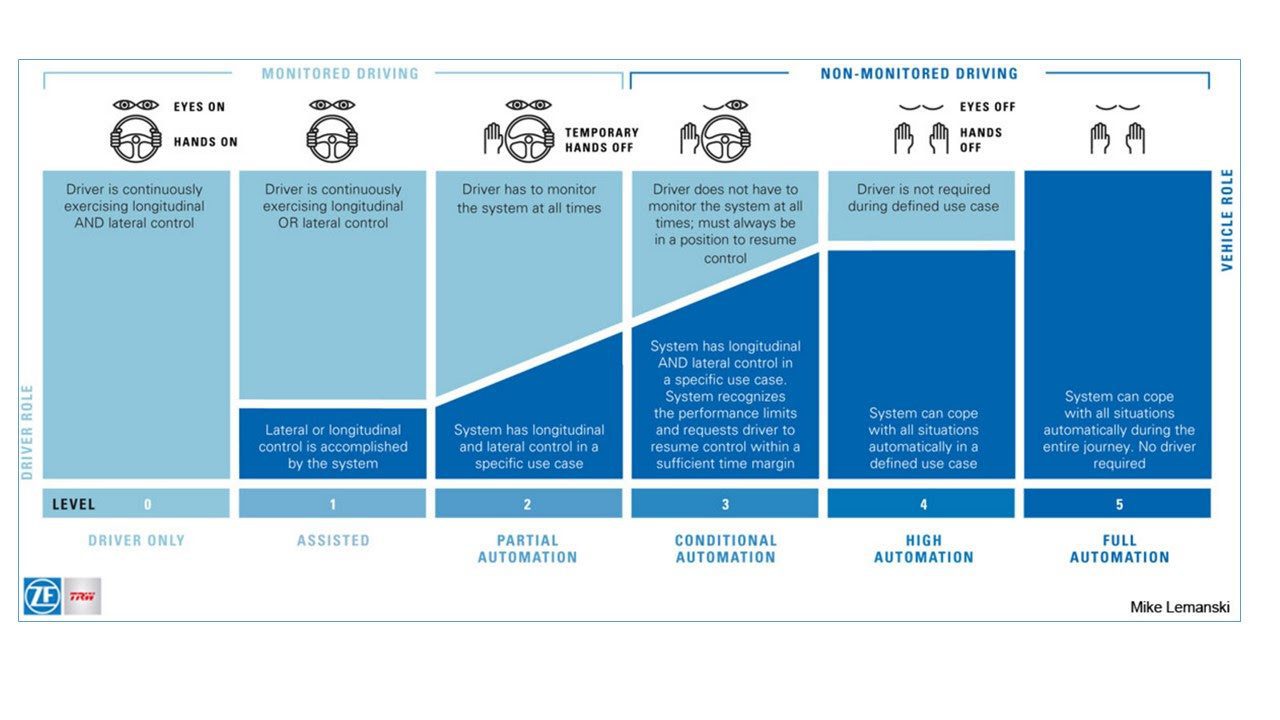
Note the two bracketed areas at the top of the diagram: they delineate the difference between driving that is monitored by the driver and driving that is not monitored. Going from one step to the next is not accomplished in linear fashion. Rather, making that transition takes a lot of work, testing and passing government regulations to ensure that the truly autonomous vehicles will work all the time, not just some of the time.
In particular, as you move from “Level 3” to “Level 4,” you’ll notice the icon for the drivers eyes being off (as in asleep) shows up. That’s the demarcation that is going to take the most government oversight and regulatory approval.
Thus, going from Level 3 (where Tesla is today) to Level 4 is going to take a lot of time and governmental oversight. And, further, Level 3 does not mean you can take your eyes off the road or the steering wheel. Watch this video of a driver using Level 3 driving assist and see what happens when a service vehicle suddenly moves from the left to pass right in front of the car. It system did adjust and prevent an accident. But, you can also hear the driver very aware that it was a dangerous situation and was able to take back control if necessary.
The current forecast for our being able to have cars and trucks that drive autonomously is at least five years off, with the more likely date to see this stuff (as I said before) around 2025. It might happen earlier but it just as likely might happen later.
Now, re-read the announcement by Uber about their testing self-driving vehicles in downtown Pittsburgh. They are not cars that come by, let you in and take you to the address you entered on your smartphone. Rather, this is a test environment in which each car will have two people in the vehicle besides the passenger: one to sit behind the wheel and take over when the situation is unsafe and the other to observer and make notes to help give engineers feedback so they can improve the software in a rapid manner.
There was a number of other announcements in the past 10 days about the future of autonomous driving. Perhaps they are all just coincidental, but it seems the auto manufacturers are each predicting they will have some form of autonomous vehicle in the market by 2021, which most likely will slip at least a year or two. Also, notice that these companies are not saying you’ll be able to buy a fully autonomous car by then. But, rather, they will sell cars that can only go in certain areas that have been marked such as in a shuttle or small form of a bus going on a certain, predefined route.
Uber also announced it was buying Otto, an autonomous vehicle software development company focused on automatic the driving of trucks rather than cars. And, Uber also announced recently a partnership with Volvo to invest $300 million in autonomous vehicle development.
Ford said recently it will roll out a fleet of driverless cars within five years. These are the vehicles that will be deployed in designated areas marked to define the route of these autonomous cars. The vehicles will operate in only a geo-fenced area that has previously been laid out and mapped. And, Ford also announced an investment in Velodyne, a company that makes LIDAR sensors for autonomous self-driving cars. LIDAR uses laser light beams to sense things nearby much like radar works.
In summary, while these developments in self-driving cars is impressive, it is still many years before you should take your eyes off the road and hands off the steering wheel. The major auto manufacturers along with firms like Uber are bringing the world of self-driving cars into reality in our lifetime.
If you left the Earth and returned in, say, 25 or 50 years, you’d likely immediately notice that no one is driving cars or trucks. They all will be driving themselves and controlled by onboard systems that are safe and allow you to do other things while going from point A to point B. And the accidents and fatalities from such operation will be a very unusual event.
In the meantime, if you use Autopilot in a Tesla or other similar super cruise control function, don’t take your eyes off the road or your hands off the steering wheel. You’ll thank me later.

J. Gerry Purdy, Ph.D., is the principal analyst with Mobilocity and a research affiliate with Frost & Sullivan. He is a nationally recognized industry authority who focuses on monitoring and analyzing emerging trends, technologies and market behavior in mobile computing and wireless data communications devices, software and services. Purdy is an “edge of network” analyst looking at devices, applications and services as well as wireless connectivity to those devices. He provides critical insights regarding mobile and wireless devices, wireless data communications and connection to the infrastructure that powers the data in wireless handheld devices. Purdy continues to be affiliated with the venture capital industry as well. He spent five years as a venture adviser for Diamondhead Ventures in Menlo Park, California, where he identified, attracted and recommended investments in emerging companies in the mobile and wireless industry. Purdy had a prior affiliation with East Peak Advisors and, subsequently, following its acquisition, with FBR Capital Markets. Purdy advises young companies that are preparing to raise venture capital, and has been a member of the program advisory board of the Consumer Electronics Association that produces CES, one of the largest trade shows in the world. He is a frequent moderator at CTIA conferences and GSM Mobile World Congress. Prior to funding Mobilocity, Purdy was chief mobility analyst with Compass Intelligence. Prior to that, he owned MobileTrax LLC and enjoyed successful stints at Frost & Sullivan and Dataquest (a division of Gartner) among other companies.
Editor’s Note: Welcome to Analyst Angle. We’ve collected a group of the industry’s leading analysts to give their outlook on the hot topics in the wireless industry.