


RCR Wireless
  • News
  • Channels
    • 5G
    • 6G
    • BSS OSS
    • Carriers
    • IoT
    • Network Infrastructure
    • Open RAN
    • Private 5G
    • Telco AI
    • Telco Cloud
    • Test & Measurement
  • Resources
    • Reports
    • Webinars
    • White papers
    • AI Fundamentals
    • Analyst Angle
    • Editorial Calendar
    • Fundamentals
      • 5G NR Release 17
      • AI
        • Telco AI in 2025
    • Podcasts
      • Let’s Get Digital with Carrie Charles
      • Wireless Connectivity to Enable Industry 4.0 for the Middleprise
      • Well Technically…
      • Will 5G Change the World
      • Accelerating Industry 4.0 Digitalization
  • AI Infrastructure
  • Programs
  • Events
  • RCRtv
  • Advertise
  • Subscribe
Saturday, July 25, 2026
RCR Wireless
  • News
  • Channels
    • 5G
    • 6G
    • BSS OSS
    • Carriers
    • IoT
    • Network Infrastructure
    • Open RAN
    • Private 5G
    • Telco AI
    • Telco Cloud
    • Test & Measurement
  • Resources
    • Reports
    • Webinars
    • White papers
    • AI Fundamentals
    • Analyst Angle
    • Editorial Calendar
    • Fundamentals
      • 5G NR Release 17
      • AI
        • Telco AI in 2025
    • Podcasts
      • Let’s Get Digital with Carrie Charles
      • Wireless Connectivity to Enable Industry 4.0 for the Middleprise
      • Well Technically…
      • Will 5G Change the World
      • Accelerating Industry 4.0 Digitalization
  • AI Infrastructure
  • Programs
  • Events
  • RCRtv
  • Advertise
  • Subscribe
Add RCR Wireless as a preferred source on Google
  • Qualcomm 6G Insights
  • Huawei Content Hub
  • Qualcomm – 6G Vision
  • OSS/BSS Channel
  • RCRTech Roundtable: AI Infrastructure
RCR Wireless
RCR Wireless
  • Advanced Mimo
  • Mobile mmWave
  • 5G Positioning
  • Green Networks
  • Metaverse
  • Automotive
  • Industrial and Wide-area IoT
Copyright 2021 - All Right Reserved
Home - Reality Check: Sprint slashes wireless capex on network strategy revamp
OpinionReality Check

Reality Check: Sprint slashes wireless capex on network strategy revamp

by Reality Check May 24, 2016
written by Reality Check May 24, 2016 Share
LinkedinEmail
Share 0LinkedinEmail
Sprint
105

The recent plan from Sprint to cut capital expenses has many industry observers wondering if the carrier can remain competitive in the market

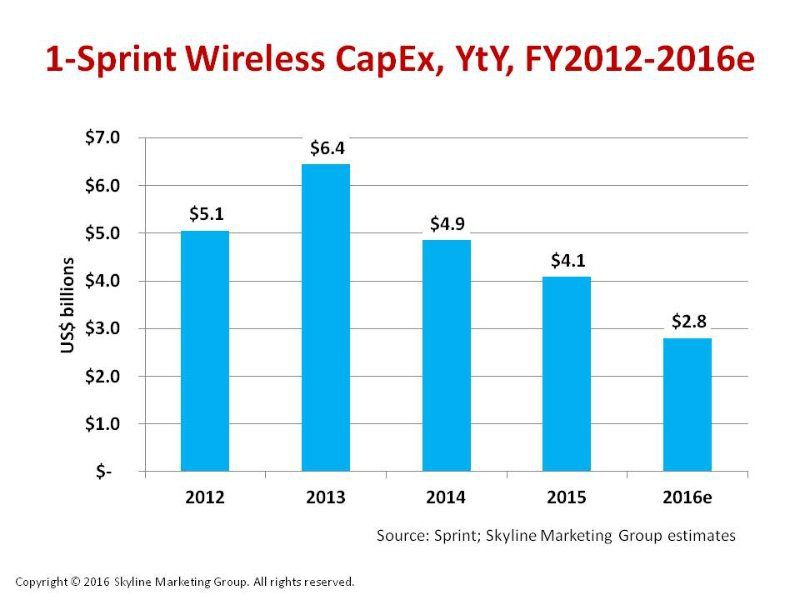
Sprint provided guidance of $3 billion in capital expenditures for financial year 2016, in its recent earnings call. Of that total, we estimate $2.8 billion will be applied to its wireless infrastructure with the balance going to its wireline network.
What this means, though, is that Sprint’s annual wireless capex will nosedive a stunning 32% from the $4.1 billion spent in FY2015. Here’s the big question: Can Sprint achieve its densification goals at these significantly reduced spending levels?
john 1
Sprint’s network investment peaked in FY2013 at $6.4 billion as the company was accelerating its LTE rollout and absorbing the Clearwire acquisition. From that peak, annual capex has declined at a compound average growth rate of -24% through FY2016.
Over that same period, Sprint’s capex-to-service revenues ratio steadily has dropped from 22% in FY2013, to 18% in FY2014, and 16% in FY2015. Ratios above 15% indicate network expansion and investment for capacity and coverage expansion while ratios below 15% suggest that the carrier is operating its network essentially in a maintenance mode with minimal expansion.
Through the FY2013 through 2015 period, Sprint has continued to expand its network, albeit at a declining rate. With FY2016 capex guidance and at the current 5% per year run rate for service revenues, that ratio now drops to 12% in FY2016.
This capital spending drop is a function of several factors: near completion of the LTE build out; cash conservation measures as the company is weathering liquidity issues; and a shift to small cell deployments and away from new macrocell builds. On the latter point, the company believes it still can meet its network densification goals by ramping up its small cell roll out for indoor and outdoor applications and leveraging its significant holdings of about 120 megahertz of 2.5 GHz spectrum. It is interesting to note that a lot of 2.5 GHz infrastructure is already in place at many tower locations. So it may be possible just to upgrade the outdoor base stations to LTE without having to build brand new 2.5 GHz macrocells, thus conserving capex.
Sprint’s densification plan calls for extensive small cells deployments in the “tens of thousands” both indoors for small- and medium-sized businesses, and at street level in major markets. The company recently signed a supply deal with Commscope for the S1000 indoor small cell that can operate a combined 2.5 GHz/Wi-Fi operation. Sprint has not identified its outdoor small cell supplier.
By leveraging small cell technology, Sprint believes it can continue its network capacity expansion even at a significantly lower capex levels and without committing to long-term tower leases. Furthermore, as existing tower leases expire, the company will look at options for relocating antennas to lower-cost infrastructure where feasible, thereby lowering operating expenses.
Two caveats to keep in mind in this scenario.
First, the cost of small cell equipment is in the order of one-tenth the cost of a macrocell, but when you factor in the costs for site acquisition (permitted pole attachments and rooftop locations), site engineering, installation and testing, the overall small cell deployment cost can easily double. So a reduced capex budget may not allow Sprint to buy as many small cells that it may need to meet its densification goals.
Secondly, moving a macrocell to lower-cost infrastructure alternatives is not straightforward. On the contrary, the original radio frequency design placed that macrocell at that location for a reason, namely, that location provided the best cellular coverage for that given area. Moving it will require a new and costly RF design, and another round of site acquisition activity.
What capital spending levels can Sprint’s suppliers expect for the balance of this year?
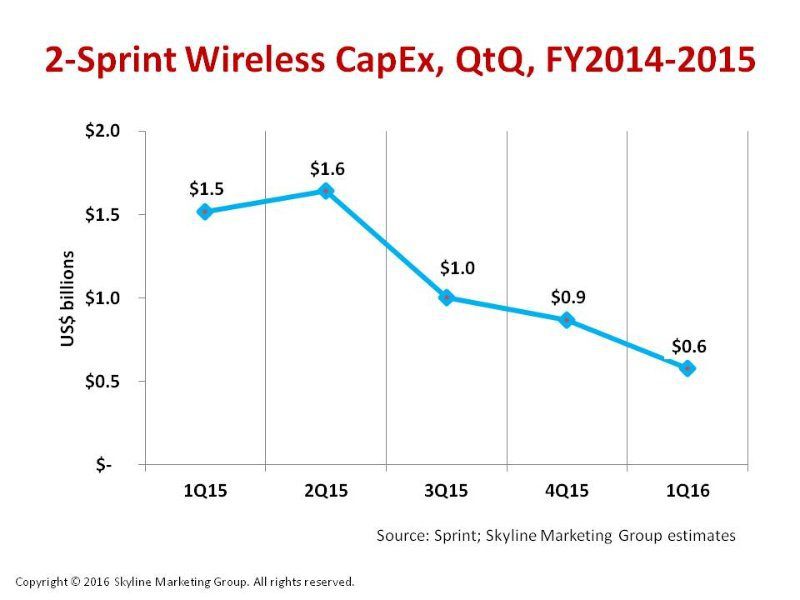
This graph shows Sprint’s quarter-to-quarter spend going downhill over the past 15 months. Historically, Sprint’s quarterly capex has averaged $1 billion to $1.5 billion. Now the QtQ capex run rate has dropped to less than half that amount. Given the FY2016 guidance, we expect Sprint to invest $600 million to $700 million per quarter in the next 12 months.
john 2
How is Sprint’s capital spending allocated?
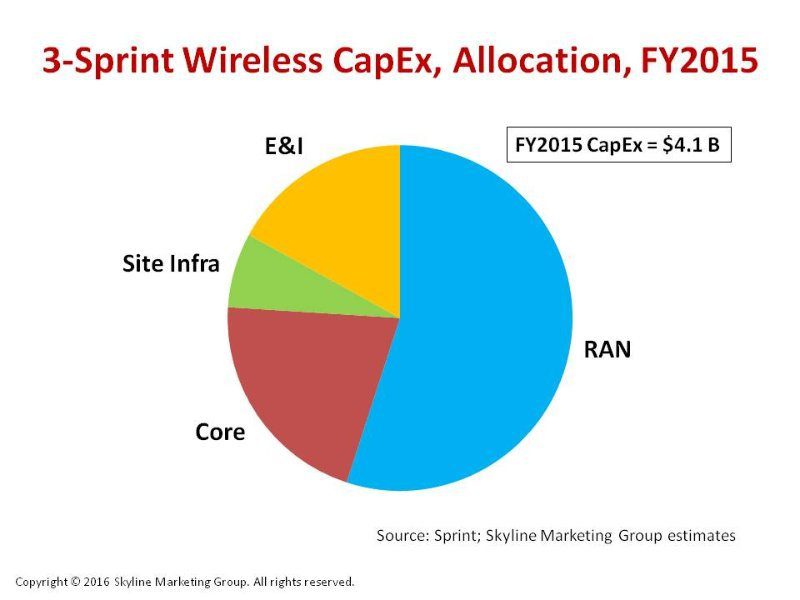
This graph shows a rough breakdown of Sprint’s capex in FY2015.
john 3
Over half of the total spending is allocated to the radio access network. Most of the RAN investment is in the radio equipment. This includes macro base station equipment [base transceiver stations and baseband unit/remote radio head configurations] and small cells. For the next several years, small cells operating across Sprint’s available spectrum is expected to garner the bulk of the RAN investment.
Supporting the radio equipment, a smaller portion of the RAN segment includes what we call the “RF subsystem” that consists of antennas; fiber optic and coaxial cable; combiners; filters and splitters; and tower-mounted amplifiers.
We also include backhaul in the RAN segment, specifically where Sprint purchases its own point-to-point microwave systems. Leased backhaul fiber optic or copper cable facilities typically are accounted for in opex, not capex.
Core network capex accounts for nearly one-quarter of the total. Core equipment includes legacy voice switching systems; data switches and routers; servers and storage devices; software-defined network and network function virtualization platforms; operation support systems and billing support systems.
Site infrastructure, roughly 7% to 10% of the total, includes towers and shelters; antenna mounts for all types of installations (towers, rooftops, water towers, etc.); back-up power; lightning protection and grounding. Engineering and installation ranges between 15% and 20% of the total, and encompasses all the professional services needed for site planning; site acquisition and permitting; site and RF engineering; and installation and testing.
Sprint is making valiant effort to shore up its financial position as it leverages new small cell technologies to reduce infrastructure expansion costs, even as service revenues erode. We should know in short order how well this strategy is working.
John Celentano, a telecom industry veteran, offers expert analysis and strategic marketing advice on wireless and wireline infrastructure markets to equipment manufacturers and service providers. Questions?: [email protected].
Editor’s Note: The RCR Wireless News Reality Check section is where C-level executives and advisory firms from across the mobile industry share unique insights and experiences.


You Might Also Like
  • Why throwing money at broadband speeds isn’t fixing America’s internet (Reader Forum)
  • Thursday (telco diary) | Telco pieces in the AI jigsaw
  • Only 50 of 170 digital infrastructure firms will exist in in five years (Reader Forum)
  • Wednesday (telco diary) | What AT&T and Lumen tell us about the AI fiber build-out
  • The most expensive wireless system is the one you install twice (Reader Forum)
  • Tuesday (telco diary) | Telco agents and outcomes
Share 0 LinkedinEmail
Reality Check

Subject to editorial review and copy edit, RCR Wireless News accepts bylined thought leadership articles, up to 1000 words, from industry executives. Submitted articles become property of RCR Wireless News. Submit articles to [email protected] with "Reality Check" in subject line.

previous post
T-Mobile tech exec explains Un-carrier impact
next post
ZTE helps China Mobile promote MANO interoperability across industry vendors

White Papers

  • Norton eBook: The 2026 Telco Playbook

  • Enea White Paper: Why Intelligent AAA is the Swiss Army Knife of Telecom

  • CSG White Paper: Telco AI Enabler: Mediation’s Defining Role

  • Enea White Paper: Scalable Database Design for 5G and Beyond

  • Supermicro and NVIDIA Whitepaper: Powering sovereign AI at scale

Editorial Reports

  • Market Pulse Report: Telco AI in 2026 – Trends, Challenges and Opportunities

  • Nvidia Report: The State of AI in Telecommunications: 2026 Trends

  • Report: Scaling Optical Networks For The Hyperscale And AI Era

Webinars

  • Webinar: Building 6G — aligning technology, policy and purpose

  • SIMCom Webinar: Scaling your next deployment – from plastic to provisioning

  • Webinar: Rethinking the RAN as AI, cloud and openness converge

  • Webinar: Scale-Up, Scale-Out, Scale-Across – Building AI-Era Network Fabrics

  • Webinar: NTN in motion – evolving standards, expanding services

Since 1982, RCR Wireless News has been providing wireless and mobile industry news, insights, and analysis to mobile and wireless industry professionals, decision makers, policy makers, analysts and investors.

Facebook Twitter Youtube Linkedin Envelope Rss

Useful Links

  • Subscribe
  • About RCR Wireless News
  • Contact Us
  • Advertise
  • Editorial Calendar
  • Archive
  • RSS
  • Wireless News Archive
  • Subscribe
  • About RCR Wireless News
  • Contact Us
  • Advertise
  • Editorial Calendar
  • Archive
  • RSS
  • Wireless News Archive

Edtior's Picks

AT&T and Ericsson use network sensing to spot drones with ordinary 5G towers
Huawei sees Mobile AI driving new wave of uplink network investment
Spectrum supercycle – US opens floodgates; UK shares it out

Latest Articles

AT&T and Ericsson use network sensing to spot drones with ordinary 5G towers
Huawei sees Mobile AI driving new wave of uplink network investment
Spectrum supercycle – US opens floodgates; UK shares it out
Why throwing money at broadband speeds isn’t fixing America’s internet (Reader Forum)

© 2026 RCR Wireless News All Right Reserved. Developed by Eight Hats.

Cookie Policy | Privacy Policy

RCR Wireless
  • News
  • Channels
    • 5G
    • 6G
    • BSS OSS
    • Carriers
    • IoT
    • Network Infrastructure
    • Open RAN
    • Private 5G
    • Telco AI
    • Telco Cloud
    • Test & Measurement
  • Resources
    • Reports
    • Webinars
    • White papers
    • AI Fundamentals
    • Analyst Angle
    • Editorial Calendar
    • Fundamentals
      • 5G NR Release 17
      • AI
        • Telco AI in 2025
    • Podcasts
      • Let’s Get Digital with Carrie Charles
      • Wireless Connectivity to Enable Industry 4.0 for the Middleprise
      • Well Technically…
      • Will 5G Change the World
      • Accelerating Industry 4.0 Digitalization
  • AI Infrastructure
  • Programs
  • Events
  • RCRtv
  • Advertise
  • Subscribe
RCR Wireless
  • News
  • Channels
    • 5G
    • 6G
    • BSS OSS
    • Carriers
    • IoT
    • Network Infrastructure
    • Open RAN
    • Private 5G
    • Telco AI
    • Telco Cloud
    • Test & Measurement
  • Resources
    • Reports
    • Webinars
    • White papers
    • AI Fundamentals
    • Analyst Angle
    • Editorial Calendar
    • Fundamentals
      • 5G NR Release 17
      • AI
        • Telco AI in 2025
    • Podcasts
      • Let’s Get Digital with Carrie Charles
      • Wireless Connectivity to Enable Industry 4.0 for the Middleprise
      • Well Technically…
      • Will 5G Change the World
      • Accelerating Industry 4.0 Digitalization
  • AI Infrastructure
  • Programs
  • Events
  • RCRtv
  • Advertise
  • Subscribe
@2020 - All Right Reserved. Designed and Developed by PenciDesign