


RCR Wireless
  • News
  • Channels
    • 5G
    • 6G
    • BSS OSS
    • Carriers
    • IoT
    • Network Infrastructure
    • Open RAN
    • Private 5G
    • Telco AI
    • Telco Cloud
    • Test & Measurement
  • Resources
    • Reports
    • Webinars
    • White papers
    • AI Fundamentals
    • Analyst Angle
    • Editorial Calendar
    • Fundamentals
      • 5G NR Release 17
      • AI
        • Telco AI in 2025
    • Podcasts
      • Let’s Get Digital with Carrie Charles
      • Wireless Connectivity to Enable Industry 4.0 for the Middleprise
      • Well Technically…
      • Will 5G Change the World
      • Accelerating Industry 4.0 Digitalization
  • AI Infrastructure
  • Programs
  • Events
  • RCRtv
  • Advertise
  • Subscribe
Saturday, July 11, 2026
RCR Wireless
  • News
  • Channels
    • 5G
    • 6G
    • BSS OSS
    • Carriers
    • IoT
    • Network Infrastructure
    • Open RAN
    • Private 5G
    • Telco AI
    • Telco Cloud
    • Test & Measurement
  • Resources
    • Reports
    • Webinars
    • White papers
    • AI Fundamentals
    • Analyst Angle
    • Editorial Calendar
    • Fundamentals
      • 5G NR Release 17
      • AI
        • Telco AI in 2025
    • Podcasts
      • Let’s Get Digital with Carrie Charles
      • Wireless Connectivity to Enable Industry 4.0 for the Middleprise
      • Well Technically…
      • Will 5G Change the World
      • Accelerating Industry 4.0 Digitalization
  • AI Infrastructure
  • Programs
  • Events
  • RCRtv
  • Advertise
  • Subscribe
Add RCR Wireless as a preferred source on Google
  • Qualcomm 6G Insights
  • Huawei Content Hub
  • Qualcomm – 6G Vision
  • OSS/BSS Channel
  • RCRTech Roundtable: AI Infrastructure
RCR Wireless
RCR Wireless
  • Advanced Mimo
  • Mobile mmWave
  • 5G Positioning
  • Green Networks
  • Metaverse
  • Automotive
  • Industrial and Wide-area IoT
Copyright 2021 - All Right Reserved
Home - Analyst Angle: Field trials prove the benefits of CoMP
Analyst AngleOpinion

Analyst Angle: Field trials prove the benefits of CoMP

by Martha DeGrasse August 26, 2015
written by Martha DeGrasse August 26, 2015 Share
LinkedinEmail
Share 0LinkedinEmail
CoMP small cells Corning
73

Every now and then a debate emerges in industry circles that raises passions and polarizes the community. Coordinated multipoint is emerging as one such topic. At times you hear dismissive statements as in “CoMP does not work,” while on other occasions you hear of great benefits in performance with throughput gain reaching 100%. Recent trial results have added valuable information to this debate.

While the debate is most heated among radio access network vendors who are aligning in opposite camps, it has moved from being an academic discussion in 3GPP to become a major issue in the discussion on future “5G” network architecture drawing in the process operators, transport vendors, research institutes and many other ecosystem players. In this debate, proponents of CoMP argue for greater centralization of baseband functions while opponents favor decentralization. The stakes are high. But should this be the case? And what is the truth of the matter?

To answer, we need to dive into some details: CoMP allows multiple base stations to communicate with a mobile device simultaneously, which implies redundancy in signal path that enables the network to reduce interference and improve performance (downlink CoMP). CoMP also works in the uplink where a mobile device sends data to multiple base stations. The concept itself is not new – it evokes memories of CDMA and 3G soft handover where, at the cell edge, mobile data traffic flows through the primary cell as well as a secondary handover cell (actually, it can include three cells in total). This was possible in CDMA and 3G because certain functions are centralized, but LTE moved these functions to the base station as a flat architecture was favored.

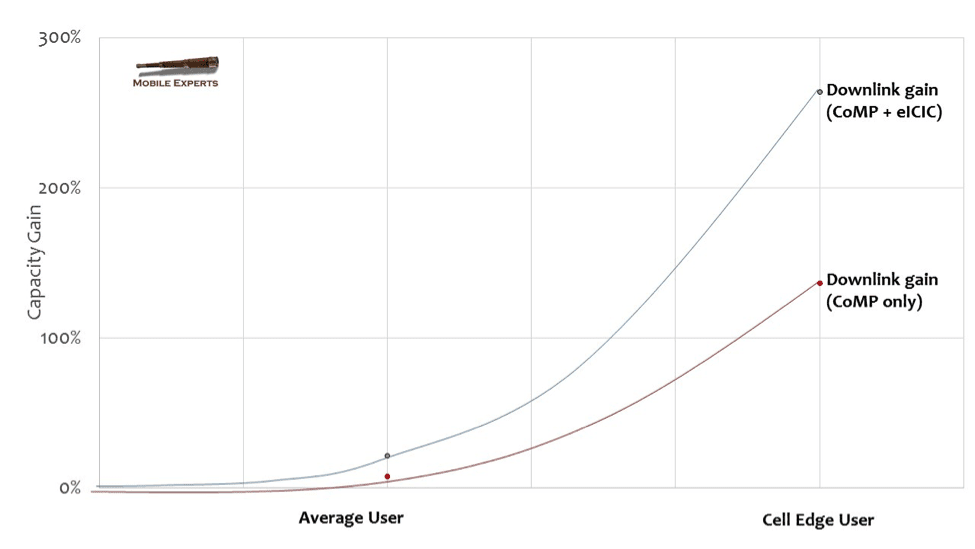
In essence, CoMP benefits are not uniform and vary according to the location of the user in the cell area. The greatest benefits are realized at the cell edge where signals from multiple base stations can be of similar quality. It is not surprising to experience large performance improvements at the cell edge, even reaching 130% throughput gain, while average performance over the entire cell area is much lower – typically less than 25% and can be as low as 3% to 5%.
project ara tweets

Source: Mobile Experts, based on Airspan/Softbank trial data

There are many different techniques to implementing CoMP. In general, these techniques fall into three categories: coordinated scheduling/coordinated beamforming; joint transmission; and transmission point selection. Each category has certain requirements on the transport link to where the data will be combined and processed jointly (hence requirements on capacity, delay and jitter). They also differ in the type of channel information that’s required to process the data. There are many possible permutations leaving much room for vendors to differentiate their solutions. Because of this, CoMP will have different performance in the uplink from the downlink and in TDD LTE from FDD LTE. In the uplink, CoMP does not require modifications or upgrades to mobile devices and has less impact from a standards perspective, but it requires a high-performance transport network. It is easier to implement more complex modes of CoMP in TD-LTE and achieve more than double the performance gain than FDD LTE because in TDD LTE the same frequency is used for the downlink and the uplink.

The network architecture also impacts the performance of CoMP where heterogeneous networks bring an added layer of complexity. This is because the performance of CoMP is different when a mobile device falls between two macro cells compared to when a small cell is involved, where there is more benefit to CoMP (in fact, CoMP gain increases with shorter distance between cell sites). Keeping with the network perspective, it is possible to implement sophisticated modes of CoMP when a mobile device is between different sectors of the same cell site where transport is not relevant while using more relaxed implementations between sectors belonging to different base station sites. This can be extended further to combine CoMP techniques with enhanced intercell interference coordination, which is a complementary feature to CoMP. In fact, many of the opponents of CoMP point to EICIC as a sufficient technique that does not require a high-quality transport link and the costs associated with it.

The variability of CoMP characteristics make it vulnerable to attack as the benefits are statistical and have been proven to have wide variations. But the fact remains that CoMP provides gain where it is mostly needed: at the cell edge. From that perspective, it complements multiple-input/multiple-output, which also has statistical performance benefits but offers the highest benefits at the cell edge (in fact, CoMP is a type of “network MIMO”). Fundamentally, CoMP is being used as a proxy for a wider battle – the one related to network architecture and the benefits of centralization of baseband resources. There is little doubt that centralization brings many performance benefits over a decentralized architecture. The issue that has to be resolved ought to center on what to centralize and what cost-performance equation will be acceptable. These are very difficult questions to address, so it is much more valuable to engage in the CoMP debate from this perspective.

In summary, the recent field trial results released by Airspan and Softbank demonstrate that significant CoMP benefits are possible, even with a distributed network of macrocells and small cells. With tightly coupled baseband processing, we can expect the performance gain to be even higher. Look for strong adoption of this technology in dense urban networks over the next few years.

Editor’s Note: Welcome to Analyst Angle. We’ve collected a group of the industry’s leading analysts to give their outlook on the hot topics in the wireless industry.


You Might Also Like
  • How operations leaders see 5G as vital for mission-critical workflows (Reader Forum)
  • Thursday (telco diary) | The plumbing is the product
  • Fifteen years on, how did that 1,000x mobile broadband forecast fare? (Analyst Angle)
  • How the FCC can protect IoT innovation and GPS resilience in the 900 MHz band (Reader Forum)
  • Why consolidation will reshape MDU connectivity (part 3/3) – Analyst Angle
  • Thursday (telco diary) | The telco AI imperative
Share 0 LinkedinEmail
Martha DeGrasse

Martha DeGrasse is the publisher of Network Builder Reports (nbreports.com). At RCR, Martha authored more than 20 in-depth feature reports and more than 2,400 news articles. She also created the Mobile Minute and the 5 Things to Know Today series. Prior to joining RCR Wireless News, Martha produced business and technology news for CNN and Dow Jones in New York and managed the online editorial group at Hoover’s Online before taking a number of years off to be at home when her children were young. Martha is the board president of Austin's Trinity Center and is a member of the Women's Wireless Leadership Forum.

previous post
Analyst Angle: Consequences of EC abolishing roaming charges – who pays?
next post
GL Communications – LTE, VoLTE and the path to 5G

White Papers

  • Enea White Paper: Why Intelligent AAA is the Swiss Army Knife of Telecom

  • CSG White Paper: Telco AI Enabler: Mediation’s Defining Role

  • Enea White Paper: Scalable Database Design for 5G and Beyond

  • Supermicro and NVIDIA Whitepaper: Powering sovereign AI at scale

  • VIAVI Whitepaper: RAN scenario generators and their critical role for future-proofing AI-native RAN in Advanced 5G and 6G networks

Editorial Reports

  • Report: Scaling Optical Networks For The Hyperscale And AI Era

  • Test And Measurement Market Pulse Report

  • Editorial Report: Securing telecom infrastructure for the quantum era

Webinars

  • Webinar: Building 6G — aligning technology, policy and purpose

  • SIMCom Webinar: Scaling your next deployment – from plastic to provisioning

  • Webinar: Rethinking the RAN as AI, cloud and openness converge

  • Webinar: Scale-Up, Scale-Out, Scale-Across – Building AI-Era Network Fabrics

  • Webinar: NTN in motion – evolving standards, expanding services

Since 1982, RCR Wireless News has been providing wireless and mobile industry news, insights, and analysis to mobile and wireless industry professionals, decision makers, policy makers, analysts and investors.

Facebook Twitter Youtube Linkedin Envelope Rss

Useful Links

  • Subscribe
  • About RCR Wireless News
  • Contact Us
  • Advertise
  • Editorial Calendar
  • Archive
  • RSS
  • Wireless News Archive
  • Subscribe
  • About RCR Wireless News
  • Contact Us
  • Advertise
  • Editorial Calendar
  • Archive
  • RSS
  • Wireless News Archive

Edtior's Picks

Webinar: Building 6G — aligning technology, policy and purpose
Vodafone at the heart of Euro telco reset as Iliad owner buys e&...
How operations leaders see 5G as vital for mission-critical workflows (Reader Forum)

Latest Articles

Webinar: Building 6G — aligning technology, policy and purpose
Vodafone at the heart of Euro telco reset as Iliad owner buys e& stake for $5.9bn
How operations leaders see 5G as vital for mission-critical workflows (Reader Forum)
Thursday (telco diary) | The plumbing is the product

© 2026 RCR Wireless News All Right Reserved. Developed by Eight Hats.

Cookie Policy | Privacy Policy

RCR Wireless
  • News
  • Channels
    • 5G
    • 6G
    • BSS OSS
    • Carriers
    • IoT
    • Network Infrastructure
    • Open RAN
    • Private 5G
    • Telco AI
    • Telco Cloud
    • Test & Measurement
  • Resources
    • Reports
    • Webinars
    • White papers
    • AI Fundamentals
    • Analyst Angle
    • Editorial Calendar
    • Fundamentals
      • 5G NR Release 17
      • AI
        • Telco AI in 2025
    • Podcasts
      • Let’s Get Digital with Carrie Charles
      • Wireless Connectivity to Enable Industry 4.0 for the Middleprise
      • Well Technically…
      • Will 5G Change the World
      • Accelerating Industry 4.0 Digitalization
  • AI Infrastructure
  • Programs
  • Events
  • RCRtv
  • Advertise
  • Subscribe
RCR Wireless
  • News
  • Channels
    • 5G
    • 6G
    • BSS OSS
    • Carriers
    • IoT
    • Network Infrastructure
    • Open RAN
    • Private 5G
    • Telco AI
    • Telco Cloud
    • Test & Measurement
  • Resources
    • Reports
    • Webinars
    • White papers
    • AI Fundamentals
    • Analyst Angle
    • Editorial Calendar
    • Fundamentals
      • 5G NR Release 17
      • AI
        • Telco AI in 2025
    • Podcasts
      • Let’s Get Digital with Carrie Charles
      • Wireless Connectivity to Enable Industry 4.0 for the Middleprise
      • Well Technically…
      • Will 5G Change the World
      • Accelerating Industry 4.0 Digitalization
  • AI Infrastructure
  • Programs
  • Events
  • RCRtv
  • Advertise
  • Subscribe
@2020 - All Right Reserved. Designed and Developed by PenciDesign