


I recently sat down with the GSMA to discuss connected women, or the lack thereof, in emerging markets. The statistics were more challenging than I expected. This is the first of a series of three articles that will highlight the work the GSMA is doing to bring these issues to light and work with companies in the telecommunications industry to improve the results.
The methodology incorporated five different information gathering formats in order to present a wider cross-section of input. The formats are as follows:
- 11,000 closed-ended face-to-face interviews with men and women in 11 countries – Niger, India, Democratic Republic of the Congo, Mexico, Indonesia, China, Turkey, Kenya, Colombia, Egypt and Jordan;
- 77 focus group discussions with men and women across the same locations;
- 123 expert interviews conducted at country and global levels;
- Market research and/or anonymous usage data from mobile network operators in more than 35 countries;
- Research reports and secondary data sets on gender and ICT from the mobile industry, international development organizations, academics and other sources.
There were 10 key findings highlighted as a result of the research. The entire report can be downloaded via this link.
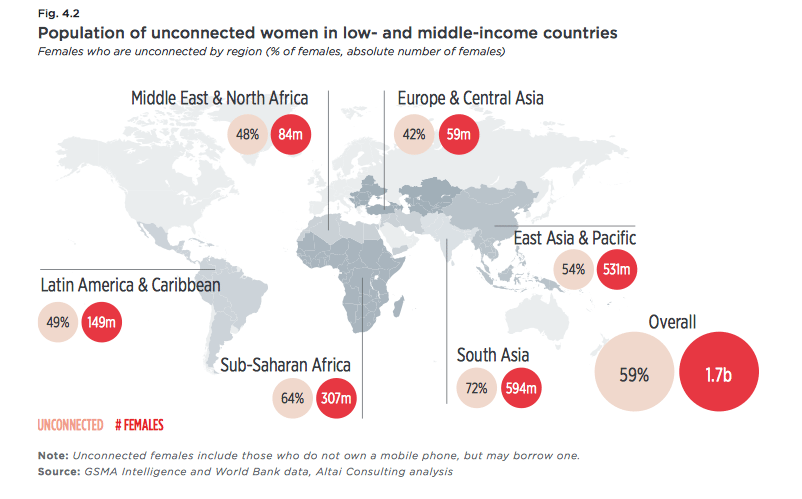
- Over 1.7 ‘billion’ women in low- and middle-income countries do not own a mobile phone.
- On average, women are 14% less likely to own a mobile phone than men.
- In South Asia that percentage rises to 38% showing that the discrepancy varies depending on geography.
- Women who do own phones in these areas tend to primarily use messaging and voice services and not the data functionalities their male counterparts use.
- Cost is the greatest barrier.
- The concern of risking security vulnerability and harassment if they have a mobile phone is another key barrier.
- Network performance and technical literacy are also areas of concern.
- When it is not the norm for a woman to have a phone in a specific area, others follow suit.
- Women now understand the value of a mobile phone unlike the prior study (5 years ago).
- Systemic barriers and biases have kept the focus off this problem as one that should be prioritized to solve.
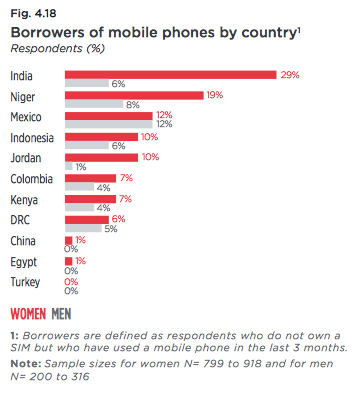 The study also found that in some countries women borrow phones from friends or share within a family. Although this could slightly improve the percentages of phone accessibility it isn’t the solution to this problem.
I had the opportunity to dig a little deeper into the report with Shireen Santosham, GSMA’s Connected Women senior programme manager (Global). First, I asked what findings in the report were most unexpected for her. Santosham said that the gender gap and variances, by country, accounting for 200 million fewer women owning a phone than men who own phones in low- and middle-income countries was key for her. “Although on average, 14% less likely to own a mobile phone than men, this aggregate number hides great regional, country and in-country variations. For example, women in South Asia are 38% less likely, although a region like Sub-Saharan Africa with a gender gap in mobile phone ownership close to the average, with women 13% less likely to own a mobile phone than men. In the Democratic Republic of Congo, women are 33% less likely to own a mobile phone than men and in Niger this number climbs to 45%. Finally, differences within countries are sometimes stark – for example in Mexico, women in urban areas are only 2% less likely to own a mobile phone than men, but in rural areas women are 26% less likely to own a mobile phone than rural men.”
As mentioned above, the GSMA works with telecommunications companies. I asked Santosham to provide a couple of examples of innovation she has seen in response to this topic. The service provider example she shared was related to Uninor, which is piloting a combo-SIM plan product aiming to increase SIM ownership among rural women. Initial research in the target area revealed that 76% of men, but only 29% of women, use mobile phones in the rural regions in the Aligarh district of Uttar Pradesh, where the pilot was launched. Two paired SIMs are sold together and its marketing campaign promotes the idea that one of the SIMs will be used by a woman, while the other is to be used by her husband or another male household member. This combo SIM plan ensures that, out of every two subscribers acquired, at least one is a woman. Uninor provides various talktime benefits for the paired SIM owners; for example, if one SIM is refilled, the other SIM automatically receives an equivalent free refill.
A key element of Uninor’s strategy is to market the product to men as well as women. Uninor has recruited a network of local female “promoters” as retailers to market and sell this product, as it is believed that these women are trusted community members who have existing relationships with households and can provide helpful post-sales support. Early evidence suggests that the SIM combo and marketing and distribution approach can be a powerful way to challenge the social norms preventing women from using mobile phones, and provides an incentive for men to see the value of female household members having a SIM of their own. Just five months after launch, sales already represent over 30% of total new Uninor subscribers, with usage (minutes of use) among SIM owners similar to other subscribers in the target area. Uninor reports the project is self-sustaining and is looking to scale up.
Telesom ZAAD is a mobile money provider also working to address this challenge. As of June 2014, they had 450,000 registered users, 139,000 of which are women. This represents 31% of the ZAAD’s total customer base, up from 17% one year after the launch of the service. The company was able to double its female customer base in a few short years by adjusting its business model to meet the needs of women. For example, in order to get a mobile money account in Somaliland, individuals are required to have the mobile money agent take a picture of the customer. However, in Somaliland, women wear a niqab to prevent male strangers from seeing their faces. In a country where the majority of agents are men, it is not culturally acceptable for women to allow unfamiliar men to see their faces in order to take the picture. Effectively, this means that women are excluded from mobile money services. Recognizing this issue, Telesom ZAAD hired female agents to assist female customers specifically, which both helps women gain access to financial services and mobile technology as well as provides employment for women. The company also deliberately launched marketing campaigns designed to reach women and included IVR services (i.e., voice-based menus) in their product offering to overcome barriers around illiteracy that many female customers face.
The GSMA is also working to help change that scenario. To date, its Connected Women program has worked with 72 mobile network operators across more than 40 countries to reach in excess of 14 million women with mobile services. In addition to providing expert advice and support on designing services for women, it also shares lessons learned and insights at global events around the world that bring together executives from the mobile industry, policymakers, donors and NGOs to help ensure women around the world can benefit from mobile technology.
Shireen Santosham joined the GSMA Connected Women Programme in 2013 and is the GSMA Connected Women senior programme manager (Global). The GSMA Connected Women programme aims to close the digital divide between men and women in access to mobile phones and the Internet by working with over 800 mobile network operators around the world.
Prior to joining the programme, Santosham was a strategy consultant at McKinsey and Company where she advised multilateral international development institutions, governments and corporations on strategy, operations and organizational design – while there, she helped found the McKinsey Center for Government. Previously, she worked in impact investing while at Vulcan Capital and served as a technical consultant to a variety of organizations including the Government of Liberia where she advised on rural development policy; Save the Children in Bolivia where she worked on health impact evaluations; and with the conservation organization Oceana where she managed a multicountry market entry feasibility study. Santosham holds an MBA from Harvard Business School and an MPA in international development from Harvard Kennedy School.
Like what you read? Follow me on twitter!
Claudia Bacco, Managing Director – EMEA for RCR Wireless News, has spent her entire career in telecom, IT and security. Having experience as an operator, software and hardware vendor and as a well-known industry analyst, she has many opinions on the market. She’ll be sharing those opinions along with ongoing trend analysis for RCR Wireless News.

