

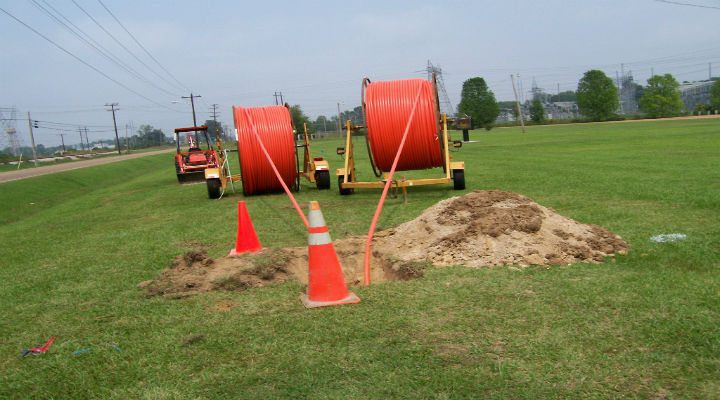
On my first day at Aviat Networks 6 years ago, I met one of the company’s most insightful and interesting employees – a certain sales director of Irish descent for those who think they can figure it out – which turned out to be a very memorable experience. I asked him to tell me about the microwave radio business, and his response, after thinking it over for a few moments, was: “Gary, microwave is a construction project.” The more time I spend in this business, the more I find myself resonating with that comment.
To explain what he meant – at the risk of oversimplifying this discussion – let’s start with an analogy: Microwave radios are to building a wireless backhaul network what pavement is to building a road. And just as wireless data bits are transported over backhaul radios, car tires travel on road pavement. But to build a road, pavement is the least of your worries.
Building the backhaul
Before you build a road you have to acquire the right-of-way, get permits, complete surveying, draw up a design and plan, plan, plan. Oh, and reroute traffic while you’re completing all the above. Then you can build the roadway, coordinating all the different work teams as well as provide project management it in the process. Ongoing maintenance will be needed after the road is built.
All these considerations also apply to wireless backhaul. In wireless backhaul construction, network engineers must:
• Acquire sites
• Survey paths
• Design RF links
• License and coordinate spectrum
• Manage installation (e.g., erect towers, climb them, hang antennas)
• Document the process
• Troubleshoot problems
• Add capacity as needed
• Take any additional steps not outlined above
To operators, it must seem unusual for a wireless backhaul vendor to say: “Our radios are 10% more efficient than the other guys’,” when all these other challenges exist. From a product point of view, many good and reliable options exist that cover all frequency bands and form factors to solve the problem of backhaul, small cell or otherwise. However, wireless backhaul is a construction project, and the “building a road” analogy is very relevant.
Things are worse before they get better
But guess what? Backhaul-related construction and operation issues are going to get worse – much worse. There are four reasons for this.
1. Dying expertise. Wireless transport experts are retiring and not being replaced, making design, installation and management more complex. Most operators have skeleton crews dealing with transmission. This is a particular problem for operators as they reduce staff and outsource.
2. Operating expense, which represents about 70% of wireless backhaul total cost of ownership. As hardware prices continue to decline, we’re going to see opex hit 90% of TCO if construction and operations issues are not simplified.
3. Rollout of small cells. Cell site numbers are projected to increase sixfold or more. Many more wireless transport links (roads) must be built. If macro cell builds were the interstate highway system, then small cells would be city streets and avenues. With a finite set of resources in organizations sized for macro cell networks, operators will struggle to build small cell backhaul infrastructure. Add to this small cell-related complexities such as site acquisition, line-of-sight and power challenges, and backhaul-related construction issues will grow.
4. The wireless backhaul industry still solves construction and operations challenges just as it did 20 years ago. Old and non-integrated tools and processes cause countless errors resulting in site revisits, cost overruns and expensive project delays. What’s worse, today’s workflows, tools and processes will not scale to meet small cell deployment challenges – especially with a less technical and experienced workforce. Compared to multimegabit Internet access, smartphone apps and the emerging “Internet of Things,” wireless backhaul planning, design and deployment is still in the dialup modem age.
OK, so how do we address these backhaul-related construction challenges?
Consider backhaul upfront
First, when designing small cell networks, backhaul should not be an afterthought. Under today’s typical operator process, small cell locations are determined by the radio access network design, and “how to backhaul it” is generally considered after cell locations have been chosen. This process needs to change to optimize cost and complexity of the deployment. At many street-level locations, fiber-based backhaul is less available than commonly thought. And street-level wireless backhaul presents a host of challenges not easily overcome.
By considering backhaul during the RAN engineering and small cell design process, simplified wireless backhaul can be achieved. For example, slightly altering small cells to the opposite side of a street or side of a building can reduce power, aesthetics and line-of-sight challenges. With consideration earlier in the process, backhaul-related construction challenges can be drastically reduced.
More integrated backhaul required
Multibox architectures can overcomplicate miniaturized sites, requiring more integration for zero footprint backhaul solutions. As urban mesh networks become more common, multidirectional backhaul solutions will be required, which means more radios to deploy and manage leading to the need for nodal backhaul designs. Routers are also typically desired as operators look to maintain their routed network architecture in small cell implementations. Zero footprint nodal microwave router solutions enable multidirectional backhaul with a single managed entity – one IP address and configuration, for example – for all radios and integrated microwave awareness into the router. This architecture simplifies site designs and improves network performance while providing clear demarcation between RAN and backhaul domains. Implementation challenges can be minimized with more integrated nodal backhaul solutions.
Integration of the backhaul with the RAN network, however, can limit flexibility. Mobile cell sites (including small cells) should be seen as multiservice hubs and the small cell backhaul network (roads) should not be built only for 3GPP access (cars), it should also be built for other applications and services (trucks, buses, emergency vehicles, military transports, cyclists, etc.) leading to a true multiservice transport network that should have a broader scope than only 3GPP access. Therefore, it is imperative that the backhaul network remains separate, evolving in the network independent of radio access technology.
Retain flexibility, update tools and workflows
Beyond products, if the growing demand for connections is to be met, the wireless backhaul industry must drastically improve its outdated tools and deliver more integrated workflows. Intelligent automation solutions are possible that can eliminate site revisits and project delays by simplifying link design, purchasing, installation, management and service delivery of wireless backhaul. Careful consideration needs to be given to integrating backhaul automation tools and workflows with those of RAN and distributed antenna systems – an emerging topic that needs more attention.
What’s clear is that small cell backhaul will be a construction project on a scale the industry has never seen. However, by following these backhaul-related prescriptions, operators can achieve higher quality, lower cost and timelier small cell build outs.
Editor’s Note: In an attempt to broaden our interaction with our readers we have created this Reader Forum for those with something meaningful to say to the wireless industry. We want to keep this as open as possible, but we maintain some editorial control to keep it free of commercials or attacks. Please send along submissions for this section to our editors at: [email protected].

