


Editor’s Note: Welcome to our weekly Reality Check column where C-level executives and advisory firms from across the mobile industry share unique insights and experiences.
Having spent three days at the recent CTIA event, which was briefly overshadowed by Apple’s iPhone 6 and Watch announcement, I am pleased to report that the wireless industry is alive and kicking (and, in the case of T-Mobile US’ recent announcement that it had a blockbuster August with 2.75 million gross and 760,000 branded retail net adds, I think we could say they are high-kicking).
There were many newsworthy items outside of the Apple announcement this week — we’ll look at three, starting with FCC Chairman Tom Wheeler’s keynote speech.
Chairman Wheeler disappoints
Tuesday morning, Chairman Tom Wheeler had a short, but sharply worded speech for the CTIA attendees. First, on competition, Wheeler stated: “We will continue to be skeptical of efforts to achieve scale through the consolidation of major players.” While this statement appeared to be directed to further efforts to merge wireless companies, one can only wonder what implications this will have for the AT&T/DirecTV merger prospects.
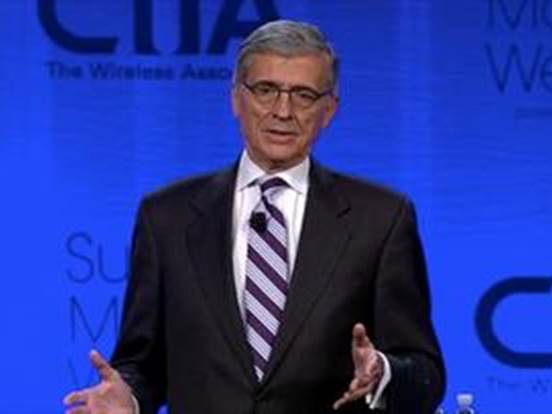
In his comments preceding his thoughts on the open Internet, Wheeler recounted: “I remember when this industry was united around the walled garden where the only apps that reached the consumer were those which the carrier approved, usually in return for a payment.” I believe he is referring to a pre-iOS/Android world where smartphones were not mainstream and the most popular app was BlackBerry e-mail (and average smartphone consumption was less than 50 megabytes per month).
Wheeler appears to blame the wireless industry’s walled garden practices for stifling innovation stating “it is instructive that the walled garden existed despite multi-carrier competition.” This seems to imply that protective policies of AT&T Mobility, Verizon Wireless and Sprint were holding back smartphone development, which is revisionist history at its finest.
As one who participated in the conversations, carriers were looking to grow data average revenue per user starting with the launch of 3G (HSPA, EV-DO Revision A networks) as early as 2005. The applications business model was driven by four operating layer support systems — Palm, Microsoft Windows, BlackBerry and Qualcomm’s Binary Runtime Equivalent for Wireless. It’s important to note that all of these companies tried to make money through software development kit sales (a common practice), not through hardware or through increased advertising. The carriers, in turn, wanted to convert application fees into either ARPU-accretive monthly fees (think AT&T Navigation app) or through one-time application sales (think Scrabble game app).
The rest of the story is well known. Apple entered the market with higher wall (iOS, which had no compatibility with any other operating systems) to support further equipment sales, and Google quickly followed with a compatible model to support increased search. Apple refused to allow certain Google apps from accessing the app store and to this day refuses to allow applications to access incoming caller ID information. Google developed a handful of proprietary apps (search, maps, etc.) that are mandatory on every Android phone. To this day, an Apple user cannot freely move purchased or free apps or content from iOS to any other application. Using early pay walls from carriers as an example of uncompetitive practices in the shadow of those created by Google and Apple is disingenuous and nonsensical. The wall is now between the consumer and their smartphone operating system provider, not their carrier.
Wheeler then goes on to raise concerns about wireless carriers’ marketing practices:
“We are very concerned about the possibility that some customers are being singled out for disparate treatment even though they have paid for the capacity that is being throttled. And we are equally concerned that customers may have been led to purchase devices relying on the promise of unlimited usage only to discover, after the device purchase, that they are subject to throttling. I am hard pressed to understand how either practice, much less the two together, could be a reasonable way to manage a network.”
The problem with this statement is that this “bait and switch” practice, if it exists, is extremely rare in a world where network upgrades are the norm. Excessive use clauses found in fine print throughout end user agreements clearly state that excessive usage could result in throttling or even suspension of service. Managing the 1% who use more than 30 gigabytes per month is good for the overall monetization of the network because it allows the 99% who are sharing that network more equal access to the Internet. An alternative exists for those with excessive usage — it’s called a metered plan. Wireless carriers should honor their commitments under unlimited plans, which include those to the 99% that do not routinely incur extremely high usage.
The FCC chairman’s message was the biggest disappointment of the show. His populist intents will drive metered plans at a faster pace for those who can least afford them and will create a two-tiered access network structure (3G vs. LTE) for the carriers.
T-Mobile US’ Wi-Fi calling: Back to the future
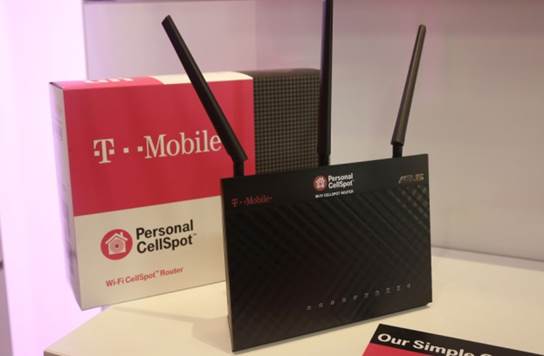
One of the interesting developments around CTIA occurred when T-Mobile US announced its in-home Wi-Fi initiative. For those of you who have followed the wireless industry for the past decade, T-Mobile US’ announcement is no surprise. It has been innovating with Wi-Fi voice since the BlackBerry/Cablevision trials in 2007. In addition, T-Mobile US introduced the Personal CellSpot (pictured), which is designed to deliver improved voice quality within the home (it does so by prioritizing voice over Wi-Fi traffic over Netflix/Hulu/HBO to Go and other users, something sure to agitate Internet neutrality advocates).
Unlike the days of 2007, when a small fraction of the T-Mobile US base had unlimited calling/texting plans, it’s impossible to buy a Simple Choice plan without unlimited minutes. With no incentive to drive adoption, will customers go through the process of enabling Wi-Fi calling? Will all calls made without an installed Personal CellSpot default to using the Wi-Fi feature or will the service be toggled through the “settings” menu (as is the case with Sprint’s current Wi-Fi calling)? If a Personal CellSpot is not purchased, will call quality be as good/strong (this depends on the quality of the router, but with 20 current and hundreds of previous versions of popular routers, troubleshooting will be a nightmare).
Wi-Fi calling is a convenience for the voice-centric callers who have unlimited plans. But it does lead to an important question: Is the next value disruption going to come from the reintroduction of voice “bucket plans” — at least as an option for low minute family plan lines? I could definitely see the “lines 4 and 5 are subject to 100 minutes of on-network minutes per month” footnote in a future family plan. For those of us with teenagers, overage risk is minimal. And with the recent iOS messaging changes, the only time most teens will be using minutes is when their parents are calling them.
Bottom line: T-Mobile US’ Wi-Fi calling is great, and, given its pioneering status, should work very well. But it will not prove to be as valuable as other “Un-carrier” moves (international roaming, JUMP, and the like), and it’s definitely not as attractive as Verizon Wireless’ “free iPhone 6 with trade-in” announcement.
Kindle Fire Phone — too little, too late?
The day before Apple’s iPhone 6 announcement, I received a notification that the Kindle Fire Phone was going on sale for 99 cents with a two-year contract from AT&T Mobility (this is attractive to some of Amazon.com’s most loyal customers because each Kindle Fire Phone purchase includes a full year of Amazon’s Prime service). Free phone is a far cry from the promises that surrounded July’s announcement.

There are a lot of things that Amazon has done well, but the Fire Phone will go down as a failure because of its flawed approach. Amazon believed that it could be successful by out-innovating and out-marketing Apple, Google, Samsung, LG, BlackBerry, Nokia and dozens of other equipment suppliers. On top of this, it believed that exclusivity to the AT&T brand would help, not hurt, sales. Customers responded with at best a collective yawn (or, at worst, see here for the study that suggests that that intent to purchase an Amazon phone ranks behind Windows — yikes!).
More device innovation is not Amazon’s solution. To drive the Kindle franchise, Amazon should reach back to one of its past successes — sponsored data. WhisperNet (originally from Sprint, now provided by AT&T Mobility) guaranteed book delivery in a minute for no extra charge. The “no extra charges” guarantee for nearly instant book delivery drove adoption. Why not do this with the full Amazon Prime suite, including Free Time and Amazon Instant Video?
Amazon can and should lead the industry on sponsored data. It would be a body blow to Netflix (especially with Amazon’s robust server infrastructure) and allow AT&T (first) and the entire wireless industry to accelerate growth. Kindle Fire sales, now with x-amount of pre-loaded data, would explode (even at price points that are $50 to $99 higher than today). Amazon Prime membership would triple and Amazon’s advertising presence would quadruple.
Bottom line: Amazon should drop the Kindle Fire Phone and aggressively include data with future Kindle Fire and Amazon apps for all Amazon Prime customers. Start with AT&T Mobility, but quickly expand to T-Mobile US, Verizon Wireless and Sprint.

Jim Patterson is CEO of Patterson Advisory Group, a tactical consulting and advisory services firm dedicated to the telecommunications industry. Previously, he was EVP – Business Development for Infotel Broadband Services Ltd., the 4G service provider for Reliance Industries Ltd. Patterson also co-founded Mobile Symmetry, an identity-focused applications platform for wireless broadband carriers that was acquired by Infotel in 2011. Prior to Mobile Symmetry, Patterson was President – Wholesale Services for Sprint and has a career that spans over twenty years in telecom and technology. Patterson welcomes your comments at [email protected] and you can follow him on Twitter @pattersonadvice.
Photo copyright: vadymvdrobot / 123RF Stock Photo
Table of Contents

