

RCR Wireless
  • News
  • Channels
    • 5G
    • 6G
    • BSS OSS
    • Carriers
    • IoT
    • Network Infrastructure
    • Open RAN
    • Private 5G
    • Telco AI
    • Telco Cloud
    • Test & Measurement
  • Resources
    • Reports
    • Webinars
    • White papers
    • AI Fundamentals
    • Analyst Angle
    • Editorial Calendar
    • Fundamentals
      • 5G NR Release 17
      • AI
        • Telco AI in 2025
    • Podcasts
      • Let’s Get Digital with Carrie Charles
      • Wireless Connectivity to Enable Industry 4.0 for the Middleprise
      • Well Technically…
      • Will 5G Change the World
      • Accelerating Industry 4.0 Digitalization
  • AI Infrastructure
  • Programs
  • Events
  • RCRtv
  • Advertise
  • Subscribe
Sunday, July 26, 2026
RCR Wireless
  • News
  • Channels
    • 5G
    • 6G
    • BSS OSS
    • Carriers
    • IoT
    • Network Infrastructure
    • Open RAN
    • Private 5G
    • Telco AI
    • Telco Cloud
    • Test & Measurement
  • Resources
    • Reports
    • Webinars
    • White papers
    • AI Fundamentals
    • Analyst Angle
    • Editorial Calendar
    • Fundamentals
      • 5G NR Release 17
      • AI
        • Telco AI in 2025
    • Podcasts
      • Let’s Get Digital with Carrie Charles
      • Wireless Connectivity to Enable Industry 4.0 for the Middleprise
      • Well Technically…
      • Will 5G Change the World
      • Accelerating Industry 4.0 Digitalization
  • AI Infrastructure
  • Programs
  • Events
  • RCRtv
  • Advertise
  • Subscribe
Add RCR Wireless as a preferred source on Google
  • Qualcomm 6G Insights
  • Huawei Content Hub
  • Qualcomm – 6G Vision
  • OSS/BSS Channel
  • RCRTech Roundtable: AI Infrastructure
RCR Wireless
RCR Wireless
  • Advanced Mimo
  • Mobile mmWave
  • 5G Positioning
  • Green Networks
  • Metaverse
  • Automotive
  • Industrial and Wide-area IoT
Copyright 2021 - All Right Reserved
Home - Multi-gigabit connectivity: Why you need a 5G transport network now (Reader Forum)
5GOpinionReader Forum

Multi-gigabit connectivity: Why you need a 5G transport network now (Reader Forum)

by Reader Forum February 20, 2019
written by Reader Forum February 20, 2019 Share
LinkedinEmail
Share 0LinkedinEmail
Image courtesy of Nokia.
115

LTE: Not over yet

In early December of 2010, Verizon launched the world’s first LTE network. Less than a decade later, we are entering the 5G era. However, 4G/LTE is not over yet.

4G/LTE gave us an end-to-end, all-IP networking environment – from end-user devices, over radio access networks (RANs) and transport networks, to packet core networks and the internet. At the same time, 4G/LTE transformed all types of communications into apps. Voice has been relegated from a massive, dedicated infrastructure and a service that reigned for over 100 years to an icon on our smartphones.

4G/LTE also served as a massive enabler for many cloud-based application and content delivery providers, propelling them into “hyperscale” by adding the mobility element to their services. Powerful processing platforms, now equipped with machine learning and early AI capabilities, helped them capitalize on their new currency — data.

Streaming video-on-demand services have disrupted the broadcasting and media industries and have made their way to mobile devices with the help of 4G/LTE.

Over the last two years, mobile devices have been equipped with new capabilities that allow them to reach and exceed gigabit speeds. Realizing the marketing potential of this development, both vendors and service providers have moved away from using standard technology terms (LTE Advanced) and have started calling this stage Gigabit LTE.

Further evolution of Gigabit LTE promises:

  • More and wider carrier aggregation combinations across diverse spectrum bands
  • Higher-order modulation techniques such as 256 QAM in uplink
  • Evolution to massive MIMO and 3D beamforming
  • Provision for the use of enhanced license-assisted access (eLAA) and new FDD/TDD design to reduce latency

Through these developments, Gigabit LTE is poised to deliver more throughput and improved performance, and further pave the way for 5G.

Welcome to the 5G era

There has been an intense R&D race among the few vendors capable of delivering 5G. After a standardization rush and early trials in 2018, 5G networks are starting to find their way into a small number of select markets.

With 5G comes the potential for major improvements, such as:

  • Increased throughput
  • Lower latency
  • Improved security
  • Cloud-based systems
  • Dynamic interconnectivity
  • Network slicing

Moreover, 5G envisages stretching one network into three very diverse application areas: enhanced mobile broadband (eMBB), massive machine-type communications (mMTC), and ultra-reliable, low latency communications (uRLLC). 5G will address a whole new world of enhanced and not-yet-imagined services and applications.

The 5G era also brings technological changes, including:

  • Decomposition of radio functions across radio elements
  • Evolution of RAN architectures from distributed to cloud RAN
  • Evolution of packet core from physical and centralized to cloud-native and distributed
  • Evolution to service-based architecture and opening of the network resources to third parties
  • Proliferation of cloud domains (multi-cloud environment)
  • Coexistence of virtualized and physical systems
  • Coexistence of legacy and new technologies

All of this comes with much improved power efficiency and a much lower cost per bit, thanks to many efficiencies driven by improved R&D and achieved across all 5G elements and systems.

5G brings a whole new set of capabilities and unleashes a new world of technological and business possibilities. To get there, 5G will be taking off (at least for consumer broadband) exactly from the current multi-gigabit speeds reached by Gigabit LTE.

Transport network for the 5G era: A bridge from 4G/LTE to 5G

The transport network has an essential role in the transition from 4G to 5G. Many consider it the first part of the system that needs to be upgraded to pave the way for 5G deployments. As such, it is a cornerstone for enabling and delivering multi-gigabit connectivity – both for Gigabit LTE and for 5G.

As shown in Figure 1 below, the 5G transport network includes many diverse domains, subsystems and elements that need to be dynamically interconnected. In addition, the network needs to ensure business continuity with existing services and operational continuity with legacy systems.
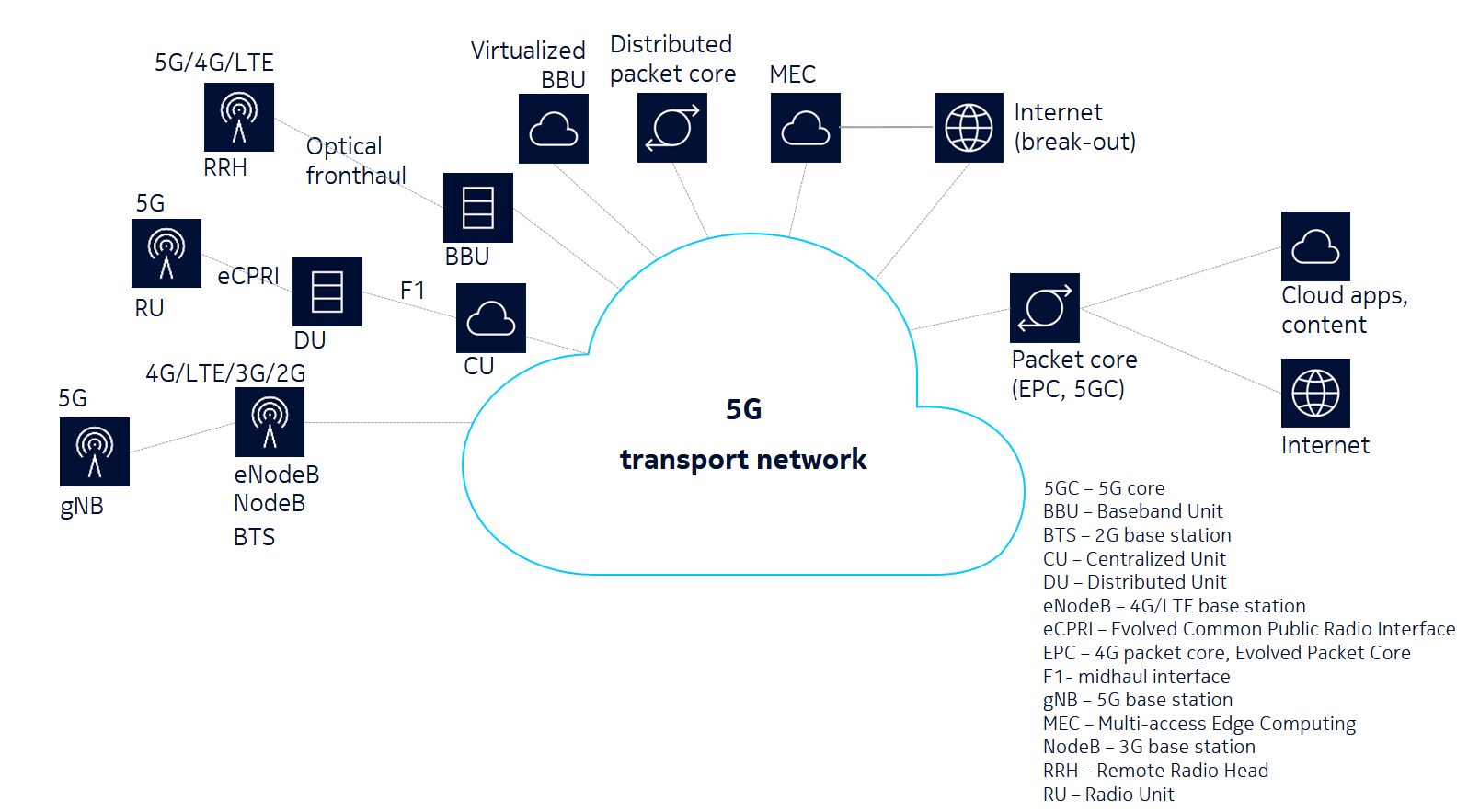
image1 1

Figure 1. 5G transport – Dynamic connectivity for many domains, subsystems and elements

The 5G transport network must bring a whole new set of transport capabilities that are required for a successful 5G rollout. It must have the capacity to handle multi-gigabit speeds, enable lower latency and improved quality of service, deliver precise timing and synchronization, and enable security by ensuring confidentiality, integrity and availability for all communications flows running across it.

But wait, there’s more. To enable automation, the entire 5G transport network needs to support software-defined networking principles. Finally, the network must be able to support network slicing: full isolation of network resources for a specific service or business use.

To address these demanding requirements, vendors have refreshed their mobile transport portfolios across all technologies: IP, optical, microwave and next-generation passive optical networks. Some vendors have also added new, innovative portfolios such as integrated access and backhaul over wireless.

Decisions, decisions…but transport first!

For many service providers, preparing for 5G means two things: keeping a close eye on the availability of spectrum in all bands (low, mid and high) and on the availability of end-user devices.

In the LTE era, it took Apple almost two years after the LTE launch in the US to deliver the first LTE-capable iPhone. With the potential for similar delays with 5G devices, should a service provider halt its plans for 5G for a couple of years?

Absolutely not.

Now is the time to do a business reality check of your own spectrum, network and even physical resources such as locations of base stations and data centers, and accessibility to fiber. Then you’ll need to create an upgrade plan for your transport network so it can deliver all the 5G capabilities.

You can also reap immediate benefits by bringing multi-gigabit connectivity to diverse cell sites (macrocells, small cells etc.). The first step is to upgrade your cell site uplinks from 1GE to 10GE and 25GE and your aggregation links to 10GE and 100GE. And, while doing this, think of the future scalability needed for 5G.

This is the logic behind the statement of some service providers that “every dollar we spend on the network is a 5G dollar.”

In this way, you can use the multi-gigabit capabilities of your new, 5G transport network to help “fill the gap” and ensure competitiveness during the critical transition from Gigabit LTE to 5G.

Learn more about how a Tier-1 US mobile network operator rolled out their 4G/LTE Advanced network with a 5G-ready mobile transport.


You Might Also Like
  • Huawei sees Mobile AI driving new wave of uplink network investment
  • Why throwing money at broadband speeds isn’t fixing America’s internet (Reader Forum)
  • Thursday (telco diary) | Telco pieces in the AI jigsaw
  • Only 50 of 170 digital infrastructure firms will exist in in five years (Reader Forum)
  • Wednesday (telco diary) | What AT&T and Lumen tell us about the AI fiber build-out
  • South Korea launches AI-RAN project to advance industrial AI

Table of Contents

  • LTE: Not over yet
  • Welcome to the 5G era
  • Transport network for the 5G era: A bridge from 4G/LTE to 5G
  • Decisions, decisions…but transport first!
Share 0 LinkedinEmail
Avatar of Reader Forum
Reader Forum

Submit Reader Forum articles to [email protected]. Articles submitted to RCR Wireless News become property of RCR Wireless News and will be subject to editorial review and copy edit. Posting of submitted Reader Forum articles shall be at RCR Wireless News sole discretion.

previous post
Fiber optic vs. 5G wireless networks: A closer look at an emerging debate (Reader Forum)
next post
American enterprises rule, transport leaves automotive for dust – Vodafone IoT poll

White Papers

  • Norton eBook: The 2026 Telco Playbook

  • Enea White Paper: Why Intelligent AAA is the Swiss Army Knife of Telecom

  • CSG White Paper: Telco AI Enabler: Mediation’s Defining Role

  • Enea White Paper: Scalable Database Design for 5G and Beyond

  • Supermicro and NVIDIA Whitepaper: Powering sovereign AI at scale

Editorial Reports

  • Market Pulse Report: Telco AI in 2026 – Trends, Challenges and Opportunities

  • Nvidia Report: The State of AI in Telecommunications: 2026 Trends

  • Report: Scaling Optical Networks For The Hyperscale And AI Era

Webinars

  • Webinar: Building 6G — aligning technology, policy and purpose

  • SIMCom Webinar: Scaling your next deployment – from plastic to provisioning

  • Webinar: Rethinking the RAN as AI, cloud and openness converge

  • Webinar: Scale-Up, Scale-Out, Scale-Across – Building AI-Era Network Fabrics

  • Webinar: NTN in motion – evolving standards, expanding services

Since 1982, RCR Wireless News has been providing wireless and mobile industry news, insights, and analysis to mobile and wireless industry professionals, decision makers, policy makers, analysts and investors.

Facebook Twitter Youtube Linkedin Envelope Rss

Useful Links

  • Subscribe
  • About RCR Wireless News
  • Contact Us
  • Advertise
  • Editorial Calendar
  • Archive
  • RSS
  • Wireless News Archive
  • Subscribe
  • About RCR Wireless News
  • Contact Us
  • Advertise
  • Editorial Calendar
  • Archive
  • RSS
  • Wireless News Archive

Edtior's Picks

AT&T says its network is already built for the agentic AI wave
AT&T and Ericsson use network sensing to spot drones with ordinary 5G towers
Huawei sees Mobile AI driving new wave of uplink network investment

Latest Articles

AT&T says its network is already built for the agentic AI wave
AT&T and Ericsson use network sensing to spot drones with ordinary 5G towers
Huawei sees Mobile AI driving new wave of uplink network investment
Spectrum supercycle – US opens floodgates; UK shares it out

© 2026 RCR Wireless News All Right Reserved. Developed by Eight Hats.

Cookie Policy | Privacy Policy

RCR Wireless
  • News
  • Channels
    • 5G
    • 6G
    • BSS OSS
    • Carriers
    • IoT
    • Network Infrastructure
    • Open RAN
    • Private 5G
    • Telco AI
    • Telco Cloud
    • Test & Measurement
  • Resources
    • Reports
    • Webinars
    • White papers
    • AI Fundamentals
    • Analyst Angle
    • Editorial Calendar
    • Fundamentals
      • 5G NR Release 17
      • AI
        • Telco AI in 2025
    • Podcasts
      • Let’s Get Digital with Carrie Charles
      • Wireless Connectivity to Enable Industry 4.0 for the Middleprise
      • Well Technically…
      • Will 5G Change the World
      • Accelerating Industry 4.0 Digitalization
  • AI Infrastructure
  • Programs
  • Events
  • RCRtv
  • Advertise
  • Subscribe
RCR Wireless
  • News
  • Channels
    • 5G
    • 6G
    • BSS OSS
    • Carriers
    • IoT
    • Network Infrastructure
    • Open RAN
    • Private 5G
    • Telco AI
    • Telco Cloud
    • Test & Measurement
  • Resources
    • Reports
    • Webinars
    • White papers
    • AI Fundamentals
    • Analyst Angle
    • Editorial Calendar
    • Fundamentals
      • 5G NR Release 17
      • AI
        • Telco AI in 2025
    • Podcasts
      • Let’s Get Digital with Carrie Charles
      • Wireless Connectivity to Enable Industry 4.0 for the Middleprise
      • Well Technically…
      • Will 5G Change the World
      • Accelerating Industry 4.0 Digitalization
  • AI Infrastructure
  • Programs
  • Events
  • RCRtv
  • Advertise
  • Subscribe
@2020 - All Right Reserved. Designed and Developed by PenciDesign
