

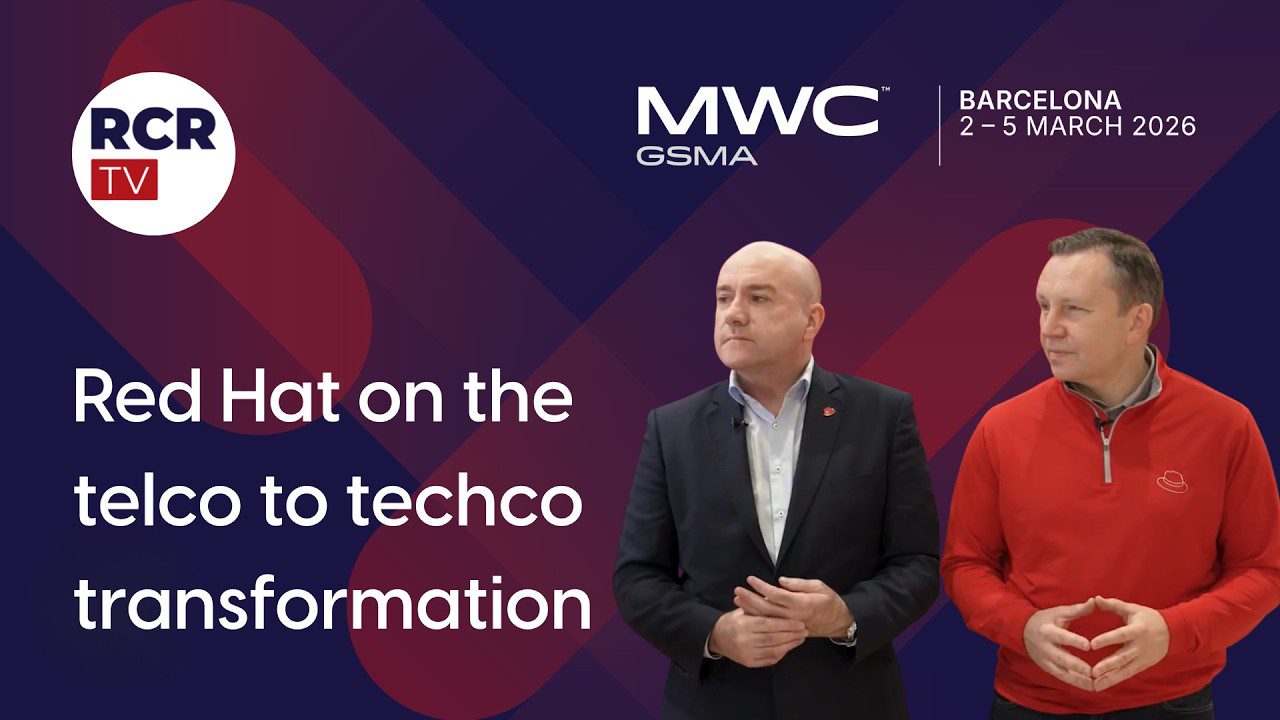
For Red Hat, the takeaway from this year’s MWC is clear: the telco to techco transformation is well underway
At MWC Barcelona, the “telco to techco” transformation felt less like a buzzword and more like a reality.
For those of you not familiar with the term, “techco” — a portmanteau of “telco” and “tech” — describes the idea of traditional telco companies becoming more tech-focused like their tech counterparts (Meta, Amazon, Google, Apple, for example) in that they invest in new technologies and provide digital services to customers.
For Red Hat, that theme is “spot on”. Andrew Brown, Senior VPresident and Chief Revenue Officer at Red Hat observed, “It’s real because there are so many partners, customers, and technology and telco providers looking at how they are moving from workloads to platforms,” noting that innovations in 6G, digital sovereignty, and AI are the biggest drivers of the shift to a cloud-native infrastructure.
Fran Heeran, Vice President and Head of Global Telco Sales peeled back the layers. He noted that the need for a common cloud infrastructure has been building among telcos for quite some time. “This desire to move to much more consistent, common infrastructure — both for network and for IT workloads, and now AI workloads as well — that’s kind of foundational,” he said.
The next step is marrying automation with AI. While automation has been a prevailing theme in telco lately with self-optimizing autonomous networks at the heart of network discussions, Heeran noted that it is the addition of AI that moves it from theory to practice.
He then highlighted that the idea of digital sovereignty has somewhat been misconstrued. “We were thinking of sovereignty from a regional perspective, but actually in some of the conversations we’ve had, it’s coming down to national sovereignty as well, even within the same region.”
He predicted that despite hyperscalers’ dominance in the space, there is an opportunity for operators to capture the market. “For many, many years, they’ve been building essentially sovereign telco networks. So with the increased focus now on providing sovereign solutions to enterprises – and as carriers look for new revenue streams as well – the digital sovereignty debate represents an opportunity for that new revenue stream where they can build and provide to others these sovereign regional or in-country networks based on their previous existing technology.”
Heeran also said that telcos have taken lessons from 5G to inform their 6G strategy. “There is a very distinct focus on where the new revenue streams come from. In the case of 5G, from a consumer point of view, that really was based on fixed wireless access, which was kind of the primary new revenue stream that came in certain areas,” he said, adding that enterprise and advanced wearables are the hottest areas of focus with 6G.
As for the timeline, they concurred that the path to 6G is unlikely to follow the standard 10-year cycle that mobile networks typically take to move from one generation to another.
“We’re seeing a more iterative approach to the generations. I think there are use cases that are around even today, and with open-source technologies, with 6G, there’s a coming together of capability that actually, for the enterprise, makes this real in maybe a shorter timeline than 10 years,” Brown said.

