Vodafone used its FY26 earnings call to outline how AI will reshape telecom networks and operations, while reporting stronger revenues, improved profits, robust African growth, and broadband momentum in the UK with a new FWA offer.
In sum – what to know:
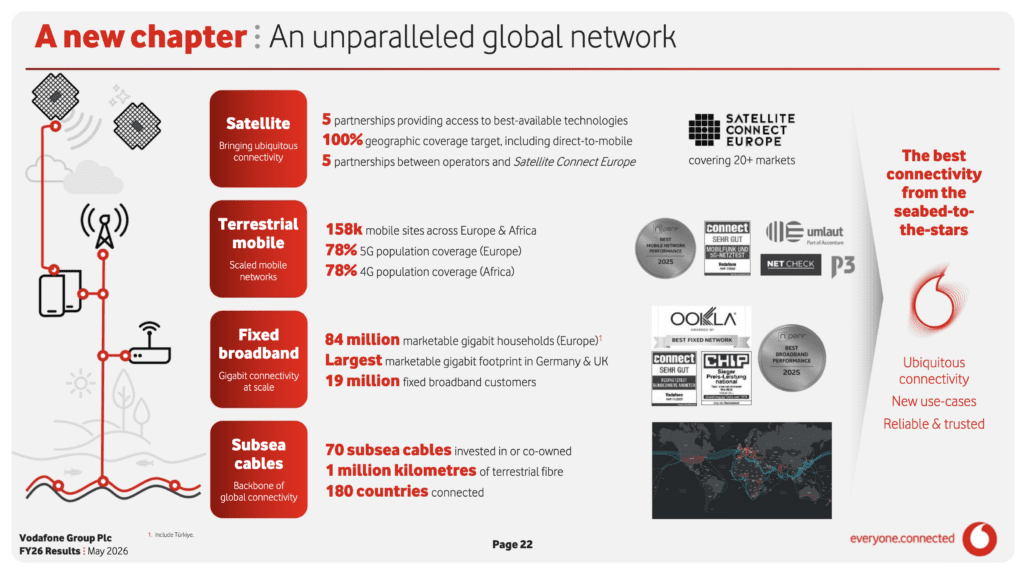
AI networks – AI needs 5G and fiber for physical AI at the edge, said Vodafone, and Vodafone is making good use of AI at the same time in service and operations.
Solid results – Revenue and profit was up by 8.8 and 3.8 percent, driven by growth in Africa, stabilization in Germany, and sharper focus from its core units.
FWA launch – Vodafone also launched a FWA in the UK to target 3.7 million premises, as it pushes ahead with its integration and summer takeover of VodafoneThree.
There was an interesting top-level exchange – a little lightweight, but good to hear – about Vodafone’s take on AI at the end of an earnings call with city analysts today (May 12), which restated the carrier position that AI is useless with out performant fixed-fiber and mobile-5G networks, and that Vodafone is busiest with AI in its internal operations, with an eye always on bread-and-butter network upgrades, and a sense that the rest will come later.
The discussion followed a decent set of full-year 2025/26 results for the UK carrier (well-illustrated in PPT), with service revenue up 8.8 percent, adjusted profit (EBITDAaL) up 3.8 percent, and notable positive cash flow. The figures were at the top-end of its guidance, it said. Its African operations contributed about a third of group profits, and represent its most bullish growth option, with organic service revenue up by 12.9 percent. But its core operations in Europe look healthier too.
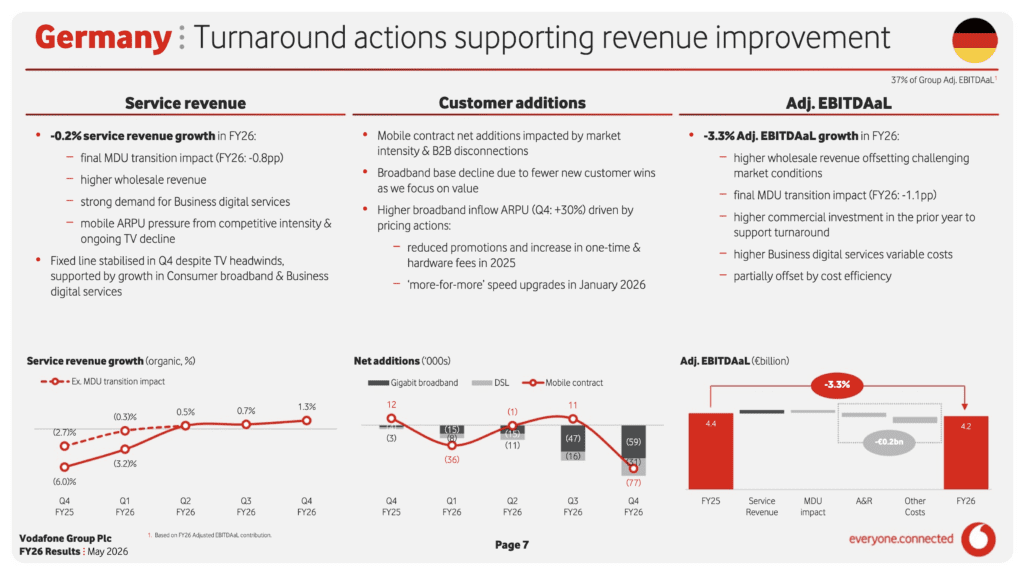
Performance in Germany, its biggest business, but also a problem-child in ways, has calmed, with revenue losses slowing to 0.2 percent. In its home market in the UK, where it has just announced it will buy CK Hutchison out of its VodafoneThree joint venture by the end of the summer, its return was flattish, but steady – up by 0.3 percent for the same. The business in Türkiye, about a quarter of the size of Germany (a third of the UK), was up by 45.2 percent.
There is a more detailed review of its numbers below. As well, Vodafone has launched a 5G fixed-wireless access (FWA) service to offer “full-fibre-like” mobile broadband to 3.7 million homes in the UK. The service, offering download speeds of up to 150Mbps, is geared for “renters [and] students”, it suggested, and premises that can’t access full fiber. It is also prepping a new outdoor hub for rural homes. More on this below, as well.
AI for networks
But following a rush of carrier quarterlies in the US, where everyone (AT&T, T-Mobile, Verizon) variously set out their stall with regards to their role in the new AI economy, it took until the last question on the earnings call for someone to ask Vodafone the same. And as always, it seems, the question was from Morgan Stanley, represented by senior telecoms research analyst Emmett Kelly, who simply asked how Vodafone is using, building, and selling AI services.
Margherita Della Valle, group chief executive, responded: “It’s a bit of everything… There is a fascinating two-way relationship between networks and AI because… AI makes our networks more efficient… but AI needs good networks. You have an AI ecosystem where, I don’t know, Nvidia is building chips, hyperscalers are building data centers, and [others] are producing software and hardware – but none of that works without a strong network.

“The more AI moves into the physical world with vehicles and robotics, the more it will need data everywhere – which means ultra-low latency and fast speeds; and we are preparing for that. When we look at the future, we are thinking about the demand for uplink [traffic], for example. Usage of the network will change over time. [These are] things we need to be ready for… The biggest impacts today are… [internally, with] how we run the company. Definitely.”
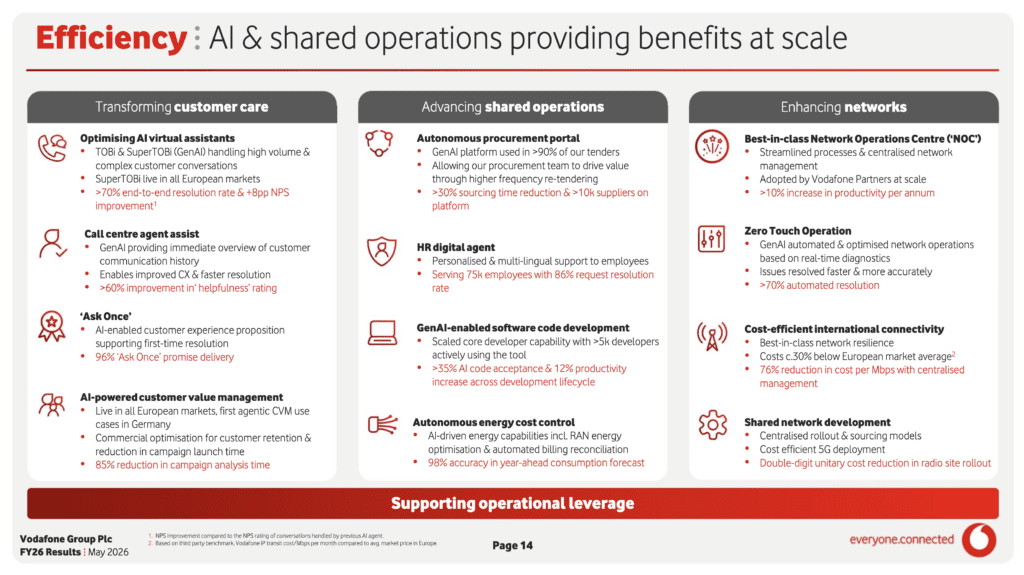
Pilar López, group chief financial officer, picked up, and to briefly comment on Vodafone’s internal AI usage. “AI is an enabler of cost efficiency and productivity. It is one of the key drivers of the op-ex growth and net savings targets – as we have communicated and [set] as a target. AI is also an enabler of capital discipline across the group… [about] how we embed AI in our core operations, drive measurable savings, enhance service and also support growth.”
She added: “The other two areas where AI is making a difference today is customer care, where we are delivering high standards… [and] operations, [where] we are embedding AI at scale. In fact, our scale operations are the perfect setup to be able to drive the benefits of AI.” The point about scale is that Vodafone’s recent strategy has been to cut its sub-par businesses (in the Netherlands, Italy, Spain, say), and bolster its core operations (like in the UK).
Hence, Vodafone’s narrative about a simpler scale-structure, and a “new chapter” to deliver “mid-term growth”. López offered a couple of examples of Vodafone’s use of AI in customer service and operational endeavours, respectively: its TOBi voice agent for “simple, high volume calls”, and its SuperTOBi generative-AI upgrade for the “most complex customer journeys”; and (what sounded like a reference to its) agentic-AI procurement / purchasing bot.
The latter has been written about in some detail here. These are delivering better customer service (she claimed), and “AI benefits through our supplier network” and “more regular [and] frequent” tender responses. The firm is seeing “significant savings already”. Della Valle chimed in again, on Vodafone’s scale to support AI services and its flex to pick AI partners. “All this is built on foundations that are essential for scale,” she said.
“I would just mention two points. One: we have a fully multi-vendor architecture. Even within the same use cases, we use different LLMs – because, of course, who knows where AI is going. So we maintain total flexibility to make sure… we have the best solutions… [Two:] we have, I think, a unique position with a single data ocean for all our European markets, which is the ideal source if you want, which we can leverage for all these AI use cases.”
Germany and Africa
There was lots more on the call, including about its strategies in Germany and Africa. The 2025/26 result in Germany appears to have shaken markets; shares in Vodafone fell by seven percent on its results, and commentators cited the German decline as the likely reason. Della Valle explained the situation, and mid-term projection, and dealt with speculation about the impact on Vodafone if rival Telefónica takes an ownership interest in its roaming customer 1&1.
The sense – from memory – is that Vodafone’s 5G SA rollout in Germany, and 1&1’s own 5G SA open RAN buildout, bring enough complexity to any such “hypothetical” in the medium term that Vodafone is not paying much mind to speculation. Something like that; the recording is here; there’s another good slide below. Paul Sidney, at equity research firm Berenberg, asked about Vodafone’s adventures in Africa, and whether it might double-down on its growth region – which was well-handled.
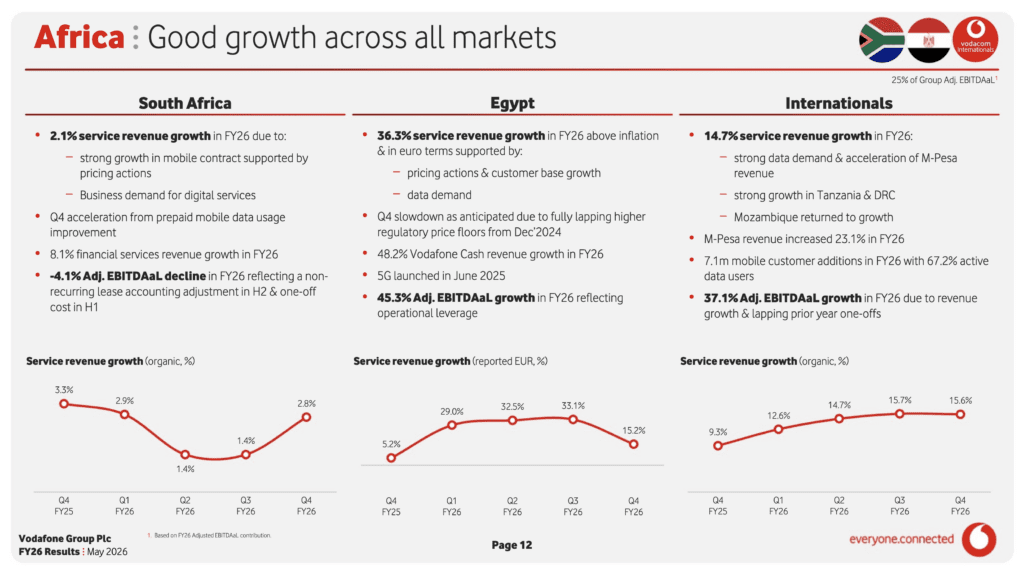
Della Valle responded: “With our Safaricom transaction, that’s exactly what we are doing in terms of increasing our exposure to Africa. We are essentially taking control of one of the most successful companies in telecom and financial services on the whole continent.” She noted Vodafone’s strategy to better-manage “the markets that we control”, and the assembly of a “small team of financial and operational specialists” to oversee all its varied interests.
“They have been quite active,” she stated, citing Vodafone’s sale of a 10 percent stake in Vantage Towers in Germany for €1.3 billion and a 50/50 joint-venture share, its sale of an 18 percent stake in Indus Towers in India for $1.82 billion, and its deal with Liberty Global to transfer its stake in VodafoneZiggo in the Netherlands (and take €1 billion in cash and a 10 percent stake in a new Benelux company called Ziggo Group).
“Which we will complete imminently”, she said of the last. She added: “You can expect, looking forward, that same team will continue to be focused on the same thing – which is to manage the portfolio with agility and discipline for value creation.” What about opportunities to expand into different markets in Africa, or increase stakes in the existing process? “We are very happy with our current shape in Africa in terms of geographies,” said Della Valle.
‘Fiber-like’ 5G FWA
Separately, Vodafone has launched a 5G fixed-wireless access (FWA) service to offer “full-fibre-like” mobile broadband in the UK. The service, branded as 5G broadband in its sales marketing (“known as known as FWA by spoddy boffins in some circles”, it writes in a cheery consumer Q&A-explainer), is pitched to 3.7 million premises in the UK, it says; these cannot currently access “full fiber” broadband – but can now get online via a 5G bridge between their homes and local internet exchanges instead. “Vodafone calls it 5G broadband,” it trumpets.
Vodafone reckons that, along with its fiber footprint (available to 23.2 million homes), it can now serve almost 26 million UK homes – “more than any other provider”, it said. The new FWA service, offering download speeds of up to 150Mbps, is geared for “renters [and] students”, it suggested, and premises that are connected on copper, or nothing at all. It is offering rolling 30-day or 24-month plans – on both WiFi 6E and Wi-Fi 7 routers, from £21 and £30 per month – and promising “out-of-the-box setups” with no engineers, no upfront costs, and next-day deliveries.
It has a postcode checker to recommend full fibre or 5G FWA. Vodafone said it will introduce an outdoor hub for homes where the “outdoor 5G signal is stronger than indoors” – which is surely everywhere. But the new self-install outdoor unit, targeted at rural homes, will provide an “extra boost”. The service will use the combined VodafoneThree network in the UK. VodafoneThree, the joint-venture company in charge of the UK network, promised to invest £11 billion to “build the UK’s best network” as part of the merger deal, which was completed in May last year (2025).
Last week, Vodafone Group said it had agreed with CK Hutchison, owner of the Three brand, to buy the Hong Kong conglomerate’s stake in VodafoneThree for £4.3 billion – to take full ownership of the UK’s largest mobile operator. The FWA service makes use of their combined multi-operator core network (MOCN) infrastructure at around 10,000 sites in the UK. Their joint £11 billion commitment, to be inherited entirely with the buy-out by Vodafone, is to deliver standalone 5G (5G SA) to 99 percent of the UK population by 2030 (99.96 percent by 2034).
The GSMA said yesterday that just two percent of EU citizens on the continent have 5G SA access, currently.
Rob Winterschladen, consumer director at VodafoneThree, commented: “Millions of households are still paying over the odds for unreliable and slow broadband that often only reaches 74Mbps… We’re giving those homes a genuinely fast alternative, at great value… We already bring fast, reliable broadband to more homes than anyone else – and by adding [FWA], we can reach millions more. This launch is about giving customers real choice: full fibre where it’s available, and powerful [FWA] where it’s not – plus, better options for anyone wanting speed with ease and flexibility.”
Growth everywhere, except
Vodafone preliminary results for the 2025/26, ending March 31 (2026), were pretty good – even if its German showing rattled the markets. Its total revenue rose eight percent to €40.5 billion in the period, versus 2024/25. This was driven by higher service revenue and consolidation of its VodafoneThree joint venture in the UK with CK Hutchison’s local Three UK business. As always, results were partly offset by foreign exchange impacts.

Service revenue increased 8.8 percent to €33.5 billion, with organic growth of 5.4 percent – and growth everywhere except for Germany, which saw a 0.2 percent organic decline (improving to 1.3 percent growth in the fourth quarter as competition and regulatory impacts eased, and wholesale and broadband ARPU was higher). UK service revenue rose 0.3 percent, helped consumer and wholesale growth – not-helped by the loss of certain managed enterprise deals.
Organic service revenue grew 0.5 percent elsewhere in Europe, undermined by competitive pressure in Portugal. Service revenue in Türkiye increased 10.8 percent (in euro terms). Africa maintained double-digit growth of 12.9 percent, with growth above inflation in Egypt and Vodacom’s international markets. Business revenue grew 3.2 percent overall – “driven by strong double-digit digital services expansion”.
Vodafone’s adjusted EBITDAaL rose 3.8 percent to €11.4 billion (4.5 percent organically). Operating profit increased to €2.8 billion – a €3.2 billion improvement year-on-year, reflecting higher EBITDA and prior-year impairment charges. The firm met the top end of guidance, also with €2.6 billion adjusted free cash flow. Vodafone said it is entering a new chapter following major transformation. It forecasts better demand for high-end connectivity.

Della Valle said: “After the transformation of the last three years, we are now a simpler company with a stronger growth outlook. Our strategic progress has generated good group service revenue momentum for the year, together with profit and cash flow at the upper end of our guidance range. We returned to top line growth in Germany, alongside strong performances across Africa and in Türkiye.
She added: “Our early successes from the UK merger integration reinforce our confidence in its potential and I am delighted that we are now gaining full ownership. We will continue to drive continuous improvements across our business, with customer experience as our number one priority. We are now well set for mid-term growth.”