


The GSMA has issued a lobbying report to argue for sweeping regulatory reform in the EU as telcos face a €475 billion investment gap to catch up with rivals in other regions – and to deliver the sovereign infrastructure for Europe to compete in the AI era.
In sum – what to know:
Investment gap – Europe needs €475 billion in network investment by 2035, says the GSMA, but faces a €205 billion shortfall, with 5G SA deployment lagging way behind other regions.
Regulatory rejig – The GSMA has called for market consolidation, cheaper and longer-spectrum licences, and “regulatory symmetry” with Big Tech to improve telco investment incentives.
Sovereignty issue – Mobile is positioned as strategic AI infrastructure, with the GSMA arguing Europe risks falling behind unless it rethinks policy and rules in its draft Digital Networks Act.
Has there ever been a better time for European operators to lobby for a better deal – and a fairer share? Maybe not – just on the grounds that new global techno-economics make regional telecoms infrastructure critical and strategic, and arguably Europe’s best chance to assert some kind of sovereign control in the middle of the grand east-west AI power-play. As such, and as the Digital Networks Act (DNA) goes through EU legislation, the GSMA has published a report to say that European telecoms is in dire straits, and needs an urgent leg-up from regulators.
Basically, it wants easier consolidation, cheaper spectrum, and better regulatory symmetry with US ‘big tech’. And it wants everyone to know that it’s not its fault – that European telcos are not making enough money to invest in critical infrastructure to sell digital change, and to make Europe’s economic heartlands hum with AI and whatever other tech is supposed to change the world. That’s the message, anyway – effectively. The GSMA reckons European operators need to invest almost half a trillion euros (€475 billion) over the next decade to upgrade their networks.
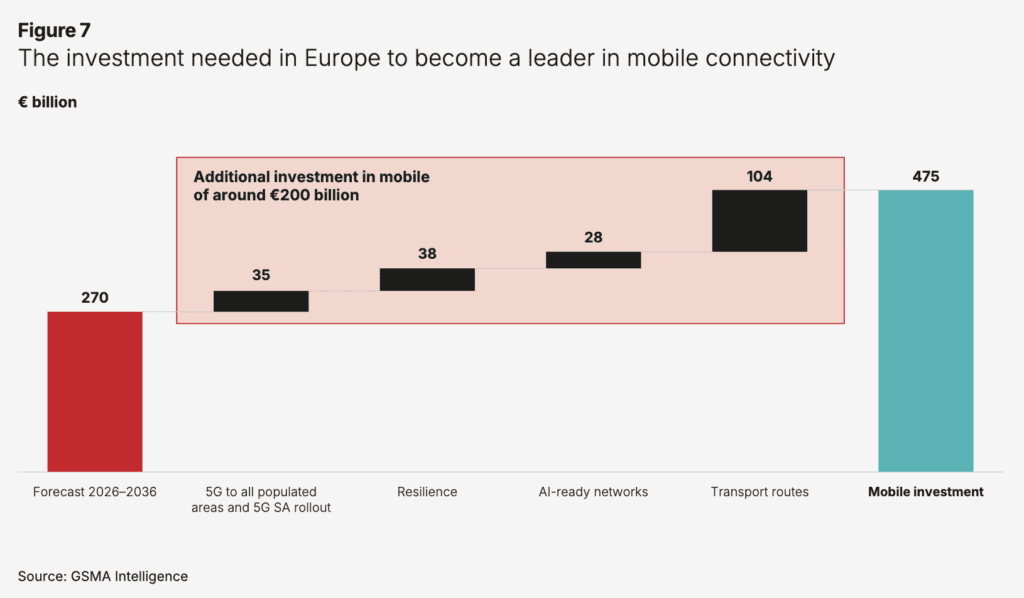
Specifically, they will have to up their current projected run rate, of about €270 billion by 2035, by investing a further €205 billion (about 75 percent) more – just to stay competitive on the global scene. Its shortfall-projection is higher, albeit also longer-term, than the European Commission’s own research in 2023, which suggested the likely costs for operators to achieve its stated Digital Decade targets would be €174 billion by 2030, rising to more than €200 billion. They have invested €141 billion since 2021, apparently – and are already missing targets, and trailing behind.
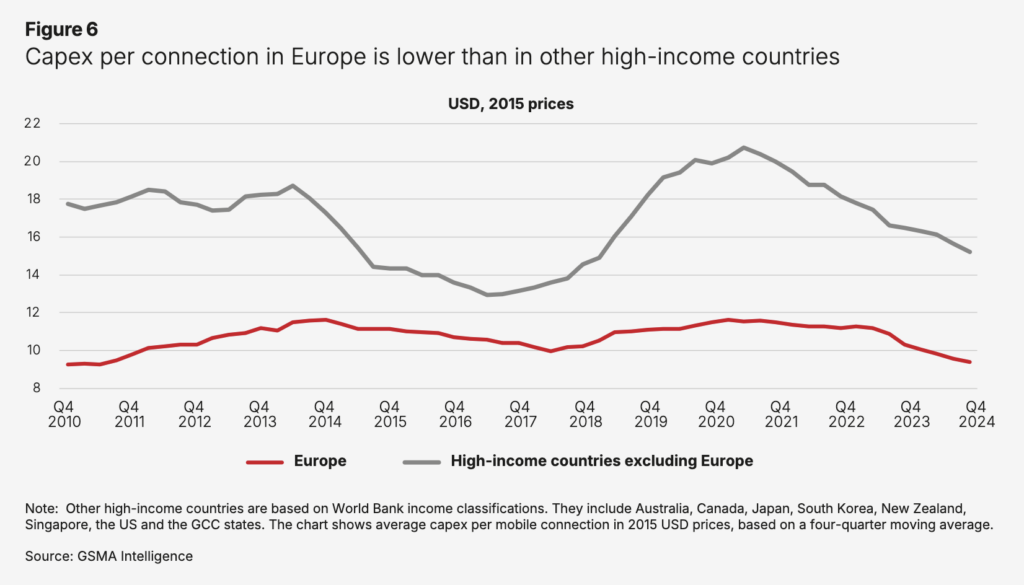
The 5G picture is not pretty – ‘standalone’ 5G (5G SA) is available to just two percent of European citizens – versus 80 percent in China and almost 50 percent in India. This is because European operators just aren’t making enough money, says the GSMA – to justify investing back into infrastructure. Mobile internet usage has increased every year since 2018 by an average of 27 percent; operator revenues have fallen by three per cent per year over the same period. ‘Cap-ex per connection’ (infrastructure investment per subscriber) is €35 in Europe, versus €70 for global “connectivity leaders”.
The bloc “remains unable to keep pace and compete”, says the GSMA. As it is, the lion’s share (85 percent) of mobile infrastructure funding is stumped-up by mobile operators. They need to find about €100 billion between them to provide 5G across main transport routes, €35 billion to extend 5G to the entire European population, €38 billion to build better network resilience, and €28 billion to underpin AI-based services and innovation – says the report, breaking-down the €205 billion shortfall. These allocations would effectively double their cap-ex per connection rate to about €70.
The only answer is regulatory reform, proposes the GSMA – to fix all the things that have hobbled European telcos through the whole 5G story, and longer, and to start to match their counterparts in “North America and East Asia”. It wants a “significantly more pro-investment regulatory environment”. Vivek Badrinath, director general of the GSMA, said the Digital Networks Act has “promise” but needs “correcting for its known shortcomings without watering down its more ambitious aspects”. He said: “Inaction now is not an option with Europe’s digital future on the line.”
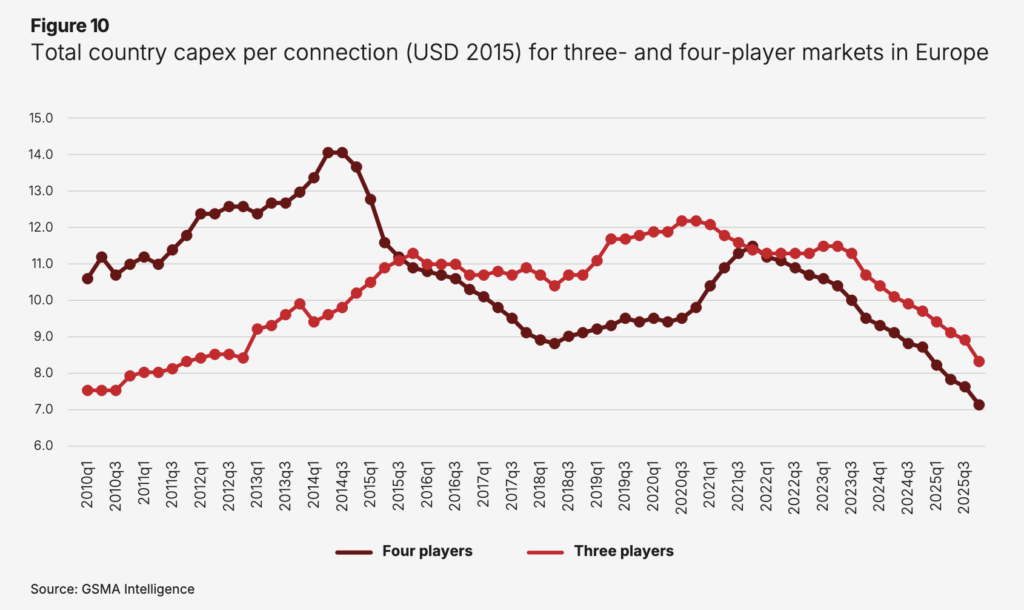
In the end, it is basically a lobbying document. But there is interest here – given everything that is going on. The GSMA argues that Europe’s market structure is too fragmented and regulated to bridge the 5G/6G investment cycle. Its proposed fixes are very specific. Fewer mobile operators would be a start; so it recommends looser competition rules to encourage consolidation, ideally pegged at three operators per market, rather than four – in line with the Orange/MásMóvil, Vodafone/Three, and Swisscom/Vodafone mergers in Spain, the UK, and Italy.
The telecom industry has been pushing this argument for years – that too many operators compete on price, and destroy investment returns. The GSMA has some economic modelling that says “three-player markets” in Europe have shown higher investment and service levels since 2015. The Vodafone/Three venture in the UK has quickly become a merger exercise, for these ends. But the message is about looser policy and larger operators – to drive bigger and faster investment to stand-up better networks for the AI economy, to give Europe a fighting chance.
It is also about spectrum, as always – costs are too high (“almost tripled over the past decade”), licences are too short, rules and policies are fragmented between member states. Auctions are treated by governments like a windfall instrument – and not as critical sovereign infrastructure vehicles (is the idea). The GSMA writes: “Measures such as low-cost renewals could free up to €30 billion in capital, with more than 500 licences due for renewal by 2035. The long-term certainty offered by indefinite licences… would also lead to improved investment incentives.”
The last is a direct reference to the draft Digital Networks Act. These are the stakes, then; the EU must get past its default regulatory-political position that consolidation raises prices and hurts competition, and that spectrum licensing is a money-spinning exercise to let private commerce run wild in the airwaves. European governments need telcos to deliver, suddenly – new techno-economics and geopolitics have conspired to make performant sovereign digital infrastructure the name of the game. So ease up, says the GSMA – so telcos can cough up and catch up.
The paper has very little about consumer 5G services, clearly – which, realistically, RCR has hardly written about for years. It makes its recommendations with a view to how 5G (becoming 6G) networks are part of the economic transformation story, swallowed-up by this jet-heeled AI story – as sovereign infrastructure, resilience infrastructure, industrial infrastructure, AI infrastructure itself. The emphasis is on 5G services and functions (dedicated slices, private networks, API access, location services, programmability) for developers, partners, enterprises, industries.
None of which is proven, of course – and where it is proven, albeit sporadically, such as with private 5G networks in Industry 4.0, mobile operators with public spectrum are not neccesssarily required anyway. In fact, the only thing that is clear is that EU policy on competition and spectrum has given EU consumers value-for-money – also versus most other equivalent geographic markets.
But public mobile networks, sliceable and programmable, are like ready-made national infrastructure platforms, implies the GSMA, which are directly tied to AI competitiveness. Europe will be more dependent on US and Chinese digital ecosystems if it fails to support its own operator community, which fails to invest properly in its assets. The same EU policy framework that made services cheap has also fragmented investments, depressed returns, and slowed development. Take your pick, the GSMA seems to be telling EU lawmakers: competition and affordability, or scale and capability.
But its tone is also defensive, rather justifying why returns have been so weak in the region despite all the NSA rollout and spending. It says, or acknowledges, that 5G has not materially improved operator revenue growth in Europe, and operators are struggling to monetize NSA services, or justify investment in SA capabilities, and that enterprise cases are immature. Which fairly describes this telco pickle, and makes a grim view of the sector’s achievements, for sure. To a degree, it is asking the EU to gamble on a dicey 5G business case – to lower the regulatory burden just so operators can prove it.
At the same time, the argument about critical infrastructure is hatrd to deny – hence the point at the top about timing. The paper says that the discipline is not to make mobile cheaper, anymore, but to ensure Europe has capable sovereign infrastructure – whether that means tax breaks and subsidies, or other industrial policy support, or another at net neutrality to create a more balanced relationship between operators of base-line network infrastructure and the whole AI industry that will flood ‘over the top’.
But less regulation might not change very much, anyway; operators may still struggle to generate returns. The industry’s problem might be structural: connectivity is commoditized, and the value is elsewhere. So regulators might well ask: is regulation suppressing investment, or is telecoms actually just a lower-margin utility business? This sovereignty card might be the last one for telcos.

